Last updated: April 13, 2026
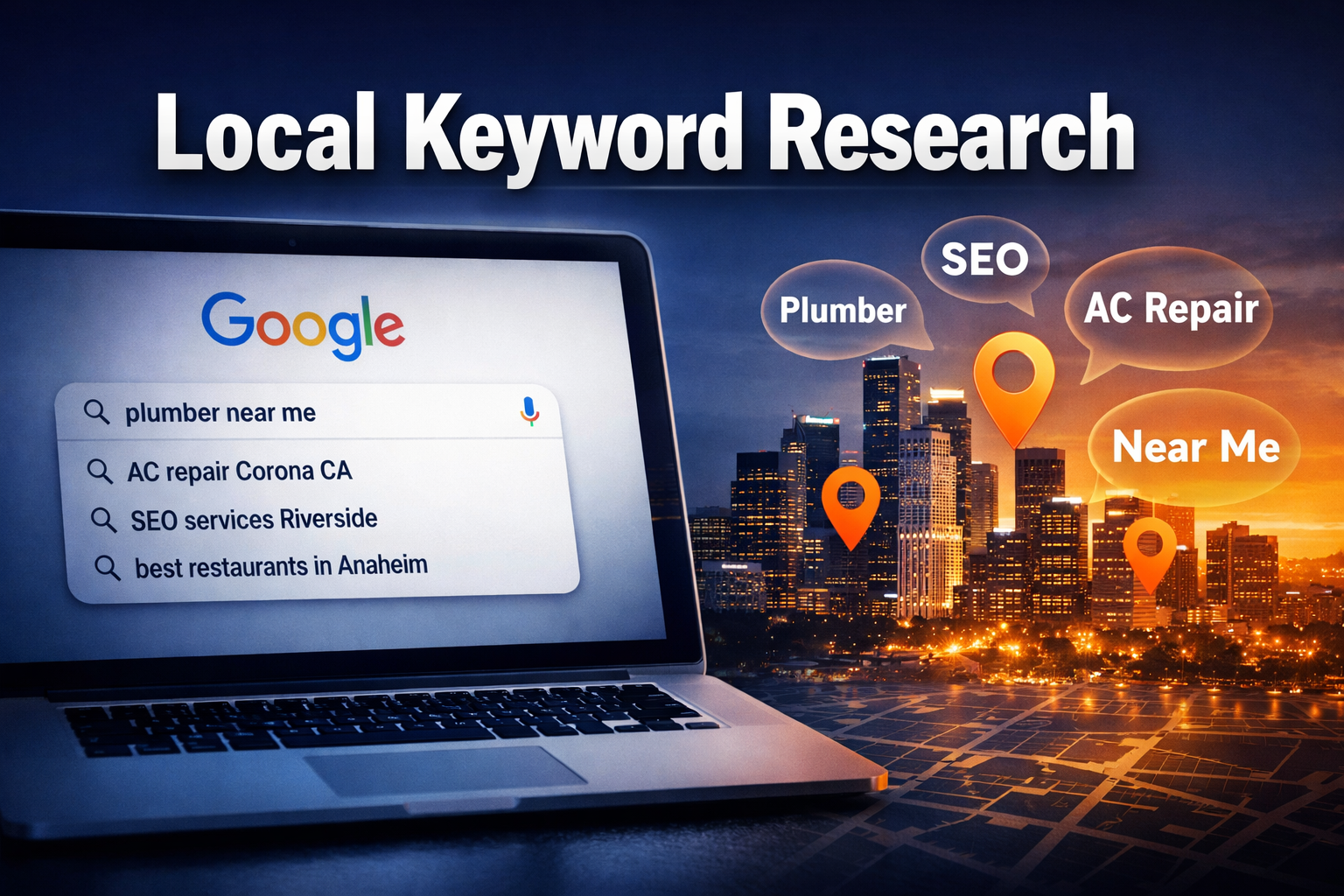
Quick Answer: Local keyword research is the process of identifying search terms that combine service intent with geographic context, such as “emergency plumber in Corona, CA.” These keywords attract buyers who are ready to act, not just browse. For local businesses, ranking for the right city-based and service-area terms is more valuable than chasing high-volume generic phrases.
Key Takeaways
- Local keyword research targets searches with both service intent and a geographic modifier (city, neighborhood, or “near me”).
- Long-tail local keywords convert significantly faster than generic terms because they match buyer-ready intent. [3]
- The most effective keyword formula is: qualifier + service + city (e.g., “affordable dentist in Riverside”).
- “Near me” searches remain among the highest-converting mobile queries when paired with an optimized Google Business Profile. [3]
- Free tools like Google Autocomplete and “People Also Ask” reveal real search behavior at zero cost. [3]
- Google Business Profile Insights show which queries actually drive calls and visits, making it essential for ongoing research. [3]
- In 2026, AI-powered local packs and tools like Google’s “Ask Maps” are reshaping how local intent is surfaced. [4]
- Apple Business launches April 14, 2026, adding a new platform where accurate business data will influence local search visibility. [5]
- Keyword research should be reviewed quarterly, not set-and-forget.
What Is Local Keyword Research and Why Does It Matter?
Local keyword research is the practice of finding search phrases that potential customers in a specific geographic area use when looking for products or services nearby. Unlike broad keyword research, local research layers in city names, neighborhoods, service areas, and proximity signals like “near me.”
For a small business, this distinction is critical. Ranking for “plumber” is nearly impossible. Ranking for “licensed plumber in Corona, CA” is achievable and far more likely to produce a phone call. The specificity of local search terms filters out casual browsers and surfaces buyers with immediate need.
According to Sterling Sky’s State of Local SEO report, local search is shifting toward AI-powered local packs, making a data-first strategy essential for businesses that want to stay visible. [2] The days of stuffing a city name into a page title and calling it done are over.
How to Find High-Intent Local Keywords
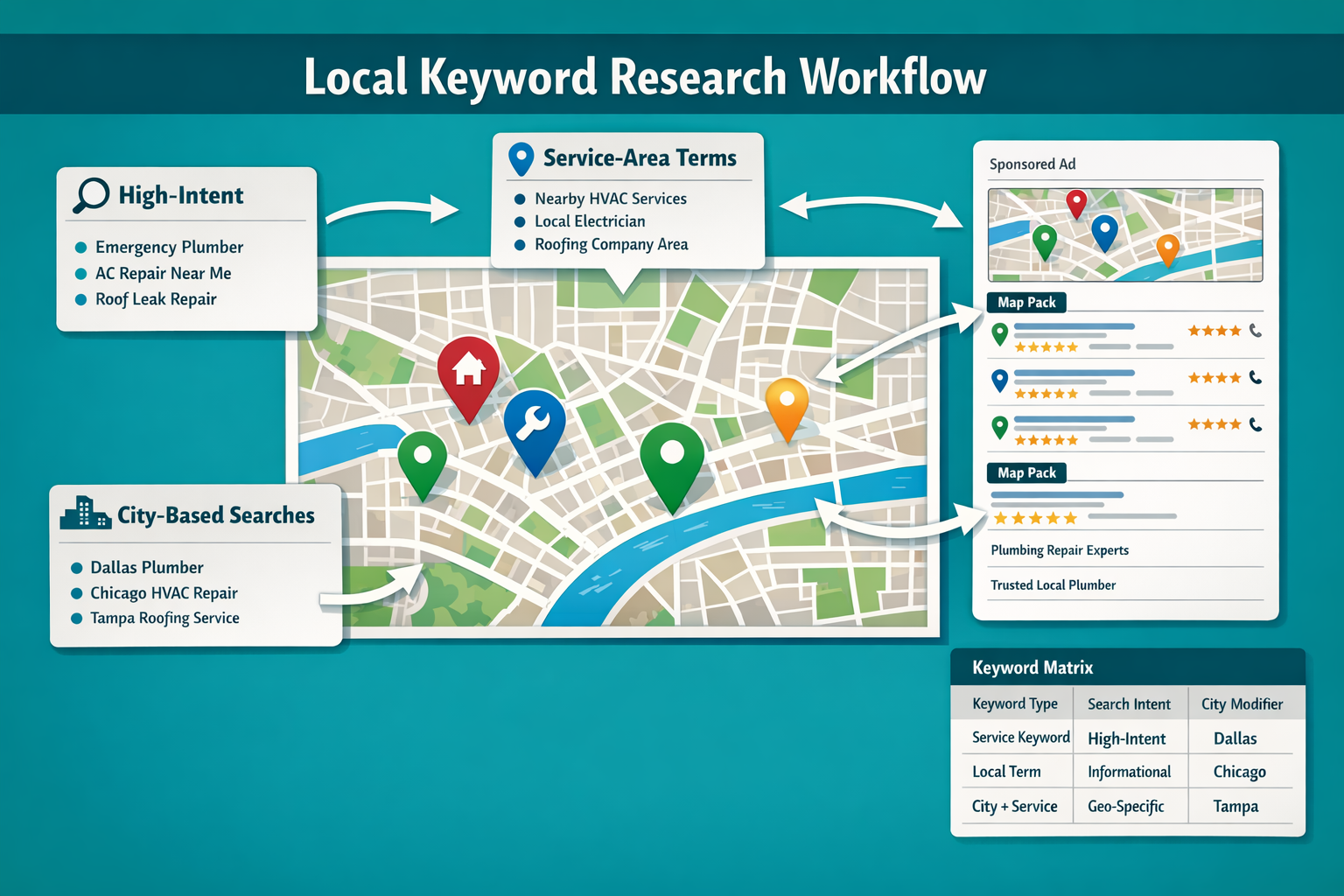
High-intent local keywords are phrases where the searcher is close to making a decision. These are the terms worth prioritizing first.
Three keyword formulas that consistently produce high-intent results: [3]
| Formula | Example | Intent Level |
|---|---|---|
| Qualifier + Service + City | “Best AC repair Cape Coral” | High |
| Emergency/Urgency + Service | “24-hour plumber near me” | Very High |
| Service + Neighborhood | “Dentist in downtown Riverside” | High |
| Affordable/Cheap + Service + City | “Affordable roof repair Corona CA” | High |
Steps to uncover high-intent terms:
- Start with Google Autocomplete. Type your core service into Google’s search bar and note every suggestion. These reflect real searches in your area. [3]
- Check “People Also Ask.” Every PAA box is a keyword opportunity. These questions reveal how buyers phrase their needs.
- Review Google Business Profile Insights. GBP shows exactly which search queries brought users to your profile, drove calls, and prompted direction requests. Review this data every quarter. [3]
- Use keyword tools for volume context. Tools like Google Keyword Planner or Semrush can confirm whether a term has enough monthly searches to justify a dedicated page.
- Analyze competitor pages. Look at what city-service combinations local competitors rank for using tools like Ahrefs or Ubersuggest.
Common mistake: Targeting a single broad keyword per page instead of building a cluster. Each location page should focus on one primary keyword and three to five related long-tail variations to avoid cannibalization. [3]
For a practical starting point, the Local SEO Audit Checklist walks through evaluating your current keyword coverage before adding new targets.
Service-Area Terms and City-Based Search Opportunities
Service-area terms extend local keyword research beyond a single city. A plumbing company serving five cities needs keyword coverage for each city, not just its headquarters.
How to build city-based keyword coverage:
- Create a dedicated landing page for each primary service area (e.g., /plumber-riverside-ca, /plumber-corona-ca).
- Each page should target a unique primary keyword to prevent pages from competing against each other.
- Include neighborhood-level terms where search volume supports it (e.g., “HVAC repair in Eastvale” rather than only “HVAC repair in Riverside”).
- Map out service-area terms by combining your top five services with each city you serve. That matrix becomes your content roadmap.
For example, the Local SEO for Plumbers in Riverside, CA, and Local SEO for Plumbers in Corona, CA pages demonstrate how city-specific pages can be built around distinct keyword targets while serving the same core audience.
Edge case: Businesses that serve rural areas or smaller towns often face low search volume per city. In those cases, combine nearby towns on a single regional page (e.g., “Plumber serving Norco, Eastvale, and Mira Loma”) rather than creating thin pages that won’t rank.
How “Near Me” and AI Search Are Changing Local Keyword Research
“Near me” searches remain among the most conversion-ready queries on mobile. [3] But in 2026, the landscape around local intent has expanded significantly.
Google’s “Ask Maps” feature, now live in the U.S. and India, lets users ask questions directly inside Google Maps, with AI-generated answers drawn from real business data. [4] This means your business information, categories, and reviews now feed AI responses, not just traditional organic listings.
ChatGPT now allows users to share their location for personalized local recommendations. [4] Businesses that maintain accurate, consistent data across all platforms are better positioned to appear in these AI-generated answers.
Yoast SEO’s April 2026 update introduced “keyword salience,” which understands the context around keywords rather than relying on exact-match repetition. [1] This benefits local businesses targeting niche or long-tail terms because it rewards natural, readable content over forced keyword insertion.
Apple Business launches on April 14, 2026, unifying Maps, Wallet, and Spotlight into a single platform. Apple Maps Ads will follow in Summer 2026. [5] Local keyword research now needs to account for how business categories and service descriptions appear across Apple’s ecosystem, not just Google.
To stay ahead of these shifts, reviewing your Google Business Profile optimization is a direct way to ensure your business data feeds both traditional and AI-powered local results.
Applying Local Keyword Research to Your SEO Strategy
Keyword research without execution is just a spreadsheet. Here’s how to connect findings to actual rankings.
Prioritization checklist:
- Identify your top five services and top five cities served
- Build a keyword matrix (service × city = target keyword)
- Assign one primary keyword per page, plus three to five long-tail variants
- Confirm each target keyword appears in the page title, H1, first paragraph, and at least one subheading
- Add the keyword naturally to the meta description and image alt text
- Link each city page from a central “Service Areas” hub page
- Set a quarterly calendar reminder to review GBP Insights and refresh keyword targets
For businesses looking to apply these steps within a broader framework, the Proven Local SEO Strategies for 2026 guide covers how keyword research connects to citations, reviews, and on-page optimization.
FAQ
What is the difference between local keyword research and regular keyword research? Local keyword research adds geographic context, such as a city name or “near me,” to service-based queries. Regular keyword research focuses on search volume and competition without a location filter. Local research prioritizes buyer intent over raw traffic volume.
How many keywords should each local landing page target? One primary keyword and three to five related long-tail variations per page. More than that, risks keyword cannibalization, where multiple pages compete for the same search results. [3]
Are “near me” keywords worth targeting directly in page content? Yes, but with nuance. Include “near me” in meta descriptions and naturally in body copy. Google connects “near me” searches to businesses based on proximity and GBP data, so optimizing your profile matters as much as the page itself. [3]
What free tools work best for local keyword research? Google Autocomplete, “People Also Ask,” and Google Business Profile Insights are the most practical free starting points. They reflect actual local search behavior rather than aggregated national data. [3]
How often should local keyword research be updated? At a minimum, quarterly. GBP Insights data refreshes regularly, and search trends shift with seasons, local events, and algorithm updates. Google’s March 2026 core update caused ranking fluctuations, making fresh keyword audits especially valuable. [4]
Does local keyword research apply to service-area businesses that don’t have a storefront? Yes. Service-area businesses (SABs) should create city-specific pages for each area they serve, using the same qualifier + service + city formula. The absence of a physical address makes GBP optimization and city-page content even more important for visibility.
What role does Google Business Profile play in local keyword research? GBP Insights reveal which search queries drive real traffic, calls, and direction requests to your profile. This data is one of the most direct signals of which keywords produce business results, not just impressions. [3]
Should small businesses target neighborhood-level keywords? Only if search volume supports it. Use keyword tools to check monthly searches for neighborhood terms. If volume is too low, combine nearby neighborhoods into a single page rather than creating multiple thin pages.
Conclusion
Local keyword research is the foundation of any local SEO effort that produces actual customers. The core principle is straightforward: match what buyers type when they’re ready to hire someone with the content on your website and your Google Business Profile.
Actionable next steps:
- Build a keyword matrix using your top services and every city you serve.
- Audit your existing pages against that matrix to find gaps.
- Create or update city-specific landing pages with one primary keyword each.
- Set up a quarterly review of GBP Insights to track which terms drive real results.
- Monitor how AI-powered features like Ask Maps and Apple Business affect your visibility as these platforms mature in 2026.
For a guided starting point, the Local SEO Agency resources at Local Website SEO Services offer practical tools and support for businesses ready to build their keyword strategy from the ground up.
References
[1] Yoast SEO News April 2026 – https://blog.mean.ceo/yoast-seo-news-april-2026/ [2] The State of Local SEO in 2026 – https://www.sterlingsky.ca/the-state-of-local-seo-in-2026/ [3] Keyword Research for Local Businesses – https://dndseoservices.com/blog/keyword-research-local-businesses/ [4] SEO News Roundup March 30 to April 5 2026 – https://localdominator.co/seo-news/seo-news-roundup-march-30-to-april-5-2026/ [5] Apple Business 2026 Local Search Dominance – https://gmbapi.com/news/apple-business-2026-local-search-dominance/