Last updated: April 14, 2026
Quick Answer: On-page local SEO is the practice of optimizing individual web pages so search engines and nearby customers can find, trust, and convert from your local business. It covers title tags, schema markup, NAP consistency, local landing pages, internal linking, and page structure built around conversion. Done correctly, it directly supports map pack rankings and drives qualified foot traffic.
Key Takeaways
- Title tags and H1s must include your primary service and location to signal local relevance to Google [3]
- Schema markup acts as a direct “cheat sheet” for Google, explicitly communicating your address, hours, and services [3]
- NAP consistency (Name, Address, Phone) across every page element and schema reference stabilizes local rankings [6]
- Dedicated local landing pages for each service-location combination capture a broader range of search queries [8]
- Internal linking between location pages and service pages distributes authority and improves crawlability
- Meta descriptions written manually (150–160 characters) improve click-through rates from local search results [3]
- E-E-A-T signals on each page build the trust Google requires for local authority [3]
- Conversion-focused page structure (clear CTAs, click-to-call, contact forms) turns local traffic into actual customers
- Content that competitors haven’t written yet significantly improves ranking likelihood [2]
What Is On-Page Local SEO and Why Does It Matter?
On-page local SEO refers to every optimization made directly on a webpage to help it rank for location-specific searches. Unlike off-page factors such as backlinks or citations, on-page signals are fully within a business owner’s control.
This matters because the local map pack — the three business listings Google displays before organic results — remains the primary touchpoint for local searchers [3]. Winning that placement requires strong on-page signals working in concert with your Google Business Profile.
How Should You Structure Local Landing Pages?
Each location or service area your business covers deserves its own dedicated, fully built-out page — not a placeholder that says “We also serve [City].” [3]
Effective local landing pages include:
- A unique H1 containing the primary service and city (e.g., “Plumbing Repair in Corona, CA”)
- Original body content addressing local pain points specific to that market
- Embedded Google Map for the service area
- Local customer testimonials or case studies
- A clear call-to-action above the fold
The service + location combination approach captures a wider range of searchers. A plumbing company serving three cities with five services should build 15 distinct pages, each targeting a unique query [8]. See how this plays out in practice with local SEO for plumbers in Corona and local SEO for plumbers in Riverside.
⚠️ Common mistake: Duplicating the same page content and swapping only the city name. Google treats this as thin content. Each page must offer genuinely unique, locally relevant information.
What Title Tags and Meta Descriptions Work Best for On-Page Local SEO?
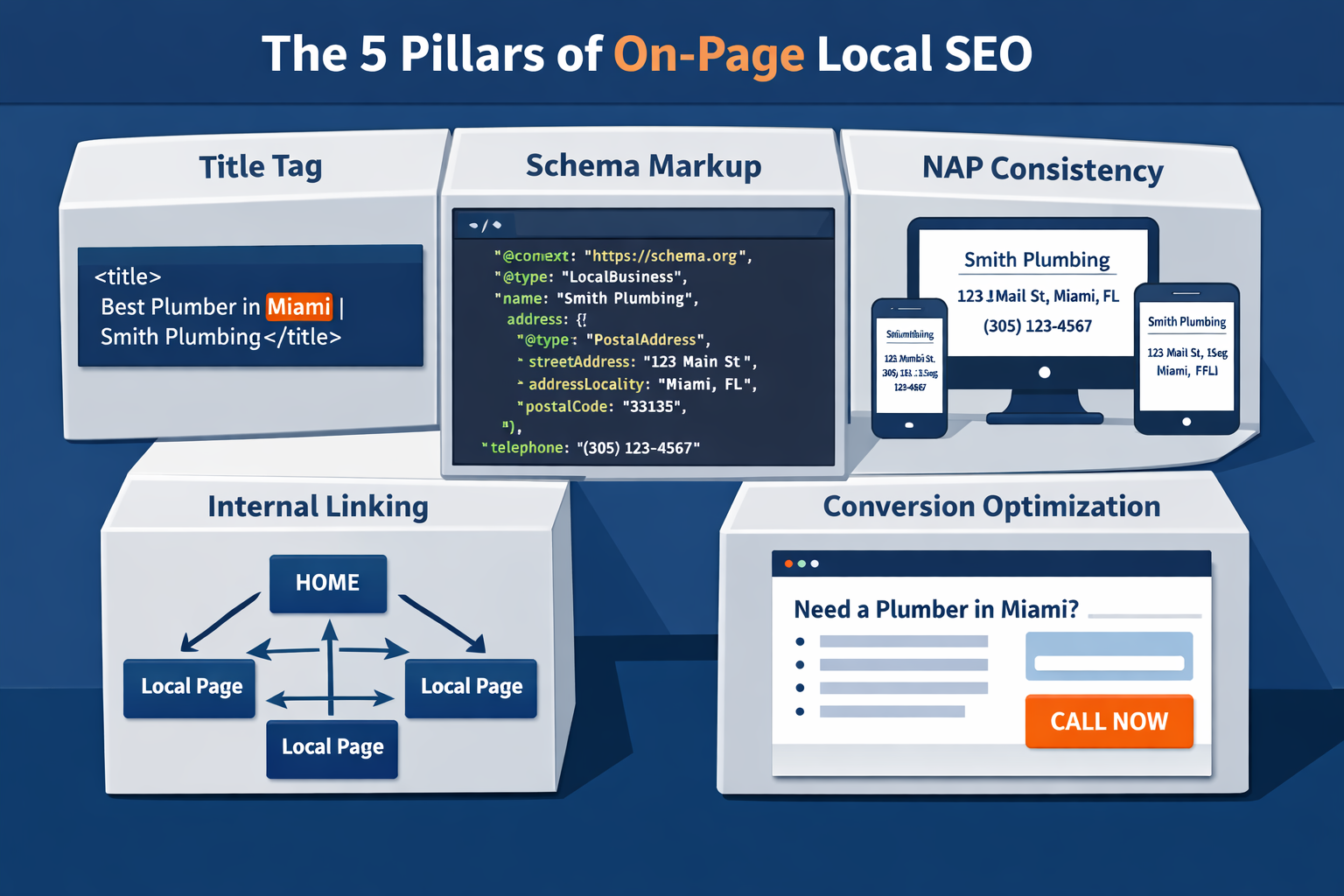
Title tags are one of the strongest on-page local ranking signals. Google pays close attention to H1 and H2 header structure and keyword placement for local rankings [3].
Title tag formula that works:
<code>Primary Service + City + Brand Name
Example: "AC Repair in Riverside, CA | CoolBreeze HVAC"
</code>- Include the target keyword and a local qualifier
- Write a direct value statement with a soft CTA (e.g., “Call today for same-day service”)
- Write these manually — auto-generated descriptions underperform in local click-through rates [3]
| Element | Recommended Format | Character Limit |
|---|---|---|
| Title Tag | Service + City + Brand | 50–60 characters |
| Meta Description | Keyword + Value + CTA | 150–160 characters |
| H1 | Service + Location (natural phrasing) | No strict limit |
| H2s | Subtopics with semantic location terms | No strict limit |
How Does Schema Markup Support On-Page Local SEO?
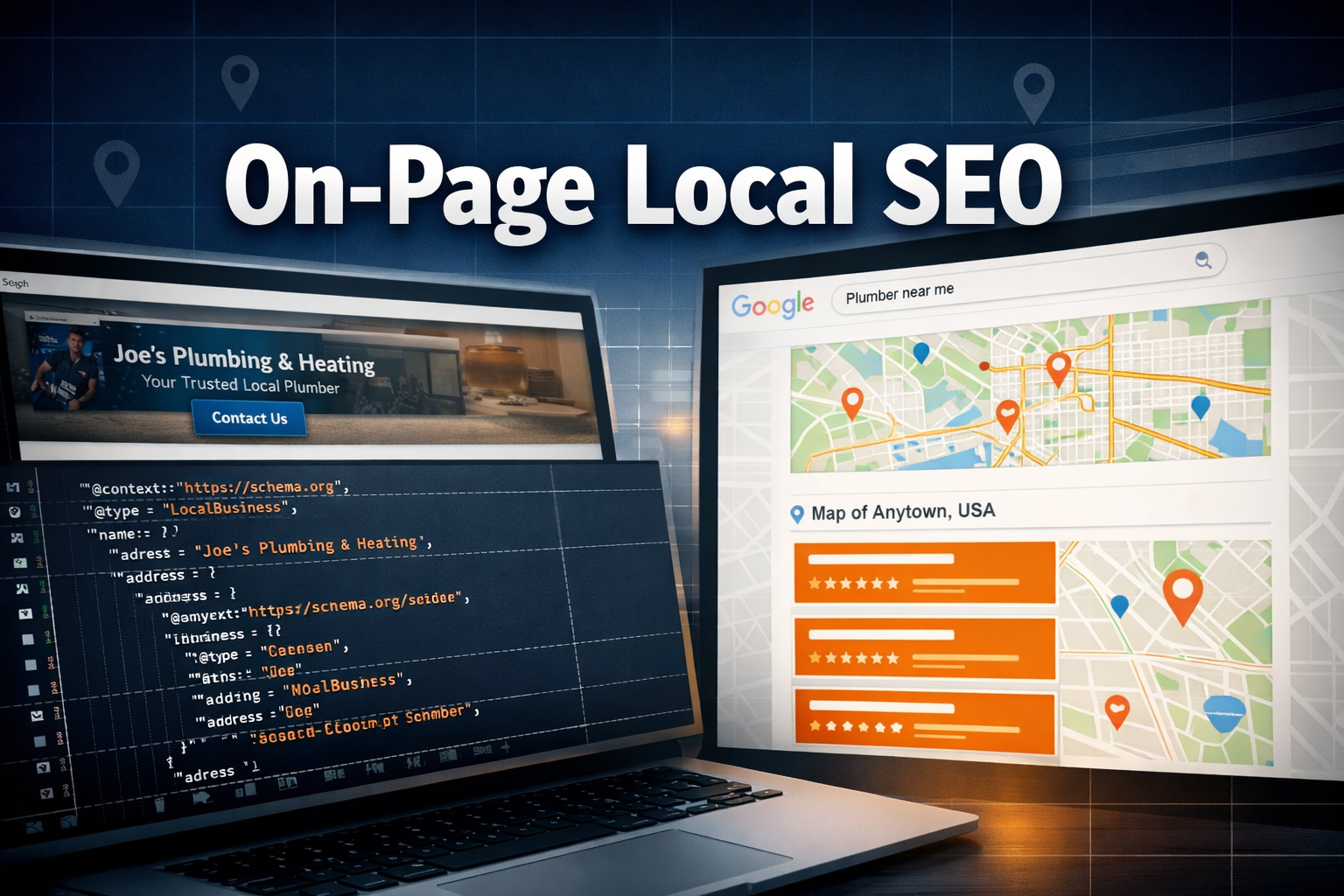
Schema markup is the top technical priority for local businesses in 2026 [3]. It gives Google explicit, structured data about your business rather than forcing the algorithm to infer it from body text.
Schema types every local business page should implement:
- LocalBusiness (or a specific subtype like
Plumber,AutoRepair,Restaurant) - PostalAddress with full NAP details
- OpeningHoursSpecification
- GeoCoordinates
- AggregateRating (when review data is available)
Use JSON-LD format, placed in the <head> or just before </body>. Validate every implementation with Google’s Rich Results Test before publishing.
💡 Schema acts as a direct communication channel to Google — telling it exactly who you are, where you operate, and what you offer, without ambiguity.
What Is NAP Consistency and How Does It Affect Local Rankings?
NAP stands for Name, Address, and Phone number. Consistency means these three data points appear identically across every location page, schema markup block, footer, and contact page on your site [6].
Even minor variations — “St.” vs. “Street,” or a missing suite number — can create conflicting signals that weaken local ranking stability.
NAP consistency checklist for on-page elements:
- Footer on every page matches schema markup exactly
- Contact page matches Google Business Profile listing
- Location landing pages each carry the correct local phone number
- Schema
PostalAddressmatches the physical address format used everywhere else
For businesses with multiple locations, each location page should carry that location’s specific NAP, not the corporate headquarters address.
How Does Internal Linking Strengthen Local SEO?
Internal linking connects your local landing pages, service pages, and blog content into a coherent structure that both users and search engines can follow.
Practical internal linking rules for local sites:
- Link from high-authority pages (homepage, main service pages) to individual location pages
- Use descriptive anchor text that includes the service and city where natural
- Create a “Service Areas” hub page that links out to all location pages
- Link related service pages to each other (e.g., “drain cleaning” links to “pipe repair”)
A well-linked site distributes authority across all local pages rather than concentrating it on the homepage alone. Pair this with a complete local SEO audit to identify gaps in your current link structure.
What Page Structure Converts Local Visitors Into Customers?
Ranking is only half the job. A local page that attracts clicks but doesn’t convert wastes every ranking signal you’ve built.
Conversion-focused local page structure:
- Above the fold: H1 with service + city, a brief trust statement, and a prominent CTA (phone number or “Get a Free Quote” button)
- Trust block: Star rating summary, number of reviews, years in business
- Service details: What’s included, how it works, local-specific context
- Social proof: 2–3 local customer testimonials with first name and neighborhood
- E-E-A-T signals: Credentials, licenses, local awards, or community involvement [3]
- FAQ section: Answers common local questions and captures voice search queries [7]
- Final CTA: Click-to-call button, contact form, or booking widget
For businesses that rely on form submissions, choosing the right contact form tool matters. See this comparison of top contact form plugins to find one that fits your setup.
Conclusion: Build Your On-Page Local SEO Foundation Now
On-page local SEO is not a one-time task — it’s a structured system of interconnected elements that compound over time. Start by auditing your existing location pages against the criteria above, then prioritize schema implementation and NAP consistency as your first technical fixes.
Actionable next steps:
- Run a full local SEO audit to find gaps in title tags, schema, and page structure
- Build or rebuild one location landing page using the conversion-focused structure above
- Implement LocalBusiness schema on every location page and validate it
- Audit NAP consistency across all on-page references
- Map your internal linking structure and connect orphaned location pages
- Review your proven local SEO strategies to align on-page work with your broader local search plan
Note: Google’s March 2026 core update is still rolling out in stages [4], so on-page changes made now may show delayed ranking movement. Make the changes, document them, and allow 4–6 weeks before drawing conclusions.
FAQ
What is on-page local SEO?
On-page local SEO is the process of optimizing webpage elements — title tags, content, schema, NAP data, and internal links — so a local business ranks for location-specific searches and converts local visitors.
How many location pages does a local business need?
One page per unique service-location combination. A business offering three services in four cities should build 12 distinct, fully optimized location pages [8].
Does schema markup directly improve rankings?
Schema markup is not a confirmed direct ranking factor, but it helps Google understand your business data accurately, which supports local pack eligibility and rich result display [3].
What is NAP consistency?
NAP stands for Name, Address, and Phone number. Consistency means these details appear identically across every on-page reference, schema block, and external listing.
How long should a local landing page be?
Long enough to fully address the local searcher’s intent — typically 500–1,000 words for a service-location page. Thin pages with fewer than 300 words rarely rank competitively.
What makes a meta description effective for local SEO?
A strong local meta description is 150–160 characters, includes the service and city, and ends with a soft call-to-action. Write it manually rather than relying on auto-generation [3].
How does internal linking help local SEO?
Internal links pass authority from stronger pages to location pages, help Google discover all local content, and guide users toward conversion actions.
Should each location page have a unique phone number?
Yes, where possible. A local phone number specific to each location reinforces geographic relevance and improves NAP consistency across schema and on-page references.
What E-E-A-T signals should appear on a local page?
Licenses, certifications, years in business, named staff members, local awards, community involvement, and verified customer reviews all demonstrate Experience, Expertise, Authoritativeness, and Trustworthiness [3].
How does voice search affect on-page local SEO?
Voice queries tend to be conversational and question-based (e.g., “Who fixes AC near me?”). Including an FAQ section with natural-language questions captures these searches [7].
References
[1] Latest SEO Trends April 2026 – https://blog.mean.ceo/latest-seo-trends-april-2026/
[2] The State of Local SEO in 2026 – https://www.sterlingsky.ca/the-state-of-local-seo-in-2026/
[3] Local SEO 2026: The Complete Guide to Dominating Local Search – https://boulderseomarketing.com/local-seo-2026-the-complete-guide-to-dominating-local-search/
[4] SEO News Roundup March 30 to April 5 2026 – https://localdominator.co/seo-news/seo-news-roundup-march-30-to-april-5-2026/
[6] 8 SEO Trends for 2026 – https://bytesplatform.com/blogs/8-seo-trends-for-2026
[7] Local SEO – Search Engine Land – https://searchengineland.com/library/seo/local
[8] Local SEO Guide – https://firstpagesage.com/seo-blog/local-seo-guide/