Ever feel like SEO experts are speaking a different language? You’re not alone. When you’re trying to grow your local business, the last thing you need is to decode a bunch of tech jargon just to understand what’s happening with your Google ranking. That’s exactly why we created this Local SEO Glossary & Definitions — to give you straight answers about the key SEO terms and metrics that actually matter for your business.
Here’s the truth: you don’t need a computer science degree to understand local SEO. You just need someone to explain it in plain English. This glossary breaks down the essential terms, metrics, and concepts you’ll encounter when working on your local search presence — without the fluff or the fancy talk.
Key Takeaways
- Local SEO has its own vocabulary — understanding key terms like GBP, NAP, and local pack helps you make smarter decisions about your online presence
- Metrics tell the real story — knowing which numbers actually drive phone calls and foot traffic keeps you focused on what matters
- You don’t need to memorize everything — bookmark this glossary and reference it whenever you need clarity on a term or metric
- These definitions are practical — we explain not just what each term means, but why it matters for your business
- Knowledge = better results — when you understand the language, you can have real conversations with SEO pros and hold them accountable
Why You Need This Local SEO Glossary
Look, we get it. You didn’t start your plumbing business or open your restaurant because you wanted to become an SEO expert. You’ve got a business to run, customers to serve, and a million things on your plate already.
But here’s the thing — when you’re trying to show up in local searches, you’re going to encounter terms like “schema markup,” “local citations,” and “click-through rate.” And if you don’t know what these mean, you can’t make informed decisions about your marketing.
This glossary is your decoder ring. It’s the resource you bookmark and come back to whenever someone throws an SEO term at you that makes your eyes glaze over. We’ve done this before — we’ve helped hundreds of local businesses cut through the jargon and focus on what actually drives results.
Core Local SEO Terms Every Business Owner Should Know
Let’s start with the fundamentals. These are the terms you’ll hear most often when working on your local SEO strategy.
Google Business Profile (GBP)
What it is: Your free business listing on Google that appears in Maps and local search results. Formerly called “Google My Business.”
Why it matters: This is your digital storefront on Google. When someone searches for your type of business in your area, your GBP is often the first thing they see. It shows your hours, photos, reviews, and contact info — and it’s the gateway to getting into the local map pack.
Real talk: If you only optimize one thing for local SEO, make it your Google Business Profile. It’s that important.
NAP (Name, Address, Phone Number)
What it is: Your business’s basic contact information that needs to be consistent across the entire web.
Why it matters: Google uses NAP consistency to verify that your business is legitimate and to understand where you’re located. If your address is “123 Main St” on your website but “123 Main Street” on Yelp, it creates confusion and can hurt your rankings.
Real talk: This sounds simple, but we’ve seen businesses lose rankings because they moved locations and forgot to update their address everywhere. Consistency is key.
Local Pack (Map Pack)
What it is: The box of three business listings that appears at the top of Google search results, complete with a map and business information.
Why it matters: This is prime real estate. If you’re in the local pack, you’re visible before all the regular organic results. It’s like having a billboard at the busiest intersection in town.
Real talk: Getting into the local pack can literally transform your business. We’ve seen clients double their call volume just from cracking into these top three spots.
Citations
What it is: Any online mention of your business’s NAP information, typically on business directories, websites, or apps.
Why it matters: Citations act like votes of confidence. The more quality citations you have from reputable sources (Yelp, Yellow Pages, industry directories), the more Google trusts that you’re a legitimate local business.
Real talk: Quality beats quantity here. One citation from a respected local chamber of commerce is worth more than ten from sketchy directories nobody’s heard of.
Search Engine & Ranking Terms
Now let’s talk about how search engines actually work and what affects your visibility.
SERP (Search Engine Results Page)
What it is: The page of results you see after typing a query into Google or another search engine.
Why it matters: Understanding the SERP helps you see where you stand. Are you on page one? Page three? In the local pack? Each position has different visibility and click-through rates.
Real talk: If you’re not on page one, you might as well be invisible. Over 90% of clicks go to first-page results [1].
Organic Results
What it is: The “regular” search results that appear below ads and the local pack, ranked by Google’s algorithm based on relevance and authority.
Why it matters: These are free placements you earn through good SEO. Unlike paid ads, organic rankings don’t cost you per click and tend to get more trust from searchers.
Real talk: Organic rankings take time to build, but they’re worth it. They keep working for you 24/7 without ongoing ad spend.
Local Search Intent
What it is: When someone’s search query indicates they’re looking for a business or service in a specific geographic area.
Why it matters: Searches like “plumber near me” or “best pizza in Corona” have local intent. Google recognizes this and shows local results instead of general information.
Real talk: Understanding search intent helps you create content that matches what people are actually looking for — not just what you want to rank for.
Proximity Ranking
What it is: Google’s tendency to show businesses that are physically closer to the searcher’s location.
Why it matters: If someone searches “coffee shop” while standing downtown, Google will prioritize coffee shops near downtown — even if there are higher-rated shops across town.
Real talk: You can’t change your location, but you can optimize for the neighborhoods you serve and make sure your service areas are clear in your GBP.
On-Page SEO Terms
These terms relate to what’s happening on your actual website.
Schema Markup (Structured Data)
What it is: Special code added to your website that helps search engines understand your content better — like your business hours, services, reviews, and location.
Why it matters: Schema markup can help you appear in rich snippets and gives Google clear signals about what your business offers and where you serve.
Real talk: This is one of those behind-the-scenes things that most business owners never see, but it makes a real difference in how Google interprets your site.
Title Tag
What it is: The clickable headline that appears in search results for each page on your website.
Why it matters: Your title tag is often the first thing people read when deciding whether to click on your site. It’s also a major ranking factor for search engines.
Real talk: A good title tag includes your main keyword and your location. “Emergency Plumber in Corona, CA – 24/7 Service” beats “Home – Bob’s Plumbing” every time.
Meta Description
What it is: The short summary text that appears under your title tag in search results.
Why it matters: While it doesn’t directly affect rankings, a compelling meta description can significantly increase your click-through rate.
Real talk: Think of this as your elevator pitch. You’ve got about 155 characters to convince someone to click your result instead of the nine others on the page.
Header Tags (H1, H2, H3)
What it is: HTML tags that create headings and subheadings on your web pages, organizing content in a hierarchy.
Why it matters: Headers help both readers and search engines understand the structure and main topics of your content. Your H1 should include your primary keyword.
Real talk: Don’t overthink this. Use headers the way you’d outline a paper — main topic, subtopics, supporting points. It’s that simple.
Metrics That Actually Matter
Let’s talk numbers. These are the metrics that tell you whether your local SEO is working.
Impressions
What it is: The number of times your business listing or website appears in search results, whether or not someone clicks on it.
Why it matters: Impressions show you how often you’re being seen. If your impressions are low, you’re not showing up enough. If they’re high but clicks are low, you’ve got a visibility problem, not a presence problem.
Real talk: Impressions alone don’t pay the bills. They’re the starting point, not the goal.
Click-Through Rate (CTR)
What it is: The percentage of people who see your listing and actually click on it. Calculated as (clicks ÷ impressions) × 100.
Why it matters: CTR tells you how compelling your listing is. A low CTR means people are seeing you but not interested enough to click.
Real talk: For local searches, a good CTR is typically 3-5% or higher. If yours is lower, look at your title tags, meta descriptions, and review count.
Conversion Rate
What it is: The percentage of website visitors who take a desired action — calling you, filling out a form, making a purchase, etc.
Why it matters: This is where the rubber meets the road. You can have all the traffic in the world, but if nobody’s converting into customers, it’s worthless.
Real talk: We care about phone calls, not fluff. A 2% conversion rate might sound low, but if you’re getting 1,000 visitors a month, that’s 20 new customers. That’s real money.
Bounce Rate
What it is: The percentage of visitors who land on your site and leave without clicking anything or viewing other pages.
Why it matters: A high bounce rate often indicates that your page isn’t giving visitors what they expected or that the user experience is poor.
Real talk: Some bounce is normal — if someone finds your phone number and calls immediately, that counts as a bounce but it’s actually a win. Context matters.
Average Position
What it is: Your average ranking position in search results for the keywords you’re tracking.
Why it matters: Position 1 gets way more clicks than position 10. Moving from position 5 to position 3 can double your traffic.
Real talk: Don’t obsess over being #1 for every keyword. Focus on ranking well for the terms that actually bring you customers.
Review & Reputation Terms
Reviews are huge for local SEO. Here’s what you need to know.
Review Velocity
What it is: The rate at which you’re receiving new reviews over time.
Why it matters: Google likes to see fresh, recent reviews. A business with 50 reviews from three years ago looks less active than one with 30 reviews from the past six months.
Real talk: Make getting reviews part of your regular process. After every completed job, ask for a review. Make it easy. Keep them coming.
Review Response Rate
What it is: The percentage of reviews you respond to, both positive and negative.
Why it matters: Responding to reviews shows you’re engaged and care about customer feedback. It also gives you a chance to address concerns publicly.
Real talk: Respond to every review. Thank people for the good ones. Address the bad ones professionally. Future customers are watching how you handle both.
Star Rating
What it is: The average rating of your business based on customer reviews, typically displayed as 1-5 stars.
Why it matters: Star ratings appear directly in search results and heavily influence whether people click on your listing or choose a competitor.
Real talk: Aim for 4.0 stars or higher. Anything below that and you’re losing business to competitors before people even visit your website.
Link Building & Authority Terms
These terms relate to how other websites connect to yours and how Google views your authority.
Backlinks
What it is: Links from other websites that point to your website.
Why it matters: Backlinks are like endorsements. When reputable sites link to you, Google sees it as a vote of confidence in your content and authority.
Real talk: One link from your local newspaper or chamber of commerce is worth more than 100 links from random blog comments. Quality over quantity, always.
Domain Authority (DA)
What it is: A score (1-100) that predicts how well a website will rank in search results, based on factors like backlinks and content quality.
Why it matters: Higher DA generally means more trust and better ranking potential. It’s not a Google metric, but it’s a useful benchmark.
Real talk: Don’t get hung up on DA scores. We’ve seen small local businesses with DA 20 outrank national brands with DA 60 for local searches — because local relevance matters more.
Anchor Text
What it is: The clickable text in a hyperlink.
Why it matters: Anchor text tells search engines what the linked page is about. If ten sites link to you with the anchor text “Corona plumber,” Google gets a strong signal about your business.
Real talk: Natural anchor text variety is best. A mix of branded terms, keywords, and generic phrases looks more natural than 100% exact-match keywords.
Technical SEO Terms
These are the behind-the-scenes technical elements that affect your site’s performance.
Mobile-Friendly (Mobile Responsive)
What it is: A website design that automatically adjusts to look good and function well on smartphones and tablets.
Why it matters: Over 60% of local searches happen on mobile devices [2]. If your site doesn’t work well on phones, you’re losing more than half your potential customers.
Real talk: This isn’t optional anymore. Google uses mobile-first indexing, meaning they judge your site based on the mobile version, not the desktop version.
Page Speed
What it is: How fast your website loads when someone visits it.
Why it matters: Slow sites frustrate users and hurt rankings. Google has confirmed that page speed is a ranking factor, especially for mobile searches.
Real talk: Every second counts. If your site takes more than 3 seconds to load, you’re losing customers. People are impatient, and they should be — your competitors’ sites load in 2 seconds.
SSL Certificate (HTTPS)
What it is: A security protocol that encrypts data between your website and visitors, indicated by the padlock icon and “https://” in the URL.
Why it matters: Google gives preference to secure sites. Plus, browsers now warn users about non-secure sites, which scares people away.
Real talk: This is table stakes in 2026. If you don’t have an SSL certificate, get one today. They’re often free through your hosting provider.
Crawling & Indexing
What it is: Crawling is when Google’s bots scan your website. Indexing is when Google adds your pages to its searchable database.
Why it matters: If Google can’t crawl or index your site, you won’t show up in search results at all.
Real talk: Most business owners never need to think about this — unless something’s broken. If you’ve launched a new site and aren’t showing up in Google after a few weeks, this might be why.
Content & Engagement Terms
These terms relate to how people interact with your content and website.
Dwell Time
What it is: How long a visitor stays on your page after clicking through from search results before returning to the SERP.
Why it matters: Longer dwell time suggests your content is valuable and relevant. It’s a quality signal to Google.
Real talk: Create content that actually helps people. Answer their questions completely. Don’t make them go back to Google to find what they need.
Local Content
What it is: Website content that’s specifically relevant to your geographic area — like neighborhood guides, local events, or area-specific services.
Why it matters: Local content helps you rank for location-based searches and shows Google you’re genuinely connected to your community.
Real talk: Don’t just stuff your city name everywhere. Write content that actually serves your local audience. Talk about local issues, events, and needs.
Call to Action (CTA)
What it is: A prompt that tells visitors what action you want them to take — “Call Now,” “Schedule an Appointment,” “Get a Free Quote,” etc.
Why it matters: Clear CTAs guide visitors toward becoming customers. Without them, people might like your content but not know what to do next.
Real talk: Make your CTAs obvious and easy. Put your phone number in big, clickable buttons. Don’t make people hunt for how to contact you.
Advertising & Paid Search Terms
While this glossary focuses on organic local SEO, you should understand these paid terms too.
Google Ads (formerly AdWords)
What it is: Google’s pay-per-click advertising platform where you bid on keywords to show ads above organic search results.
Why it matters: Ads can get you immediate visibility while you build your organic rankings. They work together, not in competition.
Real talk: Ads are great for quick results, but they stop working when you stop paying. Organic local SEO keeps working 24/7 without ongoing ad spend.
Local Services Ads (LSA)
What it is: Google’s pay-per-lead advertising program for specific service businesses (plumbers, electricians, locksmiths, etc.) that appear at the very top of search results with a “Google Guaranteed” badge.
Why it matters: LSAs can be incredibly effective for service businesses, often delivering better ROI than traditional Google Ads.
Real talk: If you’re in an eligible industry, LSAs are worth testing. But you still need strong organic presence — most people scroll past the ads.
How to Use This Glossary
Here’s how to make this resource work for you:
Bookmark it. Seriously. Next time you’re in a meeting and someone mentions “schema markup” or “review velocity,” you’ll know exactly where to look.
Share it with your team. If you have employees managing your online presence, make sure they understand these terms too. Common language = better results.
Reference it when evaluating SEO proposals. When an agency throws around fancy terms, check this glossary. If they’re using jargon to confuse rather than clarify, that’s a red flag.
Use it to track your own progress. Understanding metrics like CTR, conversion rate, and average position helps you measure what’s actually working.
Why Understanding SEO Terms Matters for Your Business
Look, you don’t need to become an SEO expert. That’s not your job — running your business is. But understanding the basic language of local SEO helps you:
✅ Make smarter decisions about where to invest your marketing dollars
✅ Have real conversations with SEO professionals instead of just nodding along
✅ Spot BS when someone’s trying to sell you services you don’t need
✅ Track what matters instead of vanity metrics that don’t drive revenue
✅ Take control of your online presence instead of feeling helpless
We’ve worked with hundreds of local businesses, and the ones that succeed are the ones that ask questions, demand clarity, and refuse to accept jargon-filled non-answers. This glossary gives you the foundation to do exactly that.
If you want to dive deeper into putting these concepts into action, check out our guide on essential local SEO strategies or explore our full range of local SEO services.
Common Questions About Local SEO Terms
Do I really need to know all these terms?
No. You need to know the ones that relate to your specific goals and the metrics you’re tracking. Start with the basics — GBP, NAP, local pack, CTR, and conversion rate. Everything else you can look up as needed.
How often do these terms and definitions change?
The fundamentals stay pretty consistent, but Google updates its algorithms regularly. What “schema markup” means won’t change, but how Google uses it might evolve. We keep our blog updated with the latest changes.
What’s the most important metric to track?
Conversions. Everything else is just a step toward that goal. Impressions, clicks, rankings — they all matter, but only if they lead to phone calls, appointments, and customers walking through your door.
Can I just hire someone to handle all this?
Absolutely. That’s what we do. But even if you hire an agency, understanding these terms helps you hold them accountable and know whether you’re getting real results or just fancy reports. Want to talk about how we can help? Get in touch.
Putting Your Knowledge Into Action
Now that you’ve got this glossary in your back pocket, here’s what to do next:
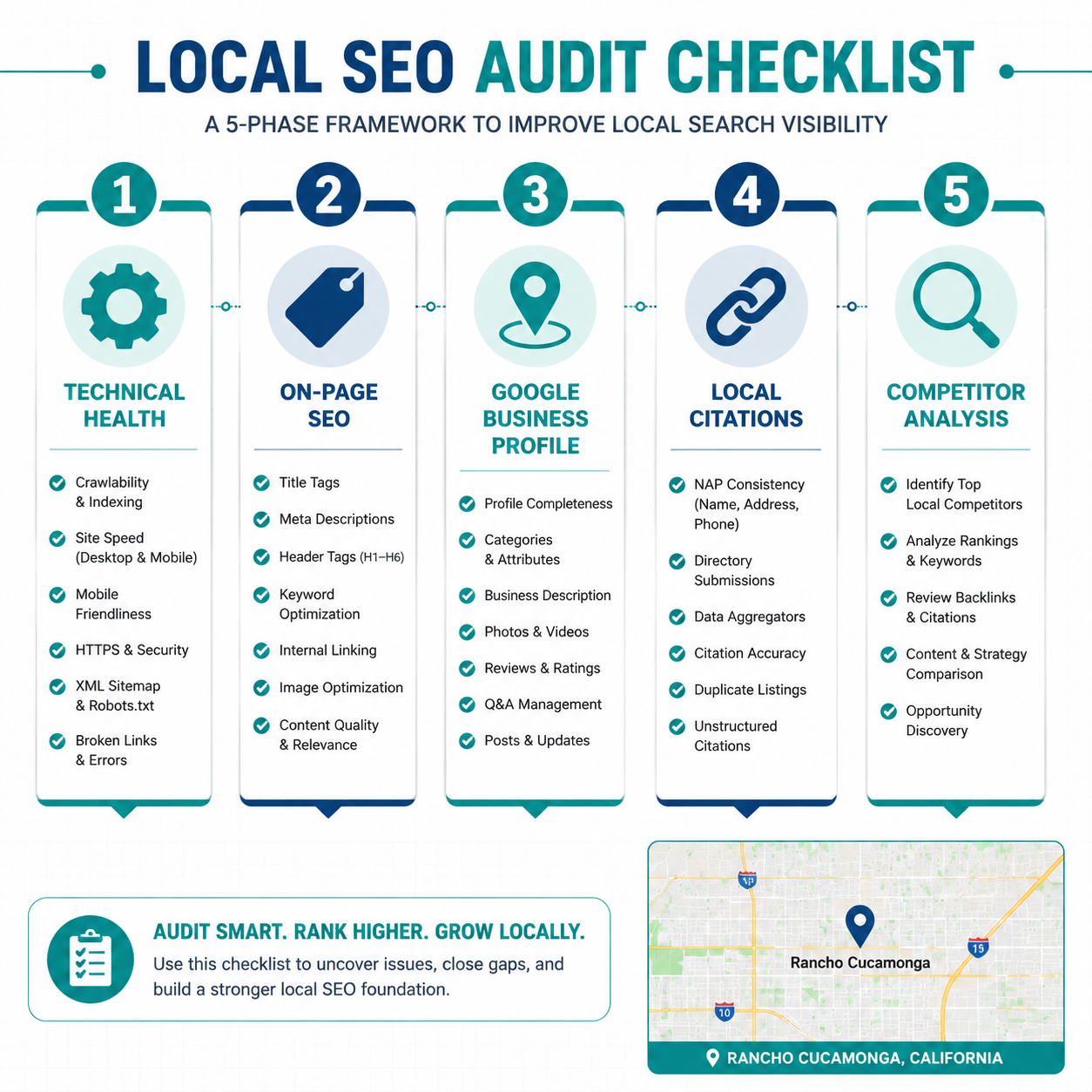
1. Audit your current situation. Look at your Google Business Profile. Check your NAP consistency. Review your website’s title tags and meta descriptions. Understanding the terms helps you spot problems.
2. Set clear goals using the right metrics. Don’t just say “I want better SEO.” Say “I want to increase my GBP impressions by 50% and my conversion rate by 2% over the next three months.” Specific, measurable goals using the right terminology.
3. Ask better questions. Whether you’re working with an agency or doing it yourself, knowing the language helps you ask the right questions and get useful answers.
4. Focus on what drives results. Not every metric matters equally. Prioritize the ones that lead to phone calls and customers — conversion rate, review velocity, local pack rankings, and click-through rate.
5. Keep learning. Local SEO evolves constantly. Bookmark our blog for updates, tips, and real-world examples of these concepts in action.
Conclusion
Here’s the bottom line: local SEO doesn’t have to be complicated or confusing. Yes, there’s a lot of terminology. Yes, the landscape changes. But the core concepts stay the same — help people find your business when they’re searching for what you offer.
This Local SEO Glossary & Definitions gives you the foundation to understand key SEO terms and metrics without getting lost in the weeds. You don’t need to memorize every definition. You just need to know where to look when you need clarity.
We’ve built our business on making SEO simple and making it work for real local businesses like yours. No jargon. No fluff. Just straightforward strategies that drive phone calls and foot traffic.
Ready to put these concepts into action? We’re here to help. Whether you need a full local SEO strategy or just want to understand where you stand, let’s talk. We’ll walk you through exactly what your business needs — in plain English.
Remember: you don’t have to figure this out alone. That’s what we’re here for.
.cg-glossary-container {
font-family: -apple-system, BlinkMacSystemFont, 'Segoe UI', Roboto, Oxygen, Ubuntu, Cantarell, sans-serif;
max-width: 1000px;
margin: 20px auto;
padding: 20px;
background: linear-gradient(135deg, #1e3a8a 0%, #3b82f6 100%);
border-radius: 12px;
box-shadow: 0 10px 30px rgba(0,0,0,0.2);
}
.cg-glossary-header {
text-align: center;
color: white;
margin-bottom: 30px;
}
.cg-glossary-header h2 {
font-size: 28px;
margin-bottom: 10px;
}
.cg-glossary-header p {
font-size: 16px;
opacity: 0.9;
}
.cg-search-filter-section {
background: white;
padding: 20px;
border-radius: 8px;
margin-bottom: 20px;
}
.cg-search-box {
width: 100%;
padding: 12px 20px;
font-size: 16px;
border: 2px solid #e5e7eb;
border-radius: 8px;
margin-bottom: 15px;
transition: border-color 0.3s;
}
.cg-search-box:focus {
outline: none;
border-color: #f97316;
}
.cg-category-filters {
display: flex;
flex-wrap: wrap;
gap: 10px;
margin-bottom: 10px;
}
.cg-filter-btn {
padding: 8px 16px;
background: #f3f4f6;
border: 2px solid #e5e7eb;
border-radius: 20px;
cursor: pointer;
font-size: 14px;
transition: all 0.3s;
}
.cg-filter-btn:hover {
background: #e5e7eb;
}
.cg-filter-btn.cg-active {
background: #f97316;
color: white;
border-color: #f97316;
}
.cg-results-count {
color: #6b7280;
font-size: 14px;
margin-top: 10px;
}
.cg-terms-container {
background: white;
border-radius: 8px;
padding: 20px;
max-height: 600px;
overflow-y: auto;
}
.cg-term-card {
padding: 20px;
margin-bottom: 15px;
border-left: 4px solid #f97316;
background: #f9fafb;
border-radius: 4px;
transition: all 0.3s;
}
.cg-term-card:hover {
background: #f3f4f6;
transform: translateX(5px);
}
.cg-term-title {
font-size: 20px;
font-weight: bold;
color: #1e3a8a;
margin-bottom: 5px;
}
.cg-term-category {
display: inline-block;
padding: 4px 12px;
background: #dbeafe;
color: #1e40af;
border-radius: 12px;
font-size: 12px;
margin-bottom: 10px;
}
.cg-term-definition {
color: #374151;
line-height: 1.6;
margin-bottom: 10px;
}
.cg-term-importance {
color: #059669;
font-weight: 600;
font-size: 14px;
margin-top: 10px;
}
.cg-no-results {
text-align: center;
padding: 40px;
color: #6b7280;
}
.cg-no-results-icon {
font-size: 48px;
margin-bottom: 10px;
}
@media (max-width: 768px) {
.cg-glossary-container {
padding: 15px;
}
.cg-glossary-header h2 {
font-size: 22px;
}
.cg-category-filters {
justify-content: center;
}
.cg-filter-btn {
font-size: 12px;
padding: 6px 12px;
}
.cg-term-title {
font-size: 18px;
}
}
</style>🔍 Local SEO Terms Quick Reference
Search and filter key SEO terms to find what you need
<div class="cg-search-filter-section">
<input
type="text"
class="cg-search-box"
id="cg-search-input"
placeholder="Search for a term... (e.g., 'GBP', 'citations', 'CTR')"
>
<div class="cg-category-filters">
<button class="cg-filter-btn cg-active" data-category="all">All Terms</button>
<button class="cg-filter-btn" data-category="core">Core Terms</button>
<button class="cg-filter-btn" data-category="metrics">Metrics</button>
<button class="cg-filter-btn" data-category="technical">Technical</button>
<button class="cg-filter-btn" data-category="content">Content</button>
</div>
<div class="cg-results-count" id="cg-results-count">Showing 20 terms</div>
</div>
<div class="cg-terms-container" id="cg-terms-container">
<!-- Terms will be populated by JavaScript -->
</div>
</div><script>
const terms = [
{
term: "Google Business Profile (GBP)",
category: "core",
definition: "Your free business listing on Google that appears in Maps and local search results.",
importance: "Critical - This is your digital storefront on Google"
},
{
term: "NAP (Name, Address, Phone)",
category: "core",
definition: "Your business's basic contact information that needs to be consistent across the web.",
importance: "Essential for local ranking and trust signals"
},
{
term: "Local Pack (Map Pack)",
category: "core",
definition: "The box of three business listings at the top of Google search results with a map.",
importance: "Prime visibility - can double your traffic"
},
{
term: "Citations",
category: "core",
definition: "Online mentions of your business's NAP on directories and websites.",
importance: "Builds authority and local ranking signals"
},
{
term: "Click-Through Rate (CTR)",
category: "metrics",
definition: "Percentage of people who see your listing and click on it.",
importance: "Shows how compelling your listing is to searchers"
},
{
term: "Conversion Rate",
category: "metrics",
definition: "Percentage of visitors who take a desired action (call, form, purchase).",
importance: "The metric that actually measures business results"
},
{
term: "Impressions",
category: "metrics",
definition: "Number of times your listing appears in search results.",
importance: "Shows visibility but not engagement"
},
{
term: "Average Position",
category: "metrics",
definition: "Your average ranking position in search results for tracked keywords.",
importance: "Higher positions get exponentially more clicks"
},
{
term: "Schema Markup",
category: "technical",
definition: "Code that helps search engines understand your content better.",
importance: "Enables rich snippets and better search visibility"
},
{
term: "Mobile-Friendly",
category: "technical",
definition: "Website design that works well on smartphones and tablets.",
importance: "Critical - 60%+ of searches are mobile"
},
{
term: "Page Speed",
category: "technical",
definition: "How fast your website loads for visitors.",
importance: "Affects rankings and user experience directly"
},
{
term: "SSL Certificate (HTTPS)",
category: "technical",
definition: "Security protocol that encrypts data on your website.",
importance: "Required for trust and ranking preference"
},
{
term: "Review Velocity",
category: "core",
definition: "The rate at which you receive new reviews over time.",
importance: "Fresh reviews signal active, engaged business"
},
{
term: "Local Search Intent",
category: "core",
definition: "When a search query indicates looking for a local business or service.",
importance: "Understanding this helps you target the right keywords"
},
{
term: "Title Tag",
category: "content",
definition: "The clickable headline in search results for each page.",
importance: "Major ranking factor and first impression"
},
{
term: "Meta Description",
category: "content",
definition: "Summary text under your title in search results.",
importance: "Doesn't affect ranking but influences clicks"
},
{
term: "Backlinks",
category: "core",
definition: "Links from other websites pointing to your site.",
importance: "Major trust and authority signal to Google"
},
{
term: "Bounce Rate",
category: "metrics",
definition: "Percentage of visitors who leave without clicking anything.",
importance: "Can indicate poor user experience or content mismatch"
},
{
term: "Local Content",
category: "content",
definition: "Website content specifically relevant to your geographic area.",
importance: "Helps rank for location-based searches"
},
{
term: "Proximity Ranking",
category: "core",
definition: "Google's tendency to show businesses closer to the searcher.",
importance: "Can't change location but can optimize service areas"
}
];const termsContainer = document.getElementById('cg-terms-container');
const searchInput = document.getElementById('cg-search-input');
const resultsCount = document.getElementById('cg-results-count');
const filterButtons = document.querySelectorAll('.cg-filter-btn');
let currentCategory = 'all';
let currentSearch = '';function renderTerms() {
const filtered = terms.filter(term => {
const matchesCategory = currentCategory === 'all' || term.category === currentCategory;
const matchesSearch = term.term.toLowerCase().includes(currentSearch.toLowerCase()) ||
term.definition.toLowerCase().includes(currentSearch.toLowerCase());
return matchesCategory && matchesSearch;
});if (filtered.length === 0) {
termsContainer.innerHTML = `
<div class="cg-no-results">
<div class="cg-no-results-icon">🔍</div>
<p>No terms found matching your search.</p>
<p style="font-size: 14px; margin-top: 10px;">Try different keywords or filters.</p>
</div>
`;
resultsCount.textContent = 'No terms found';
return;
}termsContainer.innerHTML = filtered.map(term => `
<div class="cg-term-card">
<div class="cg-term-title">${term.term}</div>
<span class="cg-term-category">${term.category.toUpperCase()}</span>
<div class="cg-term-definition">${term.definition}</div>
<div class="cg-term-importance">💡 ${term.importance}</div>
</div>
`).join('');resultsCount.textContent = `Showing ${filtered.length} term${filtered.length !== 1 ? 's' : ''}`;
}searchInput.addEventListener('input', (e) => {
currentSearch = e.target.value;
renderTerms();
});filterButtons.forEach(button => {
button.addEventListener('click', () => {
filterButtons.forEach(btn => btn.classList.remove('cg-active'));
button.classList.add('cg-active');
currentCategory = button.dataset.category;
renderTerms();
});
});// Initial render
renderTerms();
</script>References
[1] Advanced Web Ranking. (2026). "CTR Study: Click-Through Rates by Position." Digital Marketing Research.
[2] Google. (2026). "Mobile Search Statistics and Local Intent Data." Google Search Central Documentation.