Last updated: May 2, 2026
Quick Answer: Local business SEO software helps small businesses rank higher in Google Maps and local search results by managing citations, tracking keyword rankings, monitoring reviews, and auditing their online presence. The best options for small businesses in 2026 range from $14/month (Moz Local) to $39/month (BrightLocal), with each tool targeting a slightly different need. Choosing the right one depends on your budget, whether you need citation building, rank tracking, or review management — or all three.
Key Takeaways
- Local business SEO software automates the tasks that help your business show up when nearby customers search on Google.
- BrightLocal ($39/mo) is the top all-in-one option for small businesses needing audits, citations, and review tracking in one place. [1]
- Moz Local ($14/mo) is the most budget-friendly entry point with solid listing distribution. [1]
- Localo ($19/mo) offers AI-driven competitor tracking and street-level rank visibility at a low price point. [1]
- Local Falcon earns the highest G2 rating at 4.8/5 and excels at visualizing exactly where you rank on Google Maps. [1]
- Semrush Local is the G2 category leader as of April 2026, best for businesses that also want broader SEO capabilities. [3]
- SE Ranking is rated “Easiest to Use” on G2 — a strong pick if you’re new to SEO tools. [3]
- Citation consistency (matching Name, Address, Phone across all directories) is one of the fastest wins any tool can deliver.
- No software replaces a solid local SEO strategy — tools support the work, they don’t do it for you.
What Is Local Business SEO Software and Who Needs It?
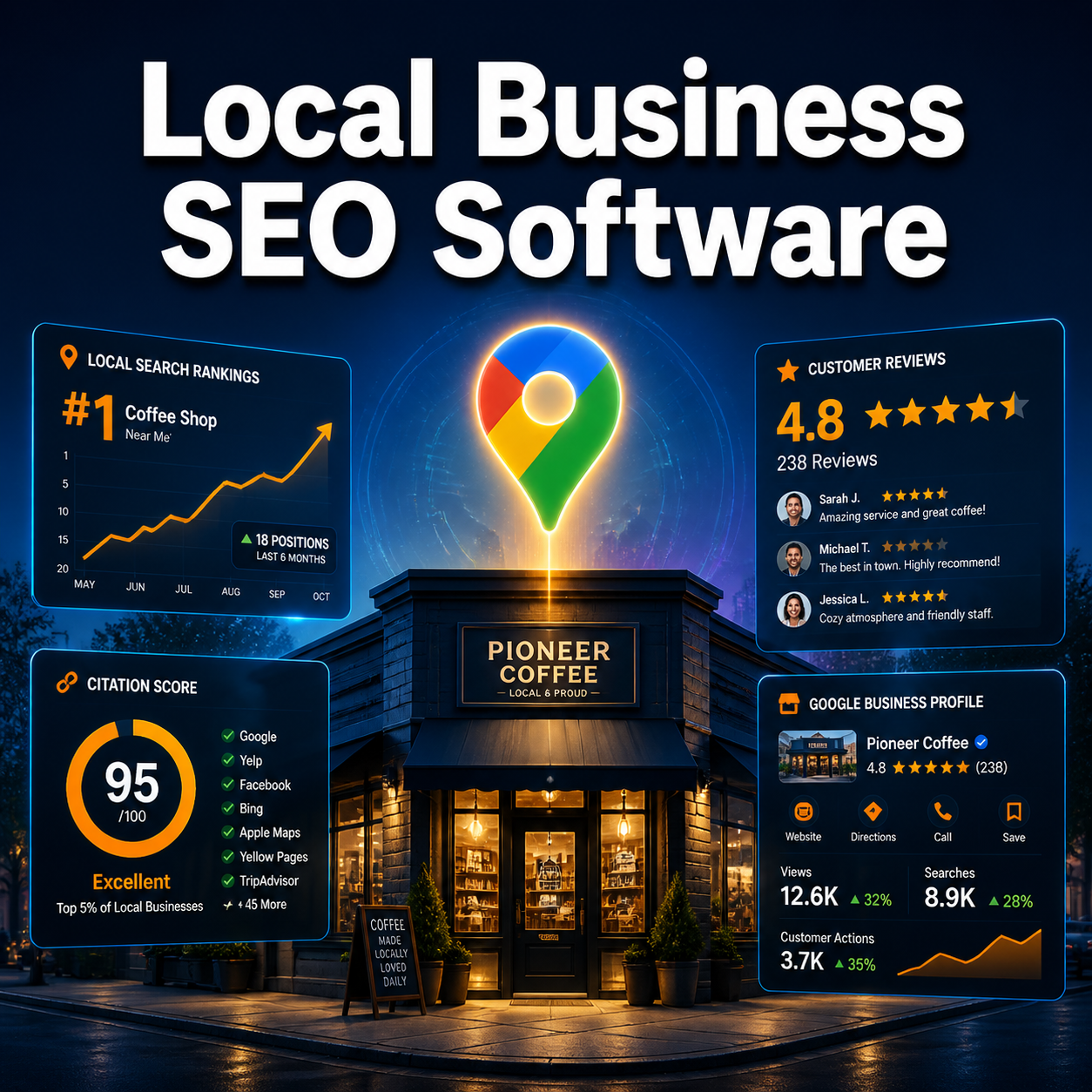
Local business SEO software is a category of tools designed to help businesses rank in geographically targeted searches — the “plumber near me” or “best coffee shop in Corona” type of queries. These tools handle the repetitive, data-heavy tasks that local SEO requires: syncing your business listings across directories, tracking where you rank on Google Maps, monitoring customer reviews, and flagging technical issues on your website.
Who needs it: Any business that depends on local customers finding them online. That includes service-area businesses like plumbers, pool companies, contractors, cleaning services, and fitness studios. If your revenue depends on people in a specific city or zip code choosing you over a competitor, this software category is built for you.
Who may not need it yet: A brand-new business with no Google Business Profile, no website, and no citations should probably start with a Google Business Profile optimization before investing in software. Get the foundation right first.
How Does Local Business SEO Software Actually Work?
Most local SEO tools connect to Google’s data (via APIs or scraping), your Google Business Profile, and major data aggregators like Foursquare and Neustar to pull in real-time information about your local presence.
Here’s what they typically do under the hood:
- Citation scanning: They search hundreds of directories to find where your business is listed and whether your Name, Address, and Phone (NAP) data is consistent.
- Rank tracking: They simulate searches from specific geographic locations — sometimes down to the street level — to show where your business appears in Google Maps results.
- Review aggregation: They pull reviews from Google, Yelp, Facebook, and other platforms into a single dashboard.
- Competitor benchmarking: They show how your rankings, reviews, and citations compare to nearby competitors.
- Audit reporting: They flag problems like missing categories on your Google Business Profile, duplicate listings, or thin website content.
Running a local SEO audit before choosing software helps you understand which of these features you actually need most.
Which Local Business SEO Software Tools Are Worth Considering in 2026?
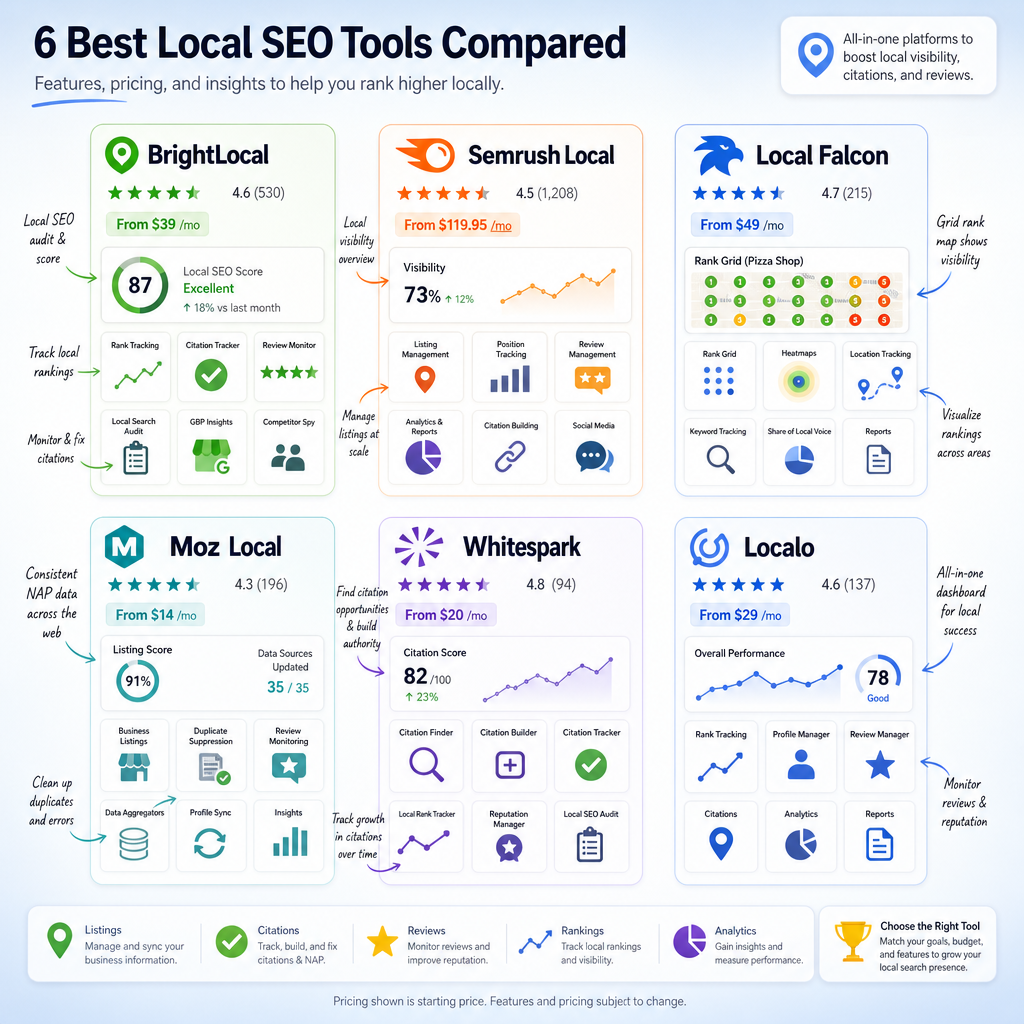
The market has several strong options. Here’s a clear comparison based on verified G2 ratings and published pricing as of 2026: [1][3]
| Tool | Starting Price | G2 Rating | Best For |
|---|---|---|---|
| Moz Local | $14/mo | 4.5/5 | Budget-conscious businesses, listing distribution |
| Localo | $19/mo | 4.7/5 | AI competitor tracking, street-level rank data |
| Local Falcon | $24/mo | 4.8/5 | Google Maps grid visualization |
| Whitespark | $33/mo | 4.5/5 | Citation building and NAP management |
| Synup | $34.99/mo | 4.5/5 | Multi-location reputation management |
| BrightLocal | $39/mo | 4.6/5 | All-in-one: audits, citations, reviews |
| SE Ranking | Varies | High | Easiest to use, broad SEO features |
| Semrush Local | Varies | G2 Leader | Comprehensive SEO + local features |
| Yext | Custom | — | Enterprise, high-volume directory sync |
Choose BrightLocal if you want one tool that handles audits, citation management, and review monitoring without needing to stitch together multiple subscriptions. [1]
Choose Moz Local if you’re on a tight budget and your main need is getting your listings distributed and consistent across directories. [1]
Choose Local Falcon if you want to see exactly where on a geographic grid your business ranks — block by block — which is especially useful for service-area businesses covering multiple neighborhoods. [1]
Choose Semrush Local if you’re already using Semrush for broader keyword research and want local features integrated into one platform. [3]
What Features Matter Most for Small Business Local SEO?
Small businesses don’t need every feature these platforms offer. Focus on the ones that move the needle for local visibility.
The three features that matter most:
Citation management — Your NAP data needs to be identical everywhere: Google, Yelp, Apple Maps, Facebook, and dozens of smaller directories. Inconsistencies confuse Google and can suppress your rankings. Whitespark and BrightLocal are strong here. [1]
Google Maps rank tracking — Knowing you rank #3 for “pool service” doesn’t tell you much if that ranking only applies to one zip code. Tools like Local Falcon show your rank across a geographic grid so you know exactly where you’re visible and where you’re not. [1]
Review monitoring — Reviews affect both rankings and customer decisions. A tool that alerts you when new reviews come in (positive or negative) lets you respond quickly, which Google rewards.
Features that are nice but not urgent for most small businesses:
- White-label reporting (more useful for agencies)
- Enterprise multi-location dashboards
- Custom pricing tiers for hundreds of locations
How Much Should a Small Business Spend on Local SEO Software?
For most small businesses, a budget of $20–$40/month covers a capable tool. Here’s a practical breakdown:
- Under $20/month: Moz Local ($14/mo) or Localo ($19/mo) — solid for listing distribution and basic rank tracking. [1]
- $20–$40/month: Local Falcon, Whitespark, or BrightLocal — more depth in citation building, grid-based rank tracking, and review management. [1]
- $40+/month: Semrush Local or SE Ranking — worth it if you also want broader keyword research, competitor analysis, and on-page SEO tools in the same platform. [3]
One common mistake: paying for a premium tier before fixing the basics. If your Google Business Profile is incomplete or your website has no local service pages, software won’t fix that. Start with a local SEO review to identify your actual gaps before committing to a tool.
What Are the Biggest Mistakes Small Businesses Make With Local SEO Tools?
Even the best local business SEO software won’t help if you’re using it wrong. Here are the most common mistakes:
- Buying software instead of fixing fundamentals. A tool that tracks your rankings is only useful if you’re actively improving them. Software shows you the problem; you (or your SEO provider) have to fix it.
- Ignoring citation errors after the initial cleanup. New duplicate listings appear over time. Citation management isn’t a one-time task.
- Tracking the wrong keywords. Ranking #1 for a keyword nobody searches is worthless. Make sure your rank tracking is set up around terms your actual customers use.
- Not responding to reviews. Most tools surface reviews for you — but many business owners still don’t respond. Google factors engagement into local rankings.
- Skipping competitor analysis. Tools like Localo and Local Falcon show you what nearby competitors are doing. Not using that data is leaving insight on the table. [1]
For businesses in specific trades, the same principles apply whether you’re a plumber in Corona or a pool service company in Riverside — the tools are the same, but the keywords and service-area pages need to match your actual market.
Conclusion: Picking the Right Local Business SEO Software in 2026
The right local business SEO software for a small business isn’t necessarily the most feature-rich or the most expensive. It’s the one that addresses your actual gaps — whether that’s messy citations, poor Google Maps visibility, or unmonitored reviews.
Actionable next steps:
- Run a quick self-audit. Check your Google Business Profile for completeness, search your business name to find inconsistent listings, and note how many reviews you have and when you last responded.
- Match your need to a tool. Use the comparison table above to pick one tool that fits your budget and primary need.
- Start with a free trial. Most tools (BrightLocal, Local Falcon, Localo) offer trials. Test the interface before committing.
- Fix your foundation first. No software replaces strong service pages, accurate business information, and a well-optimized Google Business Profile.
- Get a professional review if you’re unsure. If you’re not sure where to start, a local SEO audit can show you exactly what to prioritize before spending money on tools.
Local search is competitive, but it’s also one of the most level playing fields in digital marketing. A small business with tight, consistent local SEO can outrank much larger competitors — especially in specific cities and neighborhoods. The right software just makes that work faster and more measurable.
Frequently Asked Questions
Q: Can I do local SEO without software?
Yes, but it’s time-consuming. You can manually check citations, track rankings by searching from different locations, and monitor reviews on each platform. Software automates these tasks and surfaces issues you’d likely miss.
Q: Is BrightLocal good for beginners?
Yes. BrightLocal has a clean interface and covers the core needs (citations, rank tracking, reviews) in one dashboard. It’s one of the most beginner-friendly all-in-one options available. [1]
Q: What’s the difference between Semrush Local and a tool like BrightLocal?
Semrush Local is part of a broader SEO platform that also covers keyword research, backlink analysis, and site audits. BrightLocal is built specifically for local SEO. If you only need local features, BrightLocal is more focused and often more affordable. [3]
Q: How long does it take to see results after using local SEO software?
Citation cleanup and Google Business Profile improvements can show results within 4–8 weeks. Rank improvements from content and on-page changes typically take 3–6 months, depending on competition.
Q: Does local SEO software work for service-area businesses without a storefront?
Yes. Tools like Local Falcon and Localo are specifically useful for service-area businesses because they track rankings across geographic grids, not just from a single address. [1]
Q: Is Moz Local worth it at $14/month?
For basic listing distribution and NAP consistency, yes. It’s the most affordable comprehensive option. It’s not ideal if you need advanced rank tracking or review management — you’d want to step up to BrightLocal or Local Falcon for those. [1]
Q: What is a citation in local SEO?
A citation is any online mention of your business’s Name, Address, and Phone number (NAP). Citations appear on directories like Yelp, Yellow Pages, Apple Maps, and hundreds of smaller sites. Consistent citations help Google trust your business information.
Q: Do I need separate software for review management?
Not necessarily. BrightLocal, Synup, and Semrush Local all include review monitoring. If reviews are your primary concern, these all-in-one tools handle it without needing a separate platform. [1][6]
References
[1] Best Local SEO Software – https://www.guideflow.com/blog/best-local-seo-software
[2] Best Local SEO Tools – https://localdominator.co/best-local-seo-tools/
[3] Local SEO (G2 Category) – https://www.g2.com/categories/local-seo
[4] Best Local SEO Software – https://www.frizerly.com/best-local-seo-software.html
[5] Best Local SEO Tools – https://rivaldigital.com/blog/best-local-seo-tools/
[6] Local SEO Software – https://cognitiveseo.com/blog/22393/local-seo-software/
Tags: local business seo software, local SEO tools, BrightLocal, Moz Local, Local Falcon, citation management, Google Maps ranking, small business SEO, local search optimization, review management, Semrush Local, rank tracking