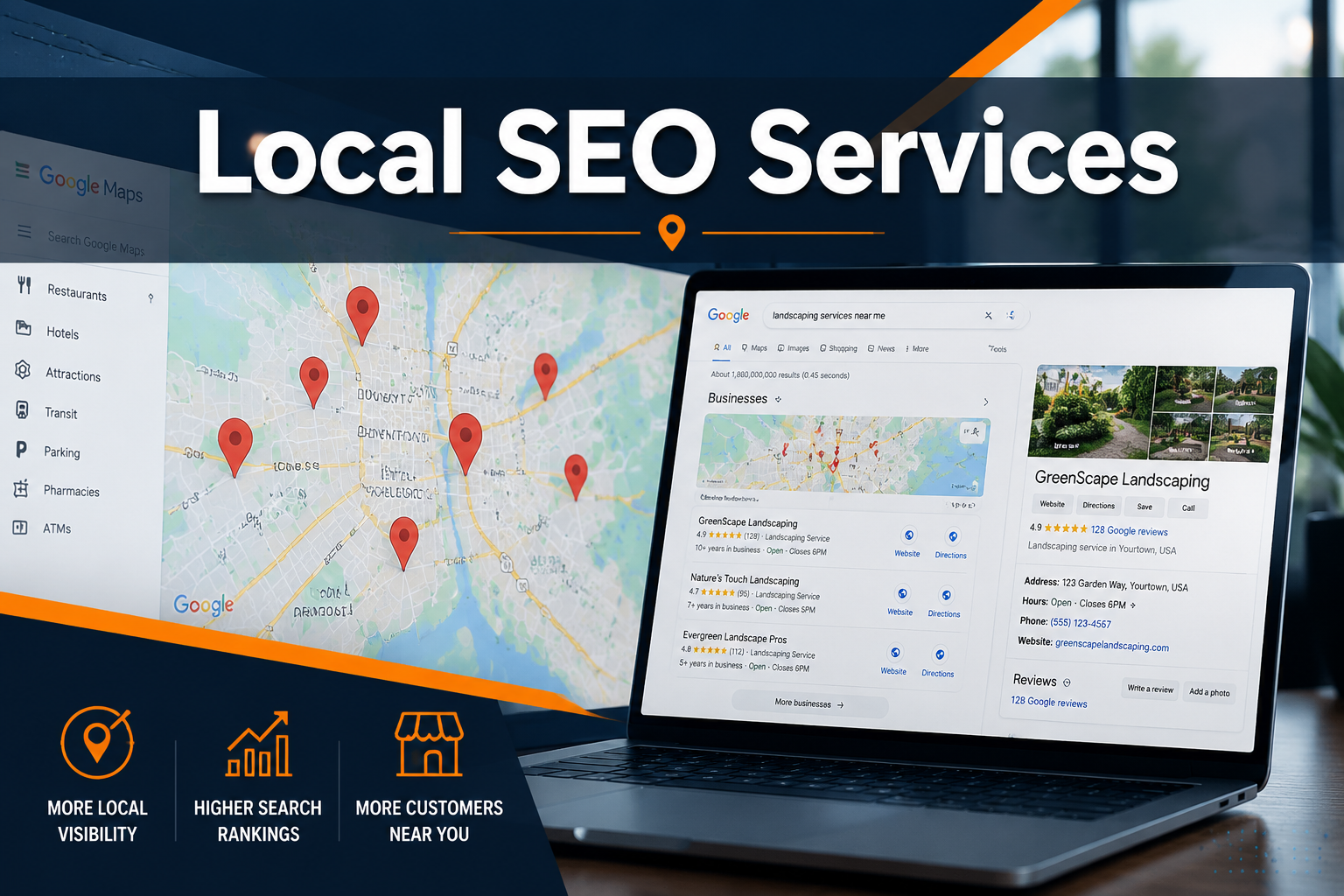
Local SEO Services

Last updated: May 10, 2026


Quick Answer

Local SEO services help businesses appear in Google Maps, the local “Map Pack,” and location-based search results when nearby customers search for products or services. A well-executed local SEO strategy combines Google Business Profile optimization, consistent directory listings, review management, localized content, and technical website improvements. Businesses that invest in these services typically see more phone calls, foot traffic, and qualified leads from their immediate service areas.


Key Takeaways

  • Google now ranks entities, not just pages — consistent signals across your website, directories, and review platforms are essential [2]
  • Five pillars drive local SEO success: Google Business Profile performance, local content, review velocity, local authority signals, and technical infrastructure [3]
  • NAP consistency across 50+ directories is foundational to building Google’s trust in your business [4]
  • AI Overviews and zero-click results mean thin location pages no longer capture traffic — specific, useful content is required [2]
  • Review velocity matters: actively generating and responding to reviews signals customer engagement to Google’s algorithm [4]
  • Intent clusters beat single keywords — target “Service + Problem + Location” combinations rather than isolated terms [3]
  • Discovery happens across multiple formats in 2026: map packs, AI summaries, voice queries, and zero-click results [3]
  • Local backlinks from authoritative sources — chambers of commerce, local media, and industry directories — still move the needle [1]
  • A structured 90-day sprint approach helps service businesses build momentum systematically rather than randomly [5]

What Are Local SEO Services and Who Needs Them?

Local SEO services are a set of strategies and ongoing tasks designed to improve a business’s visibility in geographically relevant search results — specifically Google Maps, the Map Pack (the three local listings that appear above organic results), and location-based queries like “plumber near me” or “best dentist in Corona, CA.”

Who benefits most:

  • Service-area businesses (plumbers, HVAC, landscapers, pool services)
  • Brick-and-mortar retailers and restaurants
  • Professional services with local clientele (dentists, lawyers, accountants)
  • Multi-location franchises and regional chains
Who may not need dedicated local SEO: Purely e-commerce businesses with no physical location or service area, and SaaS companies targeting national or global audiences.

“In 2026, customer discovery happens through AI summaries, map packs, voice queries, and zero-click results — many customers form opinions before they ever visit your website.” [3]


How Does Google Decide Which Local Businesses Rank?

Google uses three primary factors to rank local results: relevance, distance, and prominence. But the mechanics behind each have grown more complex.

Google now ranks entities — not individual web pages. That means it looks for consistent identity signals across your website, Google Business Profile, review platforms, directories, and brand mentions across the web. When these signals conflict or go missing, your visibility becomes fragile [2].

The five pillars that determine local ranking success [3]:

Pillar What It Covers
Google Business Profile Completeness, categories, photos, Q&A, posts
Local Content Problem-focused pages, city-specific landing pages
Review Velocity Volume, recency, response rate
Local Authority Citations, backlinks, chamber listings
Technical Infrastructure Page speed, Core Web Vitals, schema markup

When rankings stall, one of these pillars is almost always underdeveloped.

Detailed () infographic-style illustration showing five interconnected pillars labeled: Google Business Profile, Local

What Does a Complete Local SEO Services Strategy Include?

A complete local SEO strategy covers five interconnected systems. Skipping any one of them creates gaps that competitors can exploit.

1. Google Business Profile Optimization Your GBP is often the first thing a potential customer sees. Optimizing it means selecting accurate primary and secondary categories, writing a keyword-rich business description, uploading fresh photos regularly, enabling messaging, and posting updates at least twice a month. See our Google Business Profile optimization guide for a full walkthrough.

2. NAP Consistency and Citation Building Name, Address, and Phone number must match exactly across 50+ directories — Google Maps, Yelp, Apple Maps, Bing Places, and industry-specific directories. Even small inconsistencies (like “St.” vs. “Street”) can erode Google’s confidence in your entity [4].

3. Localized Content Creation Generic service pages don’t rank in competitive local markets anymore. Build individual pages for each service area using city-specific and neighborhood keywords. Target “Service + Problem + Location” intent clusters — for example, “emergency water heater repair in Riverside CA” rather than just “plumber” [3].

4. Review Generation and Management Actively request reviews after every job, respond professionally to every review (including negative ones), and maintain a steady flow of new reviews — not just a one-time burst. AI-driven review summaries now appear directly in search results, so review quality and recency directly influence how Google presents your business [4].

5. Local Link Building Earn links from local chambers of commerce, industry associations, local newspapers, and community sponsorships. These local authority signals are harder to fake and carry significant weight [1].


How Do Local SEO Services Help Businesses Rank in Google Maps?

Ranking in the Google Maps “Map Pack” depends heavily on your Google Business Profile signals combined with proximity and local authority. The Map Pack shows the top three local results for most searches, and appearing there can dramatically increase calls and visits.

Practical steps to improve Map Pack rankings:

  1. Claim and fully verify your Google Business Profile
  2. Choose the most specific primary category that matches your core service
  3. Add all relevant secondary categories
  4. Upload at least 10 high-quality photos (interior, exterior, team, work samples)
  5. Enable and answer the Q&A section proactively
  6. Post weekly updates, offers, or events
  7. Build citations on major directories to reinforce your entity signals

For businesses in competitive niches, start with a local SEO audit to identify exactly where your Map Pack visibility is breaking down.


What Role Does Content Play in Local SEO Services?

Content is the engine behind long-tail local rankings and AI Overview inclusion. Generic or thin location pages won’t get referenced in AI-generated summaries and won’t capture clicks, even if they technically rank [2].

What works in 2026:

  • Problem-focused service pages: Answer the specific questions customers ask, such as cost ranges, timelines, and what to expect
  • City-specific landing pages: One page per service area, with genuinely localized information (not just swapped city names)
  • FAQ sections: Conversational queries that match how people actually search [1]
  • Blog content: Guides, how-tos, and local resource pages that earn links naturally

For example, a pool service company targeting Corona, CA would benefit from separate pages addressing pool maintenance in Corona rather than a single generic “pool service” page.


How Long Do Local SEO Services Take to Show Results?

Most local SEO campaigns show measurable movement in 60 to 90 days for lower-competition markets, and 4 to 6 months for competitive niches. A structured 90-day sprint approach — audit in month one, optimize and build citations in month two, create content and earn reviews in month three — gives service businesses a clear framework [5].

Factors that speed up results:

  • Starting with a clean, well-structured website
  • An already-verified Google Business Profile
  • Existing positive reviews
  • Low to moderate local competition

Factors that slow results:

  • NAP inconsistencies across dozens of directories
  • Duplicate GBP listings
  • Thin or duplicate website content
  • No existing backlink profile

What Are the Most Common Local SEO Mistakes?

Even well-intentioned campaigns fail when these errors go uncorrected.

  • Inconsistent NAP data: A single wrong phone number across 30 directories undermines your entire citation strategy
  • Ignoring reviews: Not responding to reviews — especially negative ones — signals low engagement to Google’s algorithm [4]
  • One-size-fits-all location pages: Copying the same content and swapping city names is detectable and ineffective
  • Neglecting technical fundamentals: Slow page speed and poor Core Web Vitals hurt rankings even when content and citations are strong [1]
  • Keyword stuffing GBP business names: Adding keywords to your business name that aren’t part of your legal name violates Google’s guidelines and risks suspension

Our proven local SEO strategies guide covers how to avoid these pitfalls with a structured approach.


How Much Do Local SEO Services Cost?

Local SEO services range widely based on market competitiveness, scope, and whether you hire an agency, a freelancer, or manage it in-house.

Typical price ranges (estimates based on industry norms):

Service Type Estimated Monthly Cost
DIY tools + software $50–$200/month
Freelance local SEO consultant $500–$1,500/month
Small agency retainer $1,000–$3,000/month
Full-service agency (competitive market) $2,500–$5,000+/month

Choose an agency if: You’re in a competitive market, have multiple locations, or lack the internal time to manage ongoing optimization.

Choose a consultant if: You have a single location, a moderate budget, and want hands-on guidance without full agency overhead.

For small businesses in the Inland Empire, a local SEO agency serving Corona and Riverside can provide market-specific expertise that generalist agencies often lack.

Detailed () step-by-step process diagram showing a horizontal timeline with four numbered stages: Audit, Optimize GBP, Build

FAQ: Local SEO Services

What is the difference between local SEO and regular SEO? Regular SEO targets broad, national, or global search rankings. Local SEO focuses specifically on appearing in geographically relevant results — Google Maps, the Map Pack, and “near me” queries — for a defined service area.

Do I need a website to rank in Google Maps? No, but having one significantly improves your chances. A website provides additional entity signals, content depth, and backlink opportunities that a GBP alone cannot deliver.

How many Google reviews do I need to rank? There’s no magic number, but review velocity (consistent new reviews over time) matters more than hitting a specific count. Businesses in competitive markets often need 50+ reviews to be competitive, with new reviews coming in monthly.

Can I do local SEO myself? Yes, for basic optimizations — claiming your GBP, building citations, and requesting reviews. But technical SEO, content strategy, and link building typically benefit from professional expertise, especially in competitive markets.

What is a citation in local SEO? A citation is any online mention of your business’s name, address, and phone number (NAP). Citations on directories like Yelp, Yellow Pages, and industry-specific sites help Google verify your business’s existence and location.

Does social media affect local SEO rankings? Indirectly. Active social profiles (including platforms like Reddit and YouTube) contribute to entity recognition and brand signals, which can support local rankings even if social posts themselves aren’t a direct ranking factor [4].

What is the Google Map Pack? The Map Pack is the block of three local business listings that appears near the top of Google search results for location-based queries. It includes a map, business name, rating, address, and hours.

How do I know if my local SEO is working? Track Google Business Profile insights (calls, direction requests, website clicks), keyword rankings for local terms, and organic traffic from your city-specific pages. A monthly local SEO audit helps identify what’s improving and what still needs work.


Conclusion: Your Next Steps for Local SEO Success

Local SEO services aren’t a one-time task — they’re an ongoing system. The businesses that consistently appear at the top of Google Maps and local search results in 2026 are the ones treating local SEO as infrastructure, not a campaign.

Start here:

  1. Run a local SEO audit to find your biggest gaps in citations, content, and GBP completeness
  2. Optimize your Google Business Profile fully — categories, photos, Q&A, and weekly posts
  3. Fix NAP inconsistencies across your top 50 directories
  4. Build city-specific content that targets “Service + Problem + Location” intent clusters
  5. Set up a review request system so new reviews come in consistently, not in bursts
  6. Earn local backlinks from chambers of commerce, local media, and industry directories

If you’re ready to get a professional assessment of where your local search visibility stands, contact our team for a strategy conversation. And for industry-specific local SEO examples, see how these strategies apply to plumbing businesses in Riverside, CA and Corona, CA.


References

[1] Best Local SEO Services 2026 – https://surmarketing.io/best-local-seo-services-2026/ [2] The Real Playbook for Multi-Location Local SEO in 2026 – https://www.entrepreneur.com/growing-a-business/the-real-playbook-for-multi-location-local-seo-in-2026/502959 [3] Local SEO in 2026: How Local Businesses Win in Search – https://emfluence.com/blog/local-seo-in-2026-how-local-businesses-win-in-search [4] Local SEO in 2026: AI Changed Everything (YouTube) – https://www.youtube.com/watch?v=mDoqlzOFlQ4 [5] Local SEO Sprints: A 90-Day Plan for Service Businesses in 2026 – https://searchengineland.com/local-seo-sprints-a-90-day-plan-for-service-businesses-in-2026-469059