Last updated: May 2, 2026
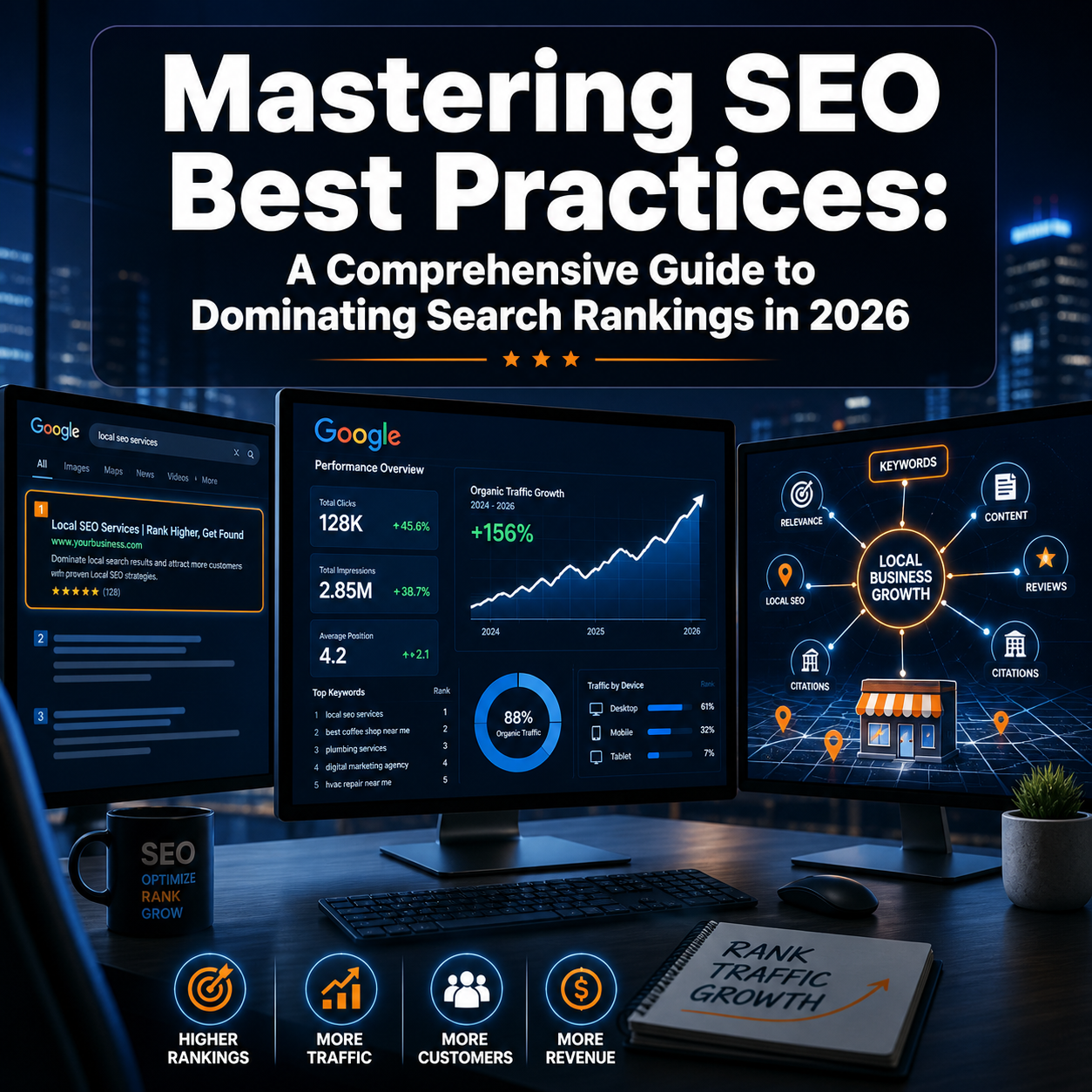
Quick Answer: Mastering SEO best practices in 2026 means combining strong on-page content, technical site health, local visibility signals, and AI-friendly content structure. For small businesses, the highest-impact actions are optimizing your Google Business Profile, targeting long-tail local keywords, building topic cluster content, and earning genuine E-E-A-T signals. Results typically begin showing within 3 to 6 months of consistent effort.
Key Takeaways
- Keyword intent beats keyword volume. Target what your customers actually mean, not just what they type.
- Topic clusters outperform isolated blog posts. Build pillar pages linked to supporting content for stronger authority signals.
- Mobile-first is non-negotiable. Google indexes the mobile version of your site first.
- E-E-A-T signals matter more than ever. Expertise, Experience, Authoritativeness, and Trustworthiness directly affect how Google ranks your content.
- Generative Engine Optimization (GEO) is now a real discipline. Structure content so AI systems can read, summarize, and recommend it.
- Local SEO is a separate but connected system. Your Google Business Profile, citations, and reviews work alongside your website.
- Long-tail keywords convert better. Specific phrases face less competition and attract buyers who are closer to a decision.
- Content freshness matters. Updating existing pages can recover lost rankings faster than publishing new ones.
- Technical SEO is the foundation. Page speed, HTTPS, and clean site structure affect everything above it.
What Does “Mastering SEO Best Practices” Actually Mean for a Small Business?
Mastering SEO best practices means consistently applying the right mix of on-page, technical, and local signals so your website earns visibility when nearby customers search for what you offer. For small businesses, this is less about competing with national brands and more about owning your local search space.
Most small business owners don’t need a 200-page SEO playbook. They need a clear priority list:
- Fix technical basics — fast load times, HTTPS, mobile layout
- Optimize for local intent — Google Business Profile, city-specific pages, consistent NAP (Name, Address, Phone)
- Create content that answers real questions — blog posts, FAQs, service pages
- Build authority signals — reviews, backlinks, author credibility
“The businesses that win local search aren’t the ones with the biggest budgets. They’re the ones who consistently do the fundamentals better than their competitors.”
Common mistake: Focusing on high-volume keywords before fixing technical issues. A fast, well-structured site with lower-volume local keywords will outperform a slow, broken site targeting competitive terms.
How Do You Research Keywords That Actually Drive Local Traffic?
Effective keyword research for small businesses focuses on four factors: search volume, keyword difficulty, search intent, and conversion potential — not volume alone [2].
Choose long-tail keywords if:
- You’re a newer website with low domain authority
- You serve a specific city or service area
- You want visitors who are close to making a buying decision
For example, “pool service Corona CA” converts far better than “pool service” because the searcher already knows what city they’re in and what they need. Tools like Google Keyword Planner, Semrush, and Ahrefs help identify these terms [2].
Practical steps for local keyword research:
- Start with your core service + your city (e.g., “plumber Riverside CA”)
- Add modifiers: “near me,” “affordable,” “emergency,” “licensed”
- Check what questions people ask in Google’s “People Also Ask” boxes
- Review competitor pages that rank in your area
For a deeper look at applying this locally, see our proven local SEO strategies for small businesses.
What On-Page SEO Elements Matter Most in 2026?
On-page SEO in 2026 centers on clear content structure, keyword placement, and signals that tell both users and search engines what your page is about [3].
Non-negotiable on-page elements:
| Element | Best Practice |
|---|---|
| Title Tag | Include primary keyword near the start; keep under 60 characters |
| Meta Description | Write for clicks, not just keywords; 150–160 characters |
| H1 Tag | One per page; match the primary search intent |
| H2/H3 Tags | Use to organize subtopics; include secondary keywords naturally |
| First 100 Words | State your primary keyword early and clearly [2] |
| URL Slug | Short, keyword-rich, no stop words |
| Image Alt Text | Describe the image; include keywords where natural |
Meta descriptions don’t directly affect rankings, but they do affect click-through rate, which indirectly signals relevance to Google [3]. Write them like a short ad for your page.
Edge case: If you have multiple service pages targeting the same keyword with slight variations (e.g., “plumber in Corona” vs. “Corona plumber”), you risk keyword cannibalization. Consolidate or clearly differentiate each page’s intent.
How Should Small Businesses Structure Their Website Content?
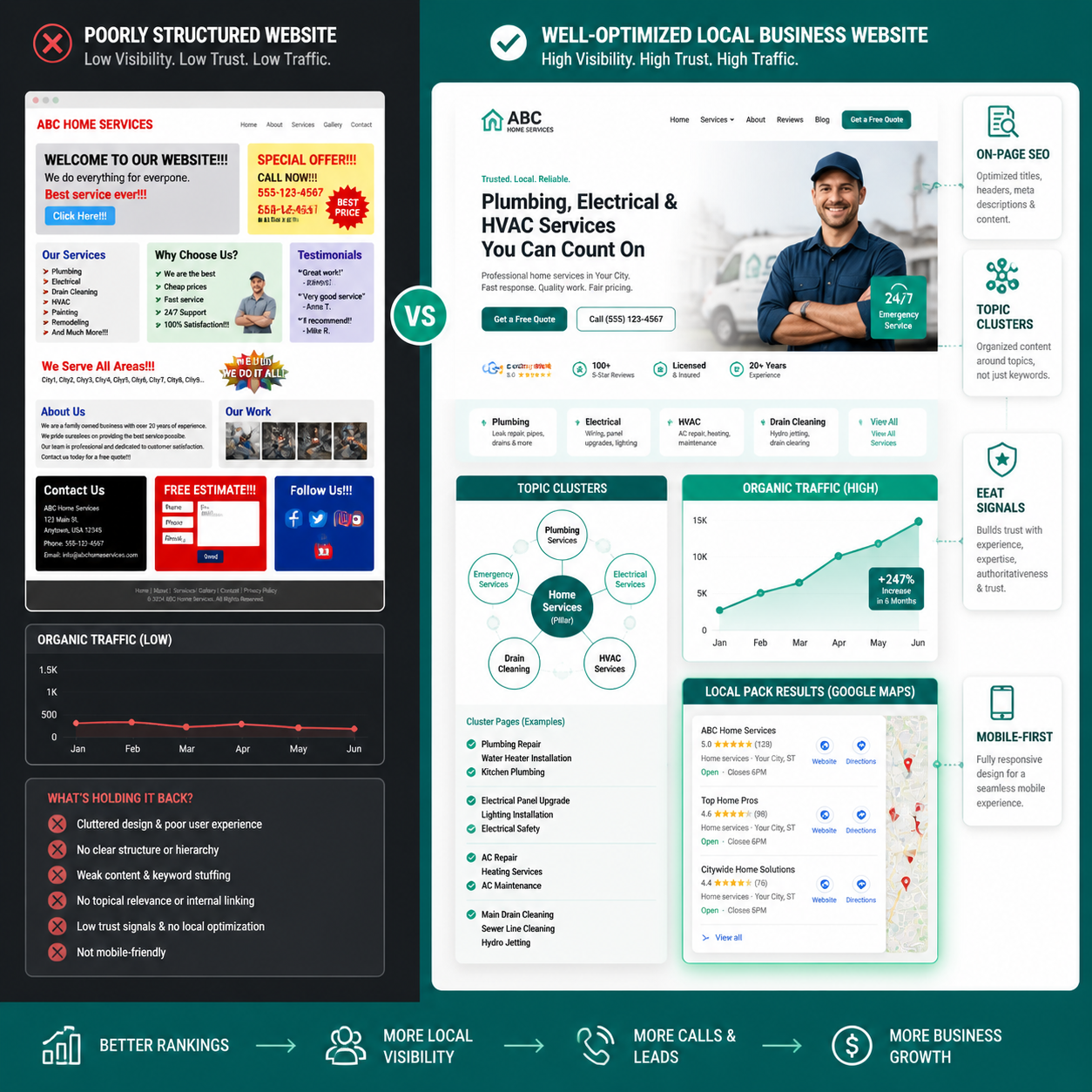
Use a topic cluster model: one strong pillar page covers a broad topic, and several supporting pages cover related subtopics, all linking back to the pillar [3].
Example for a local pool service company:
- Pillar page: Pool Service in Corona, CA (overview of all services)
- Cluster pages: Pool cleaning, pool repair, pool equipment, seasonal maintenance tips
- Blog posts: “How often should I clean my pool?” / “Signs your pool pump needs replacing”
This structure helps Google understand the relationships between your pages and establishes your site as a subject authority [3]. It also keeps visitors on your site longer, which is a positive engagement signal.
For service-specific examples, see how this applies to pool service SEO in Corona and Riverside.
What Is E-E-A-T and Why Does It Affect Your Rankings?
E-E-A-T stands for Experience, Expertise, Authoritativeness, and Trustworthiness. Google uses these signals to evaluate whether a website deserves to rank for a given topic, especially in competitive or high-stakes categories [3].
How to build E-E-A-T as a small business:
- Add an “About” page that explains your background, years in business, and credentials
- Include author bios on blog posts if you have staff writing content
- Collect and display genuine customer reviews
- Keep your site on HTTPS (not HTTP)
- Cite credible sources when making factual claims
- Keep your business information accurate and consistent across the web
Choose this approach if: You’re in a service industry where trust is a major buying factor — contractors, healthcare-adjacent services, financial services, legal services.
What Is Generative Engine Optimization (GEO) and Should Small Businesses Care?
GEO is the practice of structuring your content so AI-powered search tools (like Google’s AI Overviews, ChatGPT, and Perplexity) can read, summarize, and recommend it [5]. It’s now a distinct discipline alongside traditional SEO [7].
For small businesses, GEO matters because AI tools are increasingly answering local and service-based queries directly. If your content isn’t structured to be retrieved and summarized, you miss that visibility.
Practical GEO tactics for small businesses:
- Write clear, direct answers at the top of each page or section
- Use FAQ sections with specific, standalone answers
- Structure content with clean headings so AI can parse the hierarchy
- Avoid burying key facts in long paragraphs
- Make sure your business name, location, and services are stated clearly and often [4]
This guide itself is structured with GEO principles in mind: direct answers first, supporting detail second.
How Does Local SEO Fit Into the Bigger SEO Picture?
Local SEO is a parallel system that works alongside your website’s organic SEO. It focuses on signals that help your business appear in Google Maps, the local pack (the map results at the top of local searches), and “near me” queries.
Core local SEO components:
- Google Business Profile — categories, services, photos, posts, and review responses
- NAP consistency — your Name, Address, and Phone number must match exactly across all directories
- Local citations — listings on Yelp, BBB, industry directories
- Location-specific pages — dedicated pages for each city you serve
- Reviews — volume, recency, and owner responses all matter
Start with your Google Business Profile optimization before anything else. It’s the fastest way to improve local visibility with the least technical effort.
For a full audit of where your local SEO stands, use our local SEO audit checklist.
What Technical SEO Issues Hurt Small Business Rankings Most?
Technical SEO is the foundation. Without it, even great content struggles to rank [1].
Most common technical issues for small business websites:
- Slow page speed — especially on mobile; aim for under 3 seconds load time
- Not mobile-responsive — Google uses mobile-first indexing for all sites [1]
- Missing or broken HTTPS — any site still on HTTP loses trust signals immediately
- Duplicate content — multiple pages targeting the same keyword with near-identical content
- Missing XML sitemap — helps Google discover and index your pages efficiently
- Broken internal links — waste crawl budget and frustrate users
Quick fix checklist:
- Run a free speed test at PageSpeed Insights
- Check mobile layout on three different phone sizes
- Confirm HTTPS is active on every page
- Submit your sitemap to Google Search Console
Conclusion: Your Next Steps for Dominating Local Search in 2026
Mastering SEO best practices isn’t a one-time project. It’s a system you build and maintain. For small businesses, the path forward is clear:
- Start with a local SEO audit — know what’s broken before you try to fix it
- Optimize your Google Business Profile — it’s your fastest win
- Build or improve your service pages — one focused page per service, one per city you serve
- Create a content plan using topic clusters and long-tail keywords
- Earn reviews consistently — ask every satisfied customer
- Monitor and update — revisit your top pages every 3 to 6 months
If you’re a small business in Corona, Riverside, or the Inland Empire and you’re ready to stop guessing about SEO, our team at Local Website SEO Services is here to help. We work with real local businesses — pool companies, contractors, home service providers — and we focus on the actions that actually move the needle.
Ready to get started? Contact us today or call/text 951-545-4118 for a local SEO review.
Frequently Asked Questions
Q: How long does SEO take to show results?
Most small businesses begin seeing measurable improvements within 3 to 6 months of consistent SEO work. Highly competitive markets or technically broken sites may take longer.
Q: Is local SEO different from regular SEO?
Yes. Local SEO focuses on geographic signals — Google Business Profile, local citations, city-specific pages, and reviews — while traditional SEO focuses on content authority and backlinks. Both work together.
Q: Do I need a blog for SEO?
Not necessarily, but a blog helps you target long-tail keywords and build topic authority. For local service businesses, strong service pages and city pages often matter more than blog frequency.
Q: What’s the most important ranking factor in 2026?
There’s no single factor. Google uses hundreds of signals. For small businesses, the highest-impact combination is: a well-optimized Google Business Profile, mobile-friendly website, consistent NAP citations, and genuine customer reviews.
Q: Can I do SEO myself or do I need an agency?
Basic on-page SEO and Google Business Profile optimization are manageable for motivated business owners. Technical SEO, content strategy, and competitive markets often benefit from professional help.
Q: What is a topic cluster?
A topic cluster is a group of related web pages — one broad pillar page and several supporting pages — that link to each other. This structure signals topical authority to search engines.
Q: How many keywords should I target per page?
Focus each page on one primary keyword and two to four closely related secondary keywords. Trying to rank one page for too many unrelated terms dilutes its relevance.
Q: Does social media affect SEO rankings?
Social media doesn’t directly affect Google rankings, but it drives traffic, builds brand awareness, and can generate backlinks — all of which indirectly support SEO.
References
[1] Seo Best Practices Complete Guide 2026 – https://almcorp.com/blog/seo-best-practices-complete-guide-2026/
[2] Seo Strategy 2026 Guide 32c9824f – https://www.crobenchmark.com/blog/seo-strategy-2026-guide-32c9824f
[3] Mastering Seo Digital Marketing A Comprehensive Guide For 2026 – https://dminorstudio.com/en/blog/mastering-seo-digital-marketing-a-comprehensive-guide-for-2026
[4] Seo Best Practices – https://www.advancedwebranking.com/seo/seo-best-practices
[5] Seo Best Practices For A Small Business 2026 Guide – https://firstepbusiness.com/blog/seo-best-practices-for-a-small-business-2026-guide
[7] Mastering Generative Engine Optimization In 2026 Full Guide 469142 – https://searchengineland.com/mastering-generative-engine-optimization-in-2026-full-guide-469142
Tags: SEO best practices, local SEO, small business SEO, Google Business Profile, keyword research, topic clusters, E-E-A-T, generative engine optimization, on-page SEO, technical SEO, local search rankings, content strategy