Last updated: May 2, 2026
Quick Answer: Local SEO services help small businesses rank higher in Google’s map pack and local search results by optimizing your Google Business Profile, website content, citations, and reviews. For service-area businesses in cities like Corona and Riverside, a well-executed local SEO strategy is the most direct path to more phone calls and qualified leads in 2026.
Key Takeaways
- Google ranks local businesses based on three factors: distance, relevance, and prominence [1]
- Your Google Business Profile is the single most important tool for local map pack visibility
- Consistent NAP (name, address, phone) data across the web builds trust with Google [2]
- Hyperlocal keywords (city + service) outperform broad terms for purchase-intent traffic [2]
- Dedicated service-area pages for each city you serve significantly improve geographic relevance [1]
- Customer reviews influence both rankings and conversion rates
- Schema markup helps Google understand your business type and location [2]
- Mobile speed and clean site structure directly affect local rankings [2]
- E-E-A-T signals (expertise, authority, trust) are now core ranking factors [1]
- AI-powered search features like Google Overviews require content that answers questions directly [4]
What Are Local SEO Services and Why Do Small Businesses Need Them?
Local SEO services are specialized strategies that help businesses appear in Google’s local search results and map pack when nearby customers search for services. For small businesses, this is not optional — it’s the difference between a phone that rings and one that doesn’t.
Most customers don’t scroll past the first three map results. They search “pool service Corona CA,” scan the top listings, check the star ratings, and call the business that looks most credible. If your business isn’t in those top results, you’re invisible to that customer — regardless of how good your work actually is.
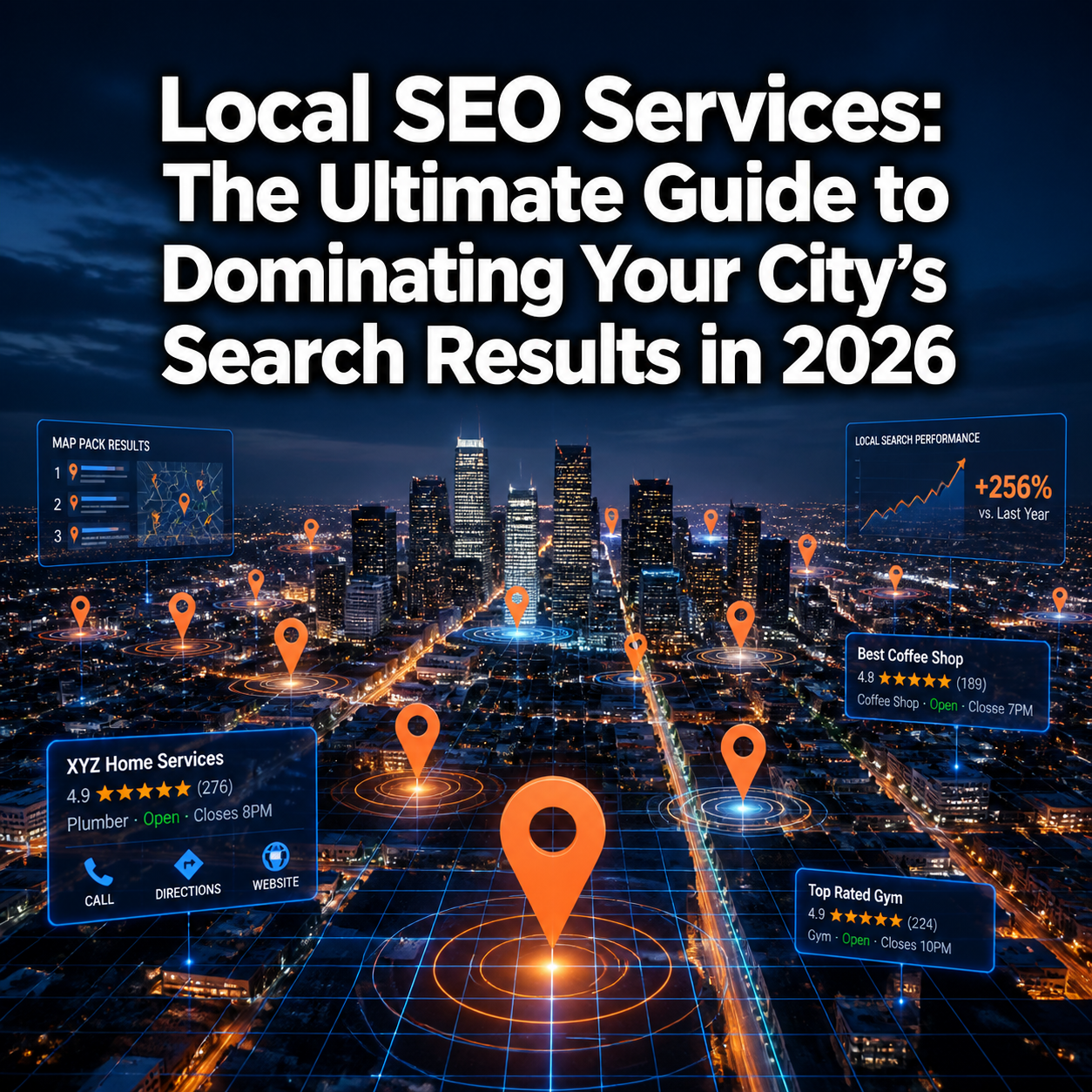
This guide to Local SEO Services: The Ultimate Guide to Dominating Your City’s Search Results in 2026 covers every core component, from your Google Business Profile to technical site structure, so you can build a strategy that actually moves the needle.
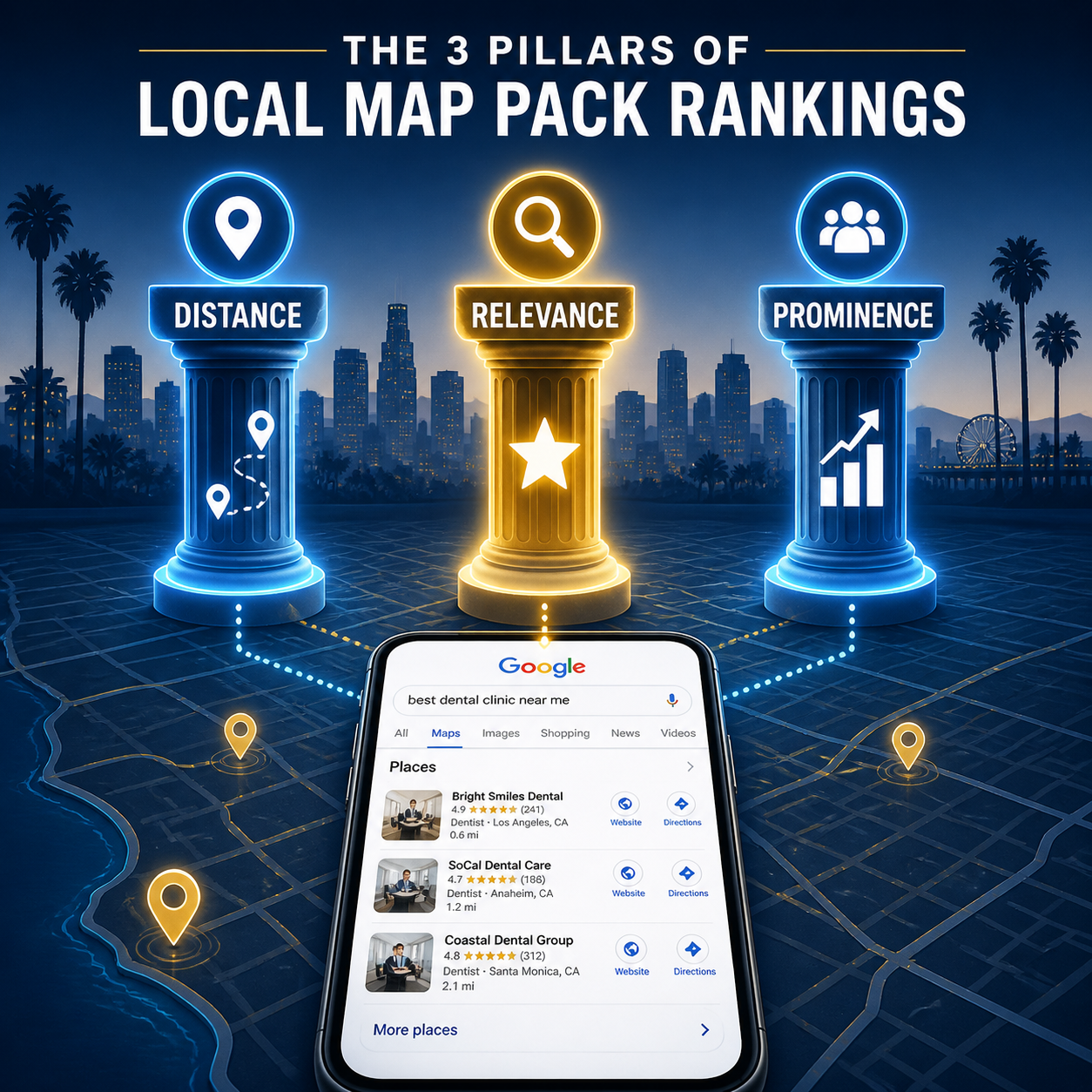
How Does Google Decide Which Local Businesses Rank First?
Google uses three primary factors to rank businesses in local search results [1]:
| Ranking Factor | What It Means | How to Improve It |
|---|---|---|
| Distance | How close your business is to the searcher | Set accurate service areas in your GBP |
| Relevance | How well your listing matches the search query | Use specific category and service keywords |
| Prominence | How well-known and trusted your business is | Build reviews, backlinks, and citations |
Common mistake: Many business owners focus only on their website and ignore their Google Business Profile. Google’s local algorithm weighs GBP signals heavily — a neglected profile with no photos, no posts, and unanswered reviews will consistently lose to a well-maintained competitor profile, even if your website is better.
What Does Google Business Profile Optimization Actually Involve?
A fully optimized Google Business Profile is the foundation of any local SEO strategy. It directly influences whether your business appears in the map pack for relevant searches [2].
Key optimization steps:
- Choose the right primary category — this is the single most impactful GBP field
- Add all relevant secondary categories that match your services
- Write a keyword-rich business description (without keyword stuffing)
- Upload fresh, high-quality photos of your work, team, and location regularly
- Post weekly updates using Google Posts to signal active management
- Answer all Q&A entries — both customer-submitted and ones you add yourself
- Respond to every review, positive and negative, within 48 hours
For a detailed walkthrough, see our Google Business Profile optimization guide.
Choose this if: You’re a service-area business that serves customers at their location (plumbers, pool services, landscapers). You can hide your physical address in GBP while still appearing in local results for your service cities.
Which On-Page SEO Elements Matter Most for Local Rankings?
On-page SEO for local businesses centers on making it crystal clear to Google what you do and where you do it. Google pays particular attention to H1 and H2 headings as ranking signals, so these should include your primary service and city naturally [1].
Core on-page elements to address:
- Page title tags — include your primary service + city (e.g., “Pool Service in Corona, CA”)
- H1 heading — one per page, matching the page’s primary topic
- H2 subheadings — break content into logical sections with relevant keyword variations
- Body content — at minimum 400-600 words per service page with specific, useful detail
- Internal links — connect service pages to city pages and related content
- Schema markup — add LocalBusiness structured data to every key page [2]
- Mobile layout — fast load times and clean navigation on phones are non-negotiable [2]
Use our local SEO audit checklist to work through each of these systematically.
Do You Need Separate Pages for Each City You Serve?
Yes — and this is one of the most overlooked opportunities for service-area businesses. Generic “we serve the Inland Empire” language on a single page doesn’t give Google enough geographic signal to rank you in specific city searches [1].
What effective city pages include:
- The city name in the page title, H1, and at least one H2
- A description of the specific services you offer in that city
- Local references (neighborhoods, landmarks, or community details) that prove genuine local knowledge
- A unique call-to-action with your phone number
- Embedded Google Map showing your service area
Edge case: If you serve 20+ cities, don’t create thin, templated pages that swap only the city name. Google treats these as low-quality duplicate content. Instead, prioritize your top 5-8 revenue cities and build genuinely useful pages for each.
For a real-world example of city-specific local SEO done right, see our local SEO for plumbers in Riverside, CA and local SEO for plumbers in Corona, CA pages.
How Do Reviews and Citations Affect Local Search Rankings?
Reviews and citations are the two most direct ways to build “prominence” — the third pillar of Google’s local ranking algorithm.
Reviews: Google looks at review quantity, recency, rating, and how often you respond. A business with 80 reviews averaging 4.6 stars will typically outrank a competitor with 12 reviews at 4.9 stars, because volume signals consistent customer experience [2].
Simple review request process:
- After completing a job, text the customer a direct link to your Google review page
- Keep the message short: “Thanks for choosing us — a quick Google review would mean a lot”
- Follow up once if no response within 3 days
Citations are mentions of your business name, address, and phone number (NAP) on directories like Yelp, Angi, BBB, and industry-specific sites. Inconsistent NAP data — different phone numbers or address formats across listings — confuses Google and weakens your local authority [2].
What Role Does Content Play in Local SEO for Small Businesses?
Content answers the questions your customers are already searching. For local service businesses, this means blog posts, FAQ pages, and service descriptions that address real local concerns — not generic filler.
Content that works for local SEO:
- “How much does pool service cost in Corona, CA?” (price transparency builds trust)
- “What to do when your AC breaks in a Riverside summer” (seasonal, local relevance)
- “5 signs your plumbing needs attention before winter in the Inland Empire.”
This type of content serves two purposes: it ranks for long-tail local searches, and it builds E-E-A-T signals by demonstrating genuine expertise and local knowledge [1].
For more proven approaches, see our local SEO strategies for small businesses.
How Long Does Local SEO Take to Show Results?
Local SEO is not instant, but it’s also not a 12-month waiting game for small businesses in most mid-size markets. Realistic timelines:
- 1-4 weeks: GBP improvements, citation fixes, and on-page changes take effect
- 2-3 months: Noticeable movement in local map pack for lower-competition keywords
- 4-6 months: Consistent ranking improvements for primary service + city terms
- 6-12 months: Established authority, ranking for multiple cities and service combinations
Choose this approach if: You’re a service-area business in a city with moderate competition (like Corona or Riverside). You don’t need to outrank national chains — you need to outrank the 5-10 local competitors showing up above you.
Conclusion: Your Next Steps to Dominate Local Search in 2026
Local SEO Services: The Ultimate Guide to Dominating Your City’s Search Results in 2026 comes down to one core principle: make it easy for Google — and your customers — to understand who you are, what you do, and where you do it.
Here’s where to start this week:
- Audit your Google Business Profile — fix categories, add photos, respond to all reviews
- Check NAP consistency — search your business name and verify your info matches across all directories
- Identify your top 3 service + city keyword combinations and make sure each has a dedicated page
- Add LocalBusiness schema markup to your homepage and service pages
- Start a simple review request process for every completed job
If you’re not sure where your biggest gaps are, a professional review can save months of guesswork. Contact our team or call/text 951-545-4118 to request a local SEO review for your business.
For more resources, visit the Local Website SEO Services blog or explore our pool service SEO strategies for Corona and Riverside as a real-world case study in local market domination.
Frequently Asked Questions
Q: What’s the difference between local SEO and regular SEO?
Regular SEO targets broad national or global audiences. Local SEO targets customers in a specific geographic area — city, neighborhood, or service radius — and focuses on Google’s map pack alongside organic results.
Q: Do I need a physical address to rank in local search?
No. Service-area businesses that work at customer locations (plumbers, cleaners, landscapers) can rank in local results without displaying a physical address by setting service areas in their Google Business Profile.
Q: How much do local SEO services typically cost?
Costs vary widely. Freelancers may charge $300-$800/month; small agencies typically range from $500-$2,000/month depending on market competition and scope. Avoid any service promising guaranteed #1 rankings for a flat one-time fee.
Q: Can I do local SEO myself?
Yes, for the basics — GBP optimization, review requests, and on-page edits are all DIY-friendly. Technical elements like schema markup, site speed optimization, and link building typically benefit from professional help.
Q: How does AI search affect local SEO in 2026?
Google’s AI Overviews now appear above traditional results for many queries. Content that directly answers specific questions in clear, structured language is more likely to be cited in these overviews [4].
Q: What’s the fastest win in local SEO?
Optimizing your Google Business Profile — especially adding the correct primary category, fresh photos, and responding to all reviews — typically produces the fastest visible improvement in map pack rankings.
Q: How many citations do I need?
Quality matters more than quantity. Consistent, accurate listings on 20-30 authoritative directories (Google, Yelp, Bing Places, BBB, industry-specific sites) outperform 200 low-quality or inconsistent citations.
Q: Does social media affect local SEO rankings?
Social media is not a direct ranking factor, but it supports brand signals and can drive traffic that indirectly benefits your SEO. Focus on local SEO fundamentals before investing heavily in social.
References
[1] Local SEO 2026: The Complete Guide to Dominating Local Search – https://boulderseomarketing.com/local-seo-2026-the-complete-guide-to-dominating-local-search/
[2] Local SEO Guide 2026 – https://www.q-tech.org/blog/local-seo-guide-2026/
[4] Boulder SEO Marketing YouTube – https://www.youtube.com/watch?v=n-_lURRus4w
Tags: local SEO services, Google Business Profile optimization, local map pack, small business SEO, city SEO pages, NAP consistency, local keyword research, Inland Empire SEO, Corona SEO, Riverside SEO, local search rankings, service area SEO