Last updated: May 14, 2026
Quick Answer
SEO services help local businesses rank higher in search results, attract nearby customers, and grow revenue without relying solely on paid ads. For small and mid-sized businesses, the highest-return activities are Google Business Profile optimization, consistent local citations, and targeted on-page content. Results typically appear within 3 to 6 months for local searches, depending on competition and starting baseline.
Key Takeaways
- Local SEO focuses on ranking in map packs and “near me” searches — it’s different from general SEO and requires its own strategy.
- Google Business Profile (GBP) is the single most important free tool for local visibility; an incomplete profile directly costs you rankings.
- On-page SEO (title tags, headers, page speed) and off-page SEO (citations, backlinks, reviews) work together — neither alone is enough.
- Keyword research for local businesses should target service + location combinations, not just broad industry terms.
- Most local SEO campaigns cost between $500 and $2,500 per month, depending on market competitiveness and scope.
- Reviews are a ranking signal AND a conversion driver; a system for collecting them consistently matters more than occasional bursts.
- A proper local SEO audit is the right starting point before any campaign — it reveals what’s broken and what’s already working.
- Tracking rankings, traffic, and leads separately helps you understand which SEO activities are actually driving business results.
What Exactly Are SEO Services, and Who Are They For?
SEO services are professional activities designed to improve a website’s visibility in organic (unpaid) search results. For local businesses, this means showing up when someone nearby searches for your service — whether that’s on Google Maps, in the local pack, or on the first page of results.
Who benefits most from local SEO services:
- Service-area businesses (plumbers, pool companies, HVAC, landscapers)
- Brick-and-mortar retailers and restaurants
- Professional service providers (dentists, attorneys, accountants)
- Any business that depends on customers within a specific geographic radius
Who may not see strong ROI from local SEO right away:
- Brand-new businesses with no web presence (need foundational setup first)
- Businesses in extremely low-search-volume niches
- E-commerce businesses targeting national audiences (different strategy applies)
“Local SEO isn’t a marketing luxury for small businesses — it’s the baseline for being found at all.”
Why Local SEO Is Different from General SEO
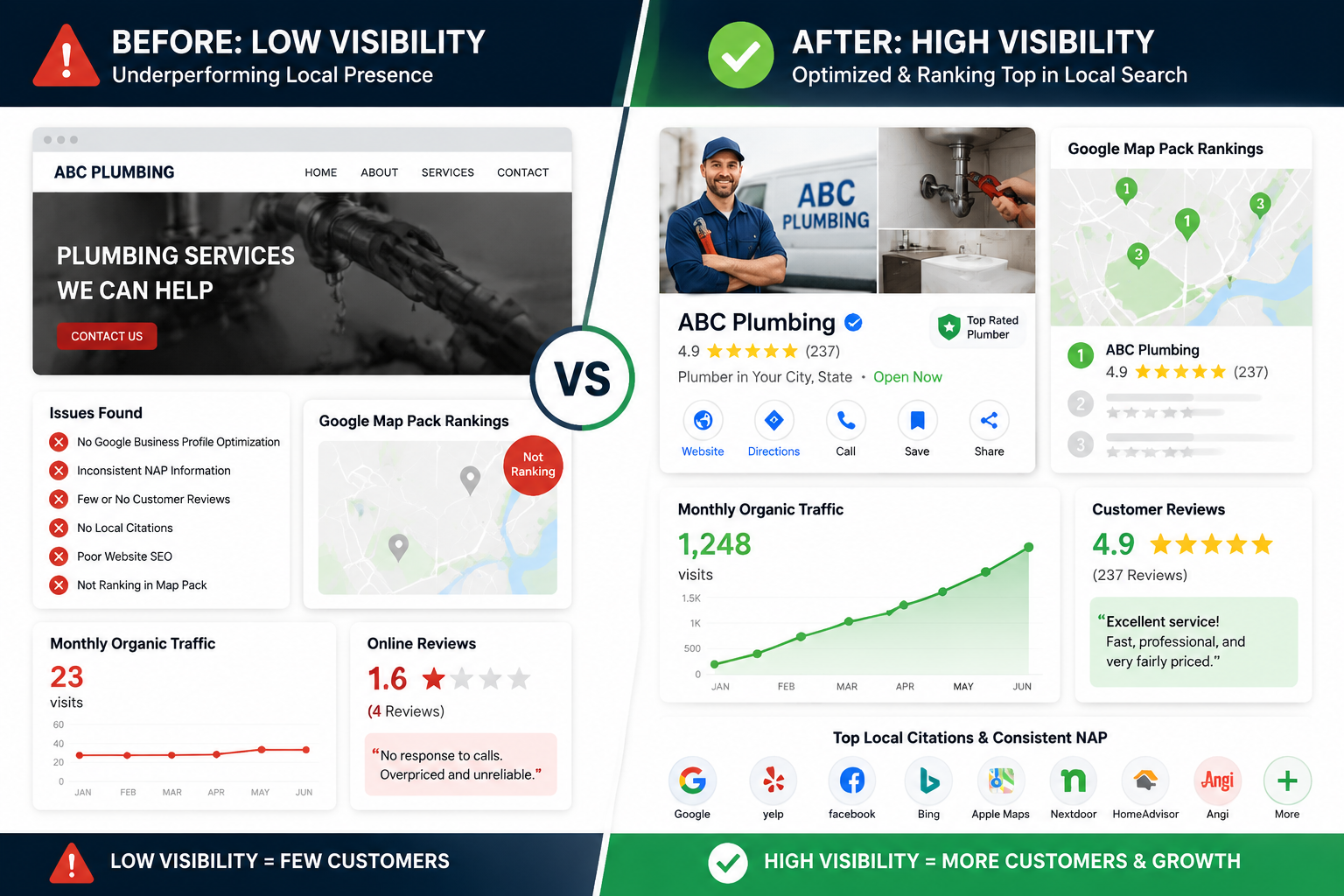
Local SEO targets geographic relevance, not just topical relevance. General SEO tries to rank for broad terms nationally or globally. Local SEO tries to rank for terms like “plumber in Corona CA” or “pool service near Riverside.”
The core difference shows up in three places:
| Factor | General SEO | Local SEO |
|---|---|---|
| Primary ranking signals | Backlinks, content authority | GBP signals, proximity, reviews |
| Key content type | Blog posts, pillar pages | Service pages, location pages |
| Most important tool | Google Search Console | Google Business Profile |
| Timeline to results | 6–18 months | 3–6 months (local pack) |
| Citation building needed | Low priority | High priority |
For businesses in competitive markets like Riverside or Corona, CA, our proven local SEO strategies for small businesses break down exactly how to compete against established players.
How Does Google Decide Who Ranks Locally?
Google uses three main factors for local rankings: relevance, distance, and prominence. Understanding these helps you prioritize where to spend time and budget.
- Relevance: Does your GBP and website clearly describe what you do and where you do it?
- Distance: How close is your business to the searcher’s location? You can’t change this, but you can expand your service-area settings.
- Prominence: How well-known and trusted is your business online? This includes reviews, backlinks, citations, and overall web presence.
Common mistake: Many businesses focus only on their website and ignore their GBP. Since Google pulls local pack results primarily from GBP data, an incomplete or unverified profile is a direct ranking penalty. Our Google Business Profile optimization guide covers every field that matters.
What Does a Solid Local SEO Campaign Actually Include?
A well-structured local SEO campaign covers five core areas. Each one affects rankings, and skipping any of them creates a gap that competitors can exploit.
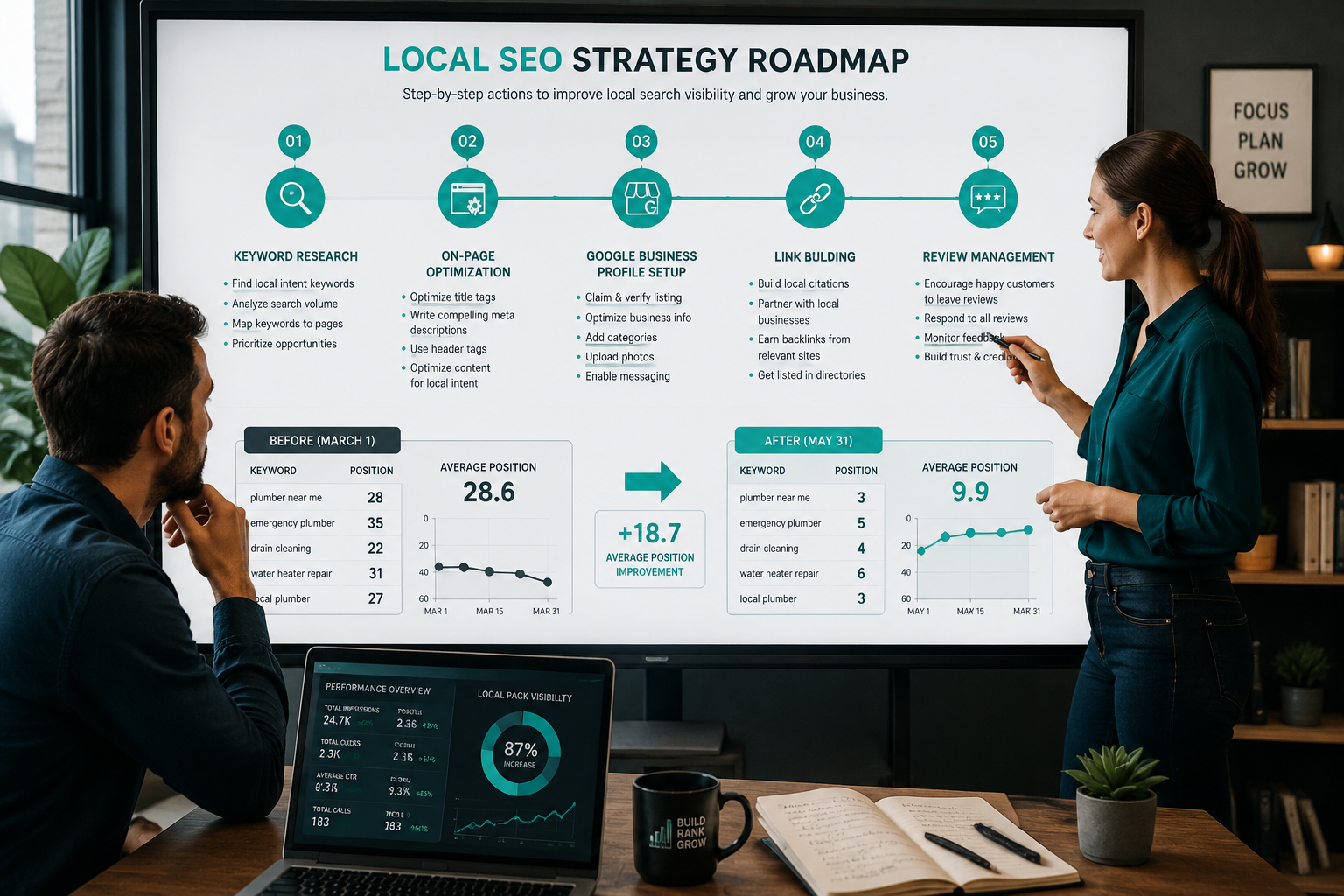
1. Technical SEO foundation
- Fast page load speed (under 3 seconds on mobile)
- Mobile-friendly design
- Clean URL structure and proper indexing
- XML sitemap submitted to Google Search Console
2. On-page optimization
- Title tags and meta descriptions with location + service keywords
- Header tags (H1, H2) that reflect what the page is about
- Service pages for each core offering, not one generic “Services” page
3. Google Business Profile
- Fully completed profile with accurate NAP (name, address, phone)
- Regular posts, photos, and Q&A responses
- Service categories set correctly
4. Citation building and consistency
- Business listed accurately on Yelp, Bing Places, Apple Maps, and industry directories
- NAP information identical across all platforms
5. Review generation
- A repeatable process for asking satisfied customers to leave reviews
- Timely responses to all reviews, positive and negative
For trade businesses like plumbers, this plays out in very specific ways. See our guides on local SEO for plumbers in Riverside and local SEO for plumbers in Corona for industry-specific examples.
How Much Do Local SEO Services Cost?
Local SEO pricing varies based on market competition, the number of locations, and the scope of work. Here’s a realistic breakdown for small businesses in 2026:
| Service Level | Monthly Cost (est.) | Best For |
|---|---|---|
| DIY with tools | $50–$150/mo (tools only) | Very small budgets, simple markets |
| Freelancer | $300–$800/mo | Single location, low competition |
| Small agency | $800–$2,000/mo | Competitive local markets |
| Full-service agency | $2,000–$5,000+/mo | Multi-location, aggressive growth |
Choose an agency if: You’re in a competitive market (multiple established competitors ranking above you), you have multiple service areas, or you want measurable growth within 6 months without managing it yourself.
Choose DIY if: You’re in a low-competition niche, you have time to learn the basics, and your budget is under $500/month.
What Are the Biggest Local SEO Mistakes to Avoid?
Most local SEO failures come down to a short list of avoidable errors.
- Inconsistent NAP data: If your phone number or address differs across directories, Google loses trust in your listing.
- Keyword stuffing: Forcing location keywords into every sentence hurts readability and can trigger Google penalties.
- Ignoring reviews: Businesses that don’t respond to reviews — especially negative ones — signal poor customer service to both Google and potential customers.
- One generic service page: Google can’t rank a single “Services” page for 10 different services. Each service needs its own page.
- No tracking setup: If you’re not tracking calls, form submissions, and rankings separately, you can’t tell what’s working. Start with Google Analytics 4 and Google Search Console at a minimum.
A structured local SEO audit checklist helps you catch these issues before they compound over months.
How Long Does Local SEO Take to Show Results?
Local SEO results follow a predictable pattern, though timelines shift based on competition and starting point.
- Weeks 1–4: Technical fixes, GBP optimization, citation cleanup. No visible ranking changes yet.
- Months 2–3: Early movement in lower-competition keywords. GBP may start appearing in map pack for specific searches.
- Months 4–6: Consistent ranking improvements for core service + location terms. Organic traffic begins growing.
- Months 6–12: Compounding results as content authority and backlinks build. Leads from organic search become measurable.
Edge case: Businesses in small towns with little competition sometimes see map pack results within 4–6 weeks. Businesses in major metros competing against established companies may need 9–12 months for meaningful movement.
FAQ
Q: What’s the difference between local SEO and regular SEO?
Local SEO targets geographically specific searches and uses tools like Google Business Profile and local citations. Regular SEO focuses on ranking for broader, non-location-based terms nationally or globally.
Q: Do I need a website to do local SEO?
A website helps significantly, but you can start with a Google Business Profile alone. A website gives you more control over content, service pages, and long-term ranking potential.
Q: How important are online reviews for local rankings?
Reviews are a confirmed ranking signal for Google’s local pack. Quantity, recency, and your response rate all factor in. Aim for a steady stream of new reviews rather than a one-time burst.
Q: Can I do local SEO myself?
Yes, especially in low-competition markets. Start with a complete GBP, consistent citations, and one optimized service page per service. Use free tools like Google Search Console to track progress.
Q: How do I know if my SEO is working?
Track three things: keyword rankings (use a rank tracker), organic traffic (Google Analytics 4), and conversions (calls, form fills, direction requests). Rankings without leads mean something in your conversion path needs fixing.
Q: What’s a citation, and why does it matter?
A citation is any online mention of your business name, address, and phone number. Consistent citations across directories like Yelp, Bing, and Apple Maps signal legitimacy to Google and support local rankings.
Q: Is Google Business Profile really free?
Yes. GBP is a free tool from Google. Some third-party tools that help manage it cost money, but the profile itself is free to create and maintain.
Q: How do I choose the right local SEO agency?
Look for agencies that show real case studies from your industry or market, set clear deliverables, and report on leads — not just rankings. Avoid any agency that guarantees a “#1 ranking” with no timeline or conditions attached.
Conclusion: Your Next Steps Toward Local Search Visibility
Unlocking digital success through effective SEO services starts with knowing exactly where you stand. Before spending a dollar on any campaign, run a proper audit of your GBP, website, and citations. Fix what’s broken first — then build.
Here’s a practical starting checklist:
- Claim and fully complete your Google Business Profile
- Run a local SEO audit to find technical and citation gaps
- Create individual service pages for each core offering
- Build a simple review request process (text or email after each job)
- Track rankings and leads monthly — adjust based on data, not guesses
If you’re ready to work with a team that specializes in local markets, our local SEO agency serving Corona and Riverside can build a plan specific to your business. Or get in touch directly to talk through your situation before committing to anything. Local seo strategies for corona can significantly improve your online visibility and attract more local customers. By tailoring our approach to the needs of businesses in Corona, we ensure that your SEO efforts are effective and impactful. Our team is dedicated to helping you navigate the unique challenges of the local market, boosting your presence and engagement with potential clients.
The businesses ranking at the top of local search results in 2026 didn’t get there by accident. They made consistent, informed decisions over time — and started with the basics done right.
References
- Google. (2023). How Google Search Works: Ranking Systems. https://developers.google.com/search/docs/fundamentals/how-search-works
- Google. (2024). Improve your local ranking on Google. https://support.google.com/business/answer/7091
Tags: local SEO services, Google Business Profile, local search ranking, SEO for small business, on-page SEO, citation building, local SEO strategy, map pack optimization, SEO audit, review management, plumber SEO, local digital marketing