Last updated: May 2, 2026
Quick Answer: Small businesses that commit to a focused digital marketing strategy — covering local SEO, a mobile-ready website, Google Business Profile, content, and email — consistently outperform competitors who rely on word-of-mouth alone. You don’t need a big budget or a marketing team. You need a clear plan and the right priorities.
Key Takeaways
- Digital marketing is no longer optional for small businesses competing locally in 2026 [1]
- A mobile-friendly website is critical: 61% of users are more likely to contact a business with a mobile-optimized site [2]
- Your Google Business Profile directly affects both Google Maps rankings and AI-powered search results [2]
- Local SEO, content, email, and paid ads work best as a coordinated system, not isolated tactics
- Email segmentation (prospects, active customers, past customers) significantly improves engagement [2]
- You don’t need to be on every platform — pick two or three and do them well
- Tracking results is not optional; if you can’t measure it, you can’t improve it
- Small businesses in service areas benefit most from hyper-local keyword targeting and city-specific landing pages
Why Digital Marketing Is Now Non-Negotiable for Small Businesses
Digital marketing is essential for small businesses in 2026, not a nice-to-have add-on [1]. Customers search online before they call, visit, or buy — and if your business doesn’t appear in those results, a competitor will.
The good news: effective digital marketing doesn’t require a large budget or complex systems [5]. What it requires is consistency, the right channels, and a plan that matches how your customers actually search.
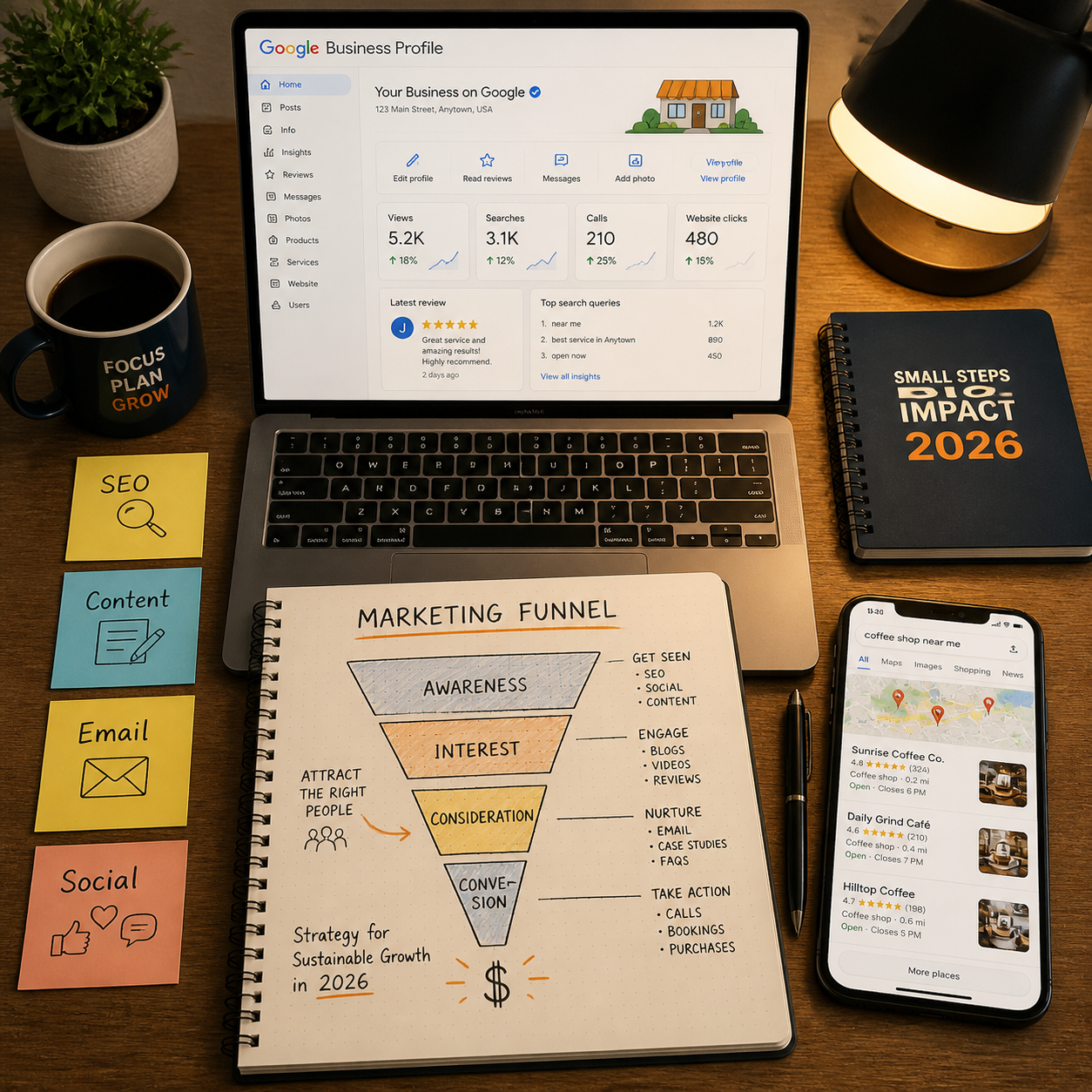
For small businesses in service areas like Corona, Riverside, and the broader Inland Empire, the opportunity is especially clear. Most local searches have strong buying intent — someone searching “pool repair near me” is ready to call. The businesses that show up and look trustworthy get the call.
What Does a Smart Digital Marketing Plan Actually Include?
A well-built marketing plan acts as a compass, aligning your efforts with your business goals and your customers’ needs [3]. For small businesses, that plan should cover six core areas:
| Channel | Primary Goal | Difficulty | Cost |
|---|---|---|---|
| Local SEO | Organic visibility in local searches | Medium | Low–Medium |
| Google Business Profile | Map Pack & AI search presence | Low | Free |
| Website (mobile-optimized) | Convert visitors to leads | Medium | Low–Medium |
| Content marketing | Build trust, support SEO | Medium | Low |
| Email marketing | Nurture and retain customers | Low | Low |
| Paid ads (Google/Meta) | Fast visibility, retargeting | Medium | Medium–High |
Start with the free and low-cost channels. Build your website and Google Business Profile first, then layer in content and email before spending on ads.
How Does Local SEO Fit Into Mastering Online Marketing: A Small Business Guide to Digital Success in 2026?
Local SEO is the single highest-ROI channel for most small service businesses. It targets customers who are already searching for exactly what you offer, in your city or neighborhood.
Key local SEO priorities for 2026:
- Google Business Profile: Keep it fully filled out with accurate categories, services, photos, and weekly posts. This profile now feeds AI-powered search results, not just Google Maps [2]. See our Google Business Profile optimization guide for step-by-step instructions.
- City-specific landing pages: If you serve multiple cities, each city should have its own page with relevant content, not a generic “we serve the area” mention.
- NAP consistency: Your business name, address, and phone number must match exactly across your website, Google profile, Yelp, and every other directory.
- Review strategy: Ask satisfied customers to leave Google reviews. Reviews influence both rankings and the decision to call.
For a structured starting point, use our local SEO audit checklist to identify gaps before you start fixing things randomly.
Common mistake: Many small business owners optimize their homepage for their business name instead of their service plus city. Rank for what customers search, not what you call yourself.
Is Your Website Actually Working for Your Business?
Your website should do three things: load fast, work on mobile, and make it easy to contact you. If it fails at any of these, you’re losing leads before they ever reach you.
- Mobile-first design is not optional. With 61% of online users more likely to contact a mobile-friendly business [2], a clunky mobile experience directly costs you customers.
- Clear calls to action on every page: phone number in the header, contact form above the fold, and a service summary that answers “what do you do and where?”
- Service pages, not just a services list: Each major service should have its own dedicated page with enough detail for Google to understand what you offer.
If you’re not sure where your site stands, a local SEO agency review can identify the highest-priority fixes quickly.
How Should Small Businesses Approach Content Marketing in 2026?
Content marketing is a foundational pillar of every effective digital strategy, but it works best when it’s platform-specific and genuinely useful [2][6]. For small businesses, that doesn’t mean blogging every day.
A practical content approach:
- Answer customer questions in blog posts (e.g., “How often should I service my pool in Riverside?”)
- Create service-specific pages that explain what you do, who it’s for, and what to expect
- Post consistently on 1–2 social platforms where your customers actually spend time
- Repurpose content: Turn one blog post into three social captions and an email
Content builds trust over time and supports your SEO by giving Google more signals about your expertise and service area. Check the Local Website SEO Services blog for examples of content that works for service businesses.
What Role Does Email Marketing Play in a Small Business Strategy?
Email marketing remains one of the most cost-effective channels available to small businesses. The key is segmentation: don’t send the same message to everyone [2].
Segment your list into at least three groups:
- Prospects (haven’t bought yet): Send educational content and offers
- Active customers (current clients): Send updates, upsells, and loyalty rewards
- Past customers (haven’t returned): Send re-engagement campaigns and seasonal reminders
A simple monthly email to each segment, written in plain language, outperforms a fancy newsletter sent to everyone with no targeting.
When Should Small Businesses Use Paid Advertising?
Paid ads (Google Ads, Meta Ads) work best as a complement to organic efforts, not a replacement [2]. Use them when:
- You need leads immediately while SEO is still building
- You want to retarget website visitors who didn’t convert
- You’re promoting a seasonal service or limited offer
Choose Google Ads if your customers are actively searching for your service. Choose Meta Ads if you want to build awareness or target a specific demographic in your area.
Don’t start paid ads without a clear budget, a specific goal, and a landing page built to convert. Sending ad traffic to your homepage is one of the most common and costly mistakes small businesses make.
How Do You Track Whether Your Digital Marketing Is Working?
Tracking is how you separate what’s working from what’s wasting money. For small businesses, you don’t need complex analytics — you need a few clear metrics.
Track these monthly:
- Google Business Profile views and calls
- Website traffic by source (organic, direct, referral, paid)
- Keyword rankings for your top 5–10 local terms
- Lead volume (calls, form fills, emails)
- Conversion rate (leads divided by visitors)
Use Google Analytics 4 and Google Search Console — both are free. If you’re running paid ads, check cost-per-lead weekly.
For businesses in specific trades, see how local SEO for plumbers in Corona and local SEO for plumbers in Riverside apply these tracking principles to a real service business context.
Mastering Online Marketing: A Small Business Guide to Digital Success in 2026 — Common Mistakes to Avoid
Even with the right strategy, small businesses often stumble on execution. Here are the most frequent mistakes and how to avoid them:
- Trying to be everywhere at once: Pick two or three channels and do them consistently. Spreading thin across six platforms produces weak results on all of them.
- Ignoring Google Business Profile: This is the fastest, cheapest win available. A neglected profile means missed Map Pack rankings.
- No local keyword targeting: Generic keywords like “pool service” are too competitive. Target “pool service in Corona CA” or “pool repair Riverside” instead. See our proven local SEO strategies for specifics.
- Skipping the follow-up: Most small businesses collect leads but don’t have a system to follow up. A simple email or text sequence can double your close rate.
- Building a website without SEO structure: A beautiful website that Google can’t read is just an expensive brochure.
Conclusion: Your Next Steps Toward Digital Success in 2026
Mastering online marketing as a small business in 2026 comes down to doing the fundamentals well and staying consistent. You don’t need to do everything at once.
Start here:
- Claim and fully optimize your Google Business Profile
- Audit your website for mobile usability and clear calls to action
- Identify 5–10 local keywords your customers actually search
- Create or improve one service page per week
- Set up a simple email list and segment it into three groups
- Track your results monthly and adjust based on what’s working
If you’re serving customers in Corona, Riverside, or anywhere in the Inland Empire, request a local SEO review to get a clear picture of where your biggest opportunities are. Call or text 951-545-4118 to get started.
Digital marketing rewards consistency over complexity. Start small, measure everything, and build from what works.
FAQ
Q: How much should a small business spend on digital marketing?
A: Most small businesses can start effectively with $300–$800 per month, prioritizing free tools (Google Business Profile, Google Analytics) before paid ads. Budget scales with your goals and market competition.
Q: How long before local SEO produces results?
A: Most businesses see measurable improvements in 3–6 months when the website, Google profile, and local content are properly set up. Competitive markets may take longer.
Q: Do I need to be on social media to succeed with digital marketing?
A: Not necessarily. Social media helps, but local SEO and a strong Google Business Profile often drive more leads for service businesses. Choose platforms where your customers actually are.
Q: What’s the difference between SEO and local SEO?
A: General SEO targets broad search terms nationally or globally. Local SEO focuses on ranking for searches that include a city, neighborhood, or “near me” — which is what most small service businesses need.
Q: Is email marketing still worth it in 2026?
A: Yes. Email consistently delivers strong returns for small businesses, especially when the list is segmented and messages are relevant to each group [2].
Q: Can I do digital marketing myself, or do I need an agency?
A: You can handle many basics yourself — Google Business Profile, social posting, basic content. Technical SEO, paid ads, and competitive markets often benefit from professional help.
Q: What’s the fastest win in local digital marketing?
A: Fully optimizing your Google Business Profile. It’s free, takes a few hours, and directly affects your visibility in Google Maps and local search results [2].
Q: How important are online reviews for small businesses?
A: Very important. Reviews influence both your local search rankings and whether a potential customer chooses to call you over a competitor. A consistent review request process is one of the highest-ROI activities for local businesses.
References
[1] Digital Marketing Strategies Small Businesses 2026 – https://www.leadnicely.com/digital-marketing-strategies-small-businesses-2026/
[2] The Ultimate Guide To Digital Marketing For Small Business Owners In 2026 – https://www.connecticallc.com/the-ultimate-guide-to-digital-marketing-for-small-business-owners-in-2026/
[3] The Ultimate Guide To Mastering Online Marketing – https://amworldgroup.com/blog/the-ultimate-guide-to-mastering-online-marketing
[5] Smb Digital Marketing 2026 Guide – https://thewordagency.co.uk/digital-marketing/smb-digital-marketing-2026-guide/
[6] The 2026 Guide To Successful Content Marketing For Small Businesses – https://cleverlight.com/content-marketing/the-2026-guide-to-successful-content-marketing-for-small-businesses/
Tags: online marketing for small business, local SEO, Google Business Profile, digital marketing 2026, small business SEO, content marketing, email marketing, local search optimization, Inland Empire SEO, small business digital strategy