Last updated: May 2, 2026
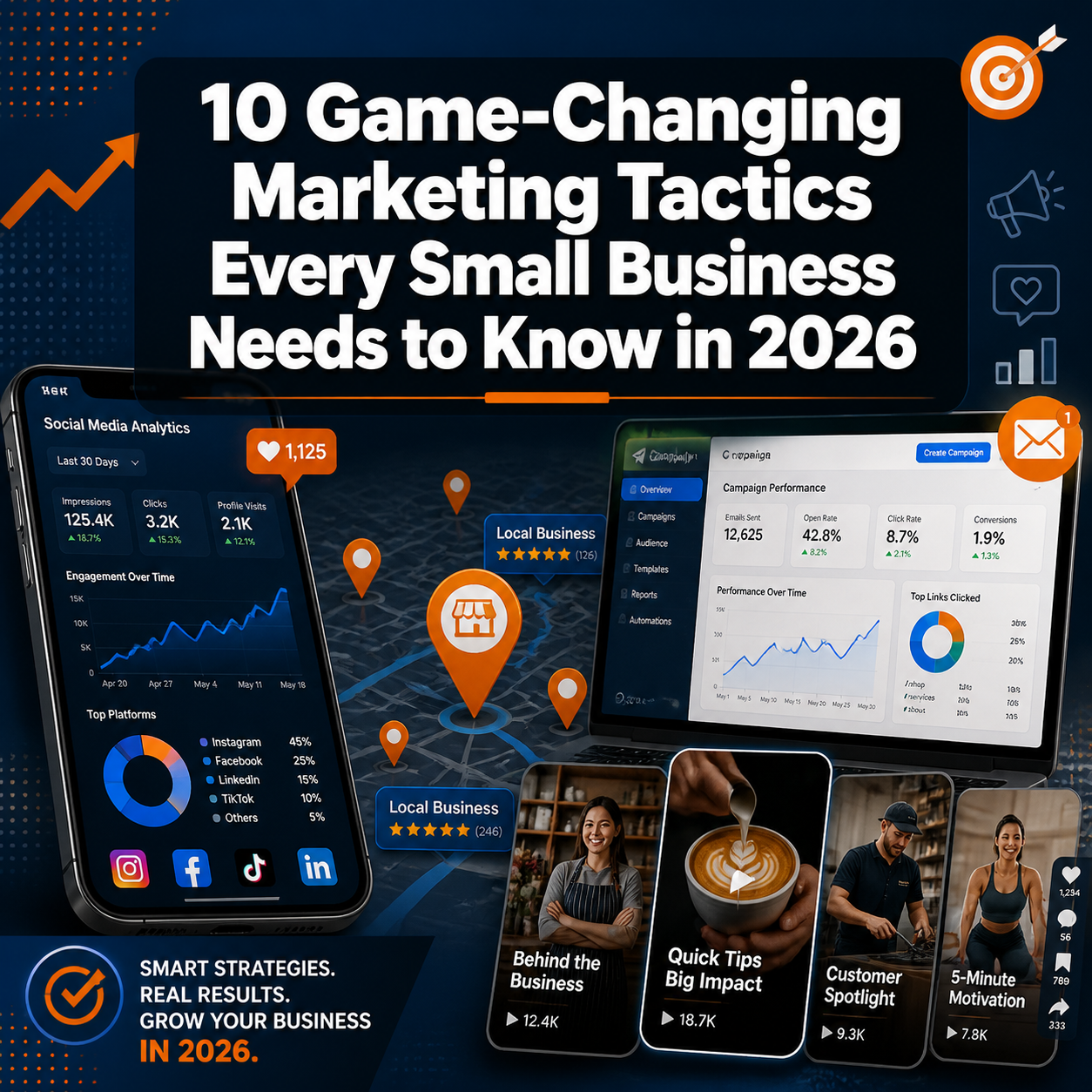
Quick Answer: Small businesses that consistently outperform their local competitors in 2026 are not spending more money — they’re spending smarter. The 10 game-changing marketing tactics every small business needs to know in 2026 center on local visibility, authentic community building, short-form video, AI-powered personalization, and voice search readiness. Apply even three or four of these consistently and you’ll see measurable improvements in leads, calls, and customer retention.
Key Takeaways
- Local SEO is non-negotiable — your Google Business Profile, local keywords, and service-area pages directly affect how many customers find you first.
- Short-form video on TikTok and Instagram drives direct sales through shoppable content and live broadcasts. [1]
- Micro-influencers (smaller, niche creators) often deliver higher engagement and lower cost per acquisition than celebrity endorsements. [1]
- Email automation with behavioral segmentation keeps your brand in front of the right customers at the right time. [1]
- Voice search and AI-generated results (GEO) are reshaping how customers find local businesses — structure your content accordingly. [2]
- Social commerce lets customers buy directly through Instagram and TikTok without leaving the platform. [1]
- Data-driven audience segmentation helps you reach Millennials and Gen Z where they actually spend time. [2]
- Geofencing and location-based marketing send timely, relevant offers to nearby customers. [1]
- Authentic community engagement builds trust faster than any paid ad campaign. [4]
- Storytelling-driven content — video, podcasts, and written — positions your brand as the solution customers remember. [2]
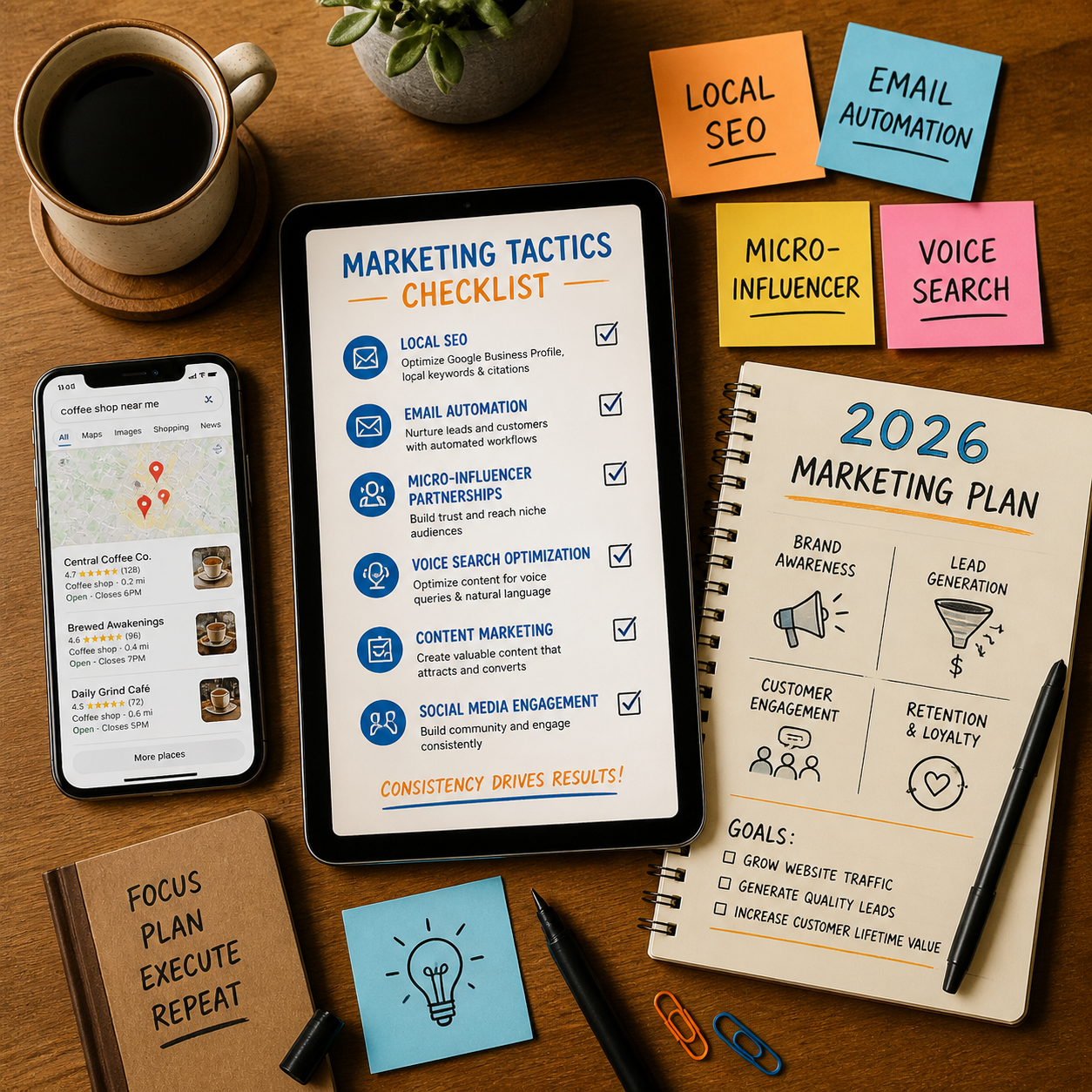
Why Most Small Business Marketing Falls Flat in 2026
Most small businesses waste their marketing budget on tactics that worked five years ago. They run a Facebook ad, post inconsistently on Instagram, and wonder why the phone isn’t ringing.
The reality is that customer behavior has shifted significantly. Buyers now expect personalized experiences, fast mobile-friendly content, and businesses they can find instantly in local search. If your marketing isn’t built around those expectations, you’re invisible to the customers who are ready to buy right now.
The 10 game-changing marketing tactics every small business needs to know in 2026 aren’t about chasing trends. They’re about closing the gap between where your customers are looking and where your business shows up. Implementing effective SEO tactics for small business growth can significantly increase your visibility in a crowded market. By optimizing your website and content for search engines, you can attract more organic traffic and ultimately drive sales. In today’s digital landscape, understanding customer intent and using relevant keywords is more crucial than ever.
Tactic 1: Dominate Local Search Before Everything Else
Local SEO is the single highest-return marketing investment for service-area businesses. When someone searches “pool service near me” or “plumber in Corona,” the businesses that appear in the top three Google Map Pack results get the overwhelming majority of calls.
Here’s what that means practically:
- Optimize your Google Business Profile with accurate categories, service descriptions, photos, and weekly posts. See our Google Business Profile optimization guide for a step-by-step breakdown.
- Build dedicated service-area pages for every city you serve — don’t just list them on one generic page.
- Run a local SEO audit to find gaps in your citations, on-page content, and technical structure. Our local SEO audit checklist walks you through this process.
Common mistake: Businesses claim their Google Business Profile but never update it. Stale profiles rank lower and look untrustworthy to potential customers.
For a deeper look at what’s working right now, read our proven local SEO strategies for 2026.
Tactic 2: Short-Form Video and Social Commerce
Short-form video is no longer optional — it’s where buying decisions happen. Platforms like TikTok and Instagram now let businesses create shoppable videos with product tags and run live shopping broadcasts that drive direct sales without the customer ever leaving the app. [1]
For small businesses, this doesn’t require a production budget. It requires consistency and authenticity.
What works:
- Behind-the-scenes clips of your service or product in action
- Customer testimonials filmed on a smartphone
- Quick “how-to” videos that answer common questions
- Live Q&A sessions that build real-time trust
Social commerce tools to use in 2026:
- Instagram Shopping (product tags, checkout)
- TikTok Shop (in-app purchases, affiliate links)
- Facebook Shops (for existing Facebook audiences)
Choose one platform where your target customers are most active and commit to it for 90 days before expanding.
Tactic 3: Micro-Influencer Partnerships That Actually Convert
Micro-influencers — creators with 1,000 to 50,000 followers in a specific niche — consistently outperform celebrity endorsements for small business ROI. Brands using influencer marketing can reduce their cost per acquisition by up to 30%, and micro-influencers tend to generate higher engagement because their audiences trust them. [1][3]
For a local service business in the Inland Empire, this might mean partnering with a local mom blogger, a home improvement YouTuber, or a community Instagram account that covers your city.
How to find the right micro-influencer:
- Search your city + niche hashtags on Instagram and TikTok
- Look for creators whose audience matches your customer profile
- Check engagement rate (aim for 3–8%), not just follower count
- Start with a product/service exchange before committing to paid deals
Tactic 4: Email Automation with Behavioral Segmentation
Email marketing remains one of the highest-ROI channels available to small businesses — but only when it’s personalized and automated correctly. Generic mass emails get ignored. Emails triggered by specific customer actions (a website visit, a purchase, an abandoned cart) get opened and acted on. [1]
Key components of effective email automation in 2026:
- Behavioral segmentation: Group subscribers by what they’ve clicked, bought, or browsed
- Dynamic content: Swap out images and text blocks based on the recipient’s profile
- A/B testing: Test subject lines and send times to find what your audience responds to
- Welcome sequences: New subscribers should receive a 3–5 email series that builds trust before asking for a sale
Tools like Mailchimp, Klaviyo, and ActiveCampaign make this accessible even for solo business owners.
Tactic 5: Voice Search and Generative Engine Optimization (GEO)
Voice search and AI-powered results are changing which businesses get found — and which ones disappear. When someone asks Siri or Google Assistant “who’s the best pool service in Riverside,” the answer comes from structured, locally optimized content, not just keyword density. [2]
Generative Engine Optimization (GEO) means structuring your website content so it appears in AI-generated responses from tools like ChatGPT, Google Gemini, and Perplexity. This complements traditional SEO rather than replacing it.
How to optimize for voice and GEO:
- Write content that directly answers specific questions (“What does pool service in Corona cost?”)
- Use FAQ sections on every service page
- Keep your Google Business Profile updated with accurate hours, services, and reviews
- Structure content with clear headings and short, direct paragraphs
Tactic 6: Personalization at Scale Using Affordable Tools
Personalization is no longer exclusive to large e-commerce brands. Small businesses can now replicate Amazon-style recommendation experiences using affordable tools that analyze browsing and purchase behavior to suggest relevant products or services. [3]
For service businesses, personalization might look like:
- Sending a seasonal maintenance reminder to customers who booked last spring
- Recommending a related service based on what a customer previously purchased
- Displaying different homepage content based on whether a visitor is new or returning
The key is collecting first-party data (email signups, purchase history, contact forms) and using it intentionally. Our top contact form plugins guide covers tools that make data collection easy.
Tactic 7: Location-Based Marketing and Geofencing
Geofencing lets you send targeted offers to potential customers the moment they enter a specific geographic area. Using GPS, Wi-Fi, and Bluetooth signals, you can create virtual boundaries around a neighborhood, a competitor’s location, or an event venue — then deliver push notifications or mobile ads to people within that zone. [1]
Best use cases for small businesses:
- A restaurant targeting lunch-hour foot traffic within a half-mile radius
- A contractor sending ads to homeowners in a specific zip code
- A fitness studio offering a free class to people near a competing gym
Geofencing works best when the offer is time-sensitive and hyper-relevant to the location.
Tactic 8: Content Marketing Built Around Real Stories
Content that tells a genuine story outperforms content that just describes a service. Customers connect with narratives — a problem they recognize, a solution that worked, and a business they can trust. [2]
For small businesses, this means:
- Sharing real customer success stories (with permission)
- Writing blog posts that answer the questions your customers actually ask
- Creating video content that shows your process, not just your results
- Exploring podcasts or audio content if your audience consumes content on the go
The most effective content in 2026 positions the customer as the hero and your business as the guide that helps them succeed.
Tactic 9: Data-Driven Audience Segmentation
Knowing exactly who your customers are — and where they spend their time — is what separates businesses that grow from those that plateau. Millennials and Gen Z now represent a dominant share of consumer spending, and they expect brands to meet them on the right platforms with relevant messaging. [2]
Simple segmentation steps for small businesses:
- Review your existing customer list and identify patterns (age, location, service type)
- Use Google Analytics 4 to see which pages attract your best leads
- Create two or three distinct customer profiles and tailor content to each
- Test different messaging on different platforms and track which converts
Tactic 10: Authentic Community Engagement
The businesses that win long-term in local markets are the ones that build genuine community relationships — not just marketing funnels. Passive tactics like countdown timers and aggressive retargeting are losing effectiveness as customers grow more skeptical. [4]
What authentic engagement looks like in 2026:
- Responding to every Google review (positive and negative)
- Participating in local Facebook groups or neighborhood apps like Nextdoor
- Sponsoring or attending local events
- Featuring community members in your content
Trust is the most durable marketing asset a small business can build. It compounds over time and creates word-of-mouth referrals that no paid ad can replicate.
Comparison: Paid vs. Organic Small Business Marketing Tactics
| Tactic | Cost Level | Time to Results | Best For |
|---|---|---|---|
| Local SEO | Low–Medium | 2–6 months | Long-term visibility |
| Short-form video | Low | 1–4 weeks | Brand awareness, sales |
| Micro-influencer | Low–Medium | 2–8 weeks | Trust building, reach |
| Email automation | Low | Immediate | Retention, upsells |
| Geofencing | Medium | Days | Local foot traffic |
| Social commerce | Low | 1–4 weeks | Direct product sales |
| Community engagement | Very Low | Ongoing | Referrals, loyalty |
Why These 10 Game-Changing Marketing Tactics Every Small Business Needs to Know in 2026 Work Together
No single tactic here works in isolation. Local SEO brings customers to your website. Short-form video builds trust before they arrive. Email automation keeps them coming back. Community engagement turns them into advocates.
The businesses that see the biggest results in 2026 are the ones that connect these tactics into a cohesive system — each channel reinforcing the others. If you’re a service-area business in Southern California, our local SEO services for small businesses are built around exactly this kind of integrated approach.
FAQ
Q: Which of these tactics should a brand-new small business start with first?
Local SEO and Google Business Profile optimization. They’re free to set up, deliver long-term results, and directly affect how many local customers find you when they’re ready to buy.
Q: How much should a small business spend on marketing in 2026?
A common benchmark is 5–10% of gross revenue for established businesses and up to 15% for businesses in growth mode. Prioritize tactics with measurable ROI before adding paid channels.
Q: Do I need to be on every social media platform?
No. Choose one or two platforms where your target customers are most active and do those well. Spreading thin across six platforms produces worse results than consistency on two.
Q: How do I measure whether these tactics are actually working?
Track three core metrics: website traffic from local searches, Google Business Profile calls and direction requests, and new customer inquiries per month. Compare month over month.
Q: Is email marketing still effective in 2026?
Yes — especially for service businesses. Segmented, automated email sequences consistently outperform social media for customer retention and repeat bookings. [1]
Q: What’s the fastest way to get more Google reviews?
Ask satisfied customers directly, immediately after service, via text message with a direct link to your Google review page. Timing and ease of access are the two biggest factors.
Q: How does geofencing differ from regular Google Ads?
Geofencing targets people based on their physical location in real time, not just their search behavior. It’s most effective for businesses with a physical service area or storefront.
Q: Can content marketing work for a plumber or contractor?
Absolutely. Service-based businesses that publish helpful, location-specific content (like “how to spot a water leak in Riverside homes”) attract highly qualified local search traffic. See our local SEO for plumbers in Riverside for a real-world example.
Conclusion: Your Next Steps Start This Week
The 10 game-changing marketing tactics every small business needs to know in 2026 aren’t complicated in theory — they’re just easy to deprioritize when you’re running a business day to day.
Here’s a simple starting point:
- This week: Audit your Google Business Profile and fix any missing information.
- This month: Record three short-form videos showing your service in action and post them.
- This quarter: Set up a basic email automation sequence for new leads and past customers.
- Ongoing: Engage with your local community online and respond to every review.
You don’t need to do all ten at once. Start with local SEO and one content channel, measure results, and build from there. If you want help identifying where your biggest opportunities are, contact our local SEO team for a straightforward website and visibility review.
References
[1] Marketing Ideas Small Business – https://www.designrush.com/agency/digital-marketing/small-business/trends/marketing-ideas-small-business
[2] Growth Marketing Strategy – https://mountain.com/blog/growth-marketing-strategy/
[3] 10 Digital Marketing Trends Insights And Strategies For Businesses For 2026 – https://www.equinetacademy.com/blog/10-digital-marketing-trends-insights-and-strategies-for-businesses-for-2026/
[4] 2026 Marketing Predictions For Small Business – https://jennakutcherblog.com/2026-marketing-predictions-for-small-business/
Tags: small business marketing, local SEO, short-form video marketing, email automation, micro-influencer marketing, social commerce, geofencing, voice search optimization, content marketing, Google Business Profile, 2026 marketing tactics, audience segmentation