Last updated: May 2, 2026
Quick Answer
Small businesses can dominate local Google search results in 2026 by fully optimizing their Google Business Profile, maintaining consistent NAP (Name, Address, Phone) data across all listings, building location-specific service pages, and actively collecting detailed customer reviews. These core actions, combined with schema markup and hyperlocal keyword targeting, are what separate businesses that rank at the top from those that stay invisible.
Key Takeaways
- A fully complete Google Business Profile delivers significantly more local search visibility than an incomplete one [3]
- NAP inconsistencies across directories can reduce local search visibility by up to 28% [3]
- Photos on your Google Business Profile generate 42% more direction requests and 35% more website click-throughs [3]
- Schema markup gives Google explicit information about your business instead of forcing it to guess [4]
- Hyperlocal keyword targeting (city names, neighborhoods, service-area variations) outperforms broad generic terms [2]
- Google’s AI Overviews now pull directly from Google Business Profile data, making a 100% complete profile essential [6]
- Reviews from Google Local Guides that include photos and video build stronger algorithmic trust than anonymous ratings [5]
- Location-specific service pages for each city you serve dramatically improve ranking for city-based searches [1]
- Strategic business hours help capture “open now” search traffic when competitors have gone offline [5]
- Local SEO is not a one-time task — it requires consistent updates, fresh content, and ongoing citation management
Why Most Small Businesses Fail at Local SEO (And What Actually Works in 2026)
Most small businesses treat local SEO as a one-time setup task. They claim their Google Business Profile, fill in a few fields, and wait. That approach stopped working years ago.
The businesses ranking in Google’s local 3-pack in 2026 are treating their online presence like a living system — one that gets updated, monitored, and refined regularly. Here’s what the research and real-world results consistently show works.
What Are the Real Local SEO Secrets: How Small Businesses Can Dominate Google Search Results in 2026?
The core secrets are not complicated, but they require consistent execution across several connected areas. No single tactic wins alone.
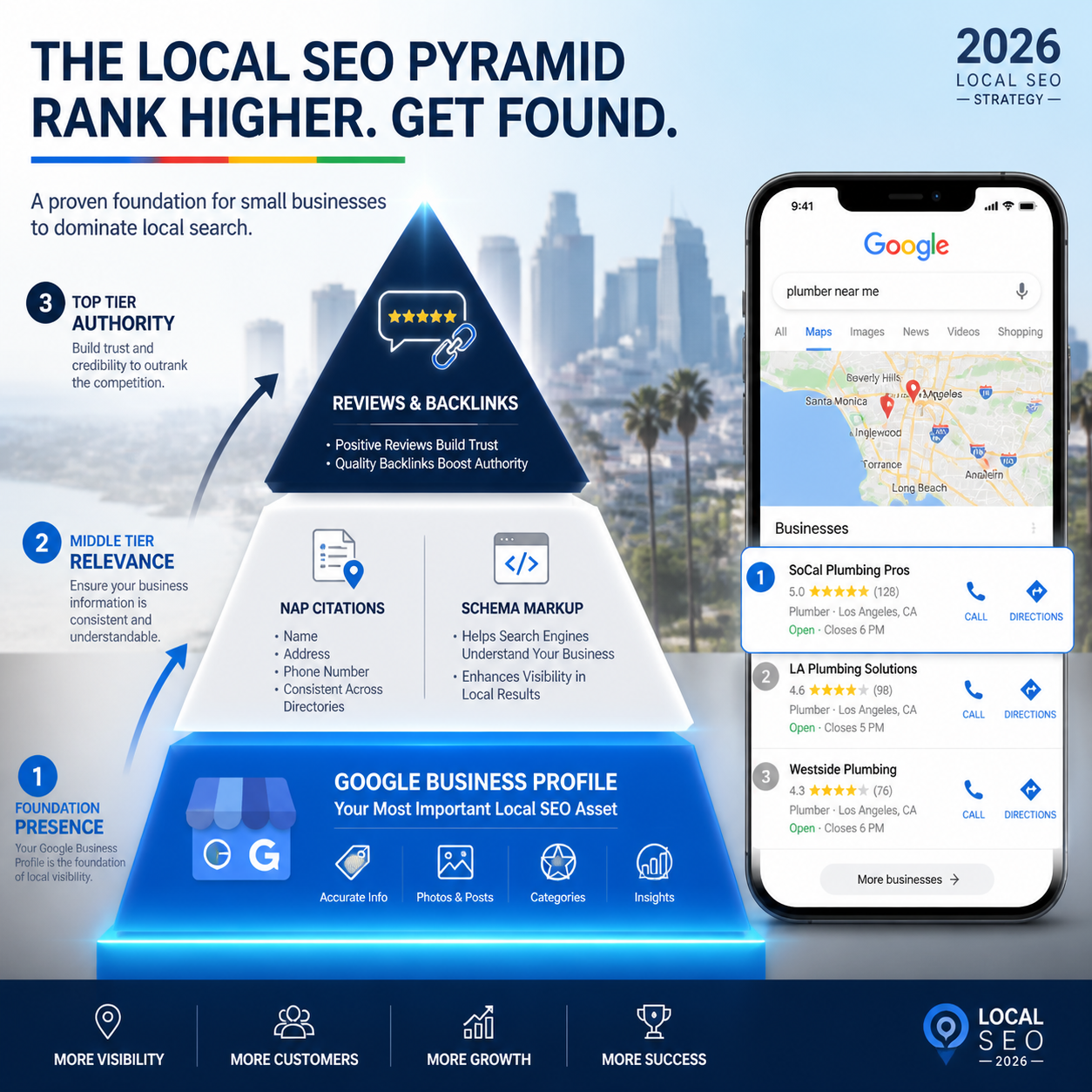
The six pillars that matter most right now:
- Google Business Profile (GBP) optimization — complete, accurate, and actively maintained
- NAP consistency — your business name, address, and phone number must match exactly across every listing
- Location-specific content — dedicated pages for each city or service area you serve
- Schema markup — structured data that tells Google exactly what your business does and where
- Review strategy — a repeatable system for collecting detailed, photo-rich reviews
- Hyperlocal keyword targeting — search terms that include city names, neighborhoods, and “near me” variations
For a deeper look at how these work together, the Proven Local SEO Strategies for 2026 guide covers each pillar with specific action steps.
How Do You Optimize a Google Business Profile for Maximum Local Visibility?
A fully optimized Google Business Profile is the single highest-leverage action a small business can take for local search. Businesses with complete profiles receive significantly more visibility than those with partial information [3].
What “fully optimized” actually means:
- Choose the most precise primary category available (not just “contractor” — use “general contractor” or “kitchen remodeler” if applicable) [5]
- Add all relevant secondary categories
- Write a keyword-rich business description that includes your city and core services
- Upload photos that meet recommended specs: logos at 720x720px minimum, cover photos at 1024x575px [3]
- Set accurate business hours — and consider extended hours to capture “open now” traffic when competitors are closed [5]
- Add your full service list with descriptions
- Post updates at least twice per month
Pull quote: “Photos on business profiles generate 42% more direction requests and 35% more click-throughs to websites.” [3]
Google’s Gemini-powered AI Overviews now pull directly from GBP data, which means an incomplete profile doesn’t just hurt your map rankings — it can exclude you from AI-generated search answers entirely [6].
For a step-by-step walkthrough, see this Google Business Profile optimization guide.
Common mistake: Businesses often set their GBP once and never return. Google rewards active profiles. Log in weekly, respond to reviews, add photos, and post updates.
Why Does NAP Consistency Matter So Much for Local Rankings?
NAP consistency matters because Google cross-references your business information across dozens of directories, social profiles, and data aggregators. When the data doesn’t match, Google’s confidence in your business drops — and so do your rankings.
NAP inconsistencies can reduce local search visibility by up to 28% [3]. That’s a significant penalty for something that’s entirely preventable.
Where NAP must be consistent:
- Your website (header, footer, and contact page)
- Google Business Profile
- Yelp, Facebook, Apple Maps, Bing Places
- Industry-specific directories
- Local chamber of commerce listings
Decision rule: If your business has moved, changed its phone number, or rebranded in the last three years, run a full citation audit before doing anything else. Fixing NAP issues often produces faster ranking improvements than any new content you could create.
Use our Local SEO Audit Checklist to identify and prioritize citation problems systematically.
How Do Location-Specific Pages Help Small Businesses Rank in Multiple Cities?
Location-specific service pages help because Google ranks pages, not entire websites. If you serve five cities but have only one generic “service area” page, you’re competing for all five cities with a single thin page — and losing to competitors who have dedicated content for each location.
What a strong location page includes:
| Element | Why It Matters |
|---|---|
| City name in H1 and title tag | Signals geographic relevance to Google |
| Embedded Google Map | Reinforces location signals |
| City-specific FAQ content | Matches local search intent |
| Local client examples or testimonials | Builds trust and E-E-A-T signals |
| Service descriptions with local context | Differentiates from generic competitors |
For example, a plumbing company serving both Corona and Riverside should have separate pages optimized for each city — not one page that mentions both. See how this works in practice with local SEO for plumbers in Riverside and local SEO for plumbers in Corona.
What Role Does Schema Markup Play in Local SEO in 2026?
Schema markup is structured data code added to your website that tells Google explicitly what your business is, where it’s located, what it does, and when it’s open. Without it, Google has to infer this information — and inference is less reliable than explicit data [4].
Schema types that matter most for local businesses:
LocalBusiness(or a more specific subtype likePlumber,HomeAndConstructionBusiness)ServiceFAQPageHowTo
Using H2 headers for FAQ-style content combined with the FAQPage schema is particularly effective because it matches how AI systems parse and display local business information [6].
Edge case: Schema markup alone won’t fix a weak page. It amplifies what’s already there. A well-written location page with schema will outperform a thin page with perfect schema every time.
How Do Reviews Actually Affect Local Search Rankings?
Reviews influence local rankings through two separate mechanisms: the algorithmic signals Google uses to rank businesses, and the trust signals that convert searchers into callers.
What the algorithm actually rewards:
- Review volume (more is better, but quality matters more than quantity)
- Review recency (a steady stream beats a burst followed by silence)
- Review content (reviews that mention specific services and locations carry more weight)
- Reviewer authority (reviews from Google Local Guides with photos and video build stronger trust signals than anonymous five-star ratings) [5]
A simple review request system:
- Identify your top 10 most satisfied customers each month
- Send a direct link to your Google review page via text or email
- Ask them to mention the specific service and city in their review
- Respond to every review — positive and negative — within 48 hours
Common mistake: Asking for reviews in bulk after a long gap. Google’s algorithm can detect unnatural review patterns and may filter them out.
What Hyperlocal Keywords Should Small Businesses Target in 2026?
Hyperlocal keywords are search terms that combine a service with a specific geographic identifier — city, neighborhood, zip code, or “near me.” These terms convert at higher rates than broad keywords because the searcher’s intent is clear and immediate [2].
Examples of hyperlocal keyword structures:
- “[Service] in [City]” — “pool service in Corona”
- “[Service] near [Neighborhood]” — “HVAC repair near Eastvale”
- “[Service] [City] CA” — “landscaper Riverside CA”
- “best [service] [city]” — “best plumber Menifee”
- “[service] open now [city]” — captures after-hours searches
Decision rule: If you serve more than one city, build separate keyword lists for each location. Don’t try to rank one page for ten cities — it rarely works, and it dilutes your content quality.
For businesses in the Inland Empire, the Local SEO Agency serving Corona and Riverside can help identify the specific terms your local competitors are ranking for.
Conclusion: Your Next Steps for Local SEO Dominance in 2026
The local SEO secrets that actually move the needle in 2026 aren’t secrets at all — they’re disciplined execution of proven fundamentals. The businesses winning in local search right now have complete Google Business Profiles, consistent NAP data, location-specific content, schema markup, and a steady flow of detailed reviews.
Start here if you’re not sure where to begin:
- Run a full audit of your Google Business Profile — fill every field, add photos, and verify your categories
- Check NAP consistency across your top 10 directory listings
- Identify which cities you serve and create (or improve) a dedicated page for each
- Add LocalBusiness and FAQPage schema to your key pages
- Build a simple, repeatable review request process for satisfied customers
If you want a professional assessment of where your business stands right now, request a local SEO review — we’ll show you exactly what needs to be fixed and which actions will have the biggest impact first.
Frequently Asked Questions
Q: How long does local SEO take to show results?
Most small businesses see measurable improvements in local visibility within 60 to 90 days when GBP, NAP, and on-page basics are properly addressed. Competitive markets may take 4 to 6 months for significant ranking movement.
Q: Do I need a physical address to rank in local search?
Not always. Service-area businesses (those that travel to customers) can rank in local search without a publicly listed address, but they must properly configure their service area in Google Business Profile.
Q: How many photos should I have on my Google Business Profile?
There’s no official minimum, but profiles with 10 or more high-quality photos consistently perform better. Add interior, exterior, team, and work-in-progress photos regularly [3].
Q: Is a Google Business Profile free?
Yes. Google Business Profile is completely free to claim, verify, and manage.
Q: What’s the difference between local SEO and regular SEO?
Regular SEO targets broad organic rankings. Local SEO specifically targets geographically qualified searches — people looking for services in a specific city or area. Local SEO relies heavily on GBP, citations, and location-specific content that general SEO does not.
Q: Can I do local SEO myself, or do I need an agency?
Many small business owners can handle the basics — GBP optimization, NAP cleanup, and review requests — on their own. Technical tasks like schema markup, location page creation, and competitive keyword research often benefit from professional help.
Q: How important are backlinks for local SEO?
Backlinks from locally relevant sources (local news sites, chambers of commerce, industry directories) carry meaningful weight for local rankings. You don’t need hundreds — a dozen high-quality local links can make a real difference.
Q: What is the Google local 3-pack?
The local 3-pack is the block of three business listings that appears at the top of Google search results for local queries, usually above organic results. It includes a map, business name, rating, hours, and contact options. Ranking here is the primary goal of local SEO.
References
[1] SEO Best Practices For A Small Business 2026 Guide – https://firstepbusiness.com/blog/seo-best-practices-for-a-small-business-2026-guide
[2] Local SEO Guide 2026 – https://www.q-tech.org/blog/local-seo-guide-2026/
[3] Local Business SEO Guide 2026 – https://chilledsites.com/blog/local-business-seo-guide-2026/
[4] Local SEO 2026: The Complete Guide To Dominating Local Search – https://boulderseomarketing.com/local-seo-2026-the-complete-guide-to-dominating-local-search/
[5] Local SEO Ranking Factors in 2026 (Video) – https://www.youtube.com/watch?v=7uhlOC3X0zU
[6] Local SEO Mistakes – https://www.connecticallc.com/local-seo-mistakes/
Tags: local SEO, Google Business Profile, small business SEO, local search ranking, NAP consistency, schema markup, hyperlocal keywords, local SEO 2026, Google Maps ranking, local citations, review strategy, service area SEO