Last updated: May 2, 2026
Quick Answer
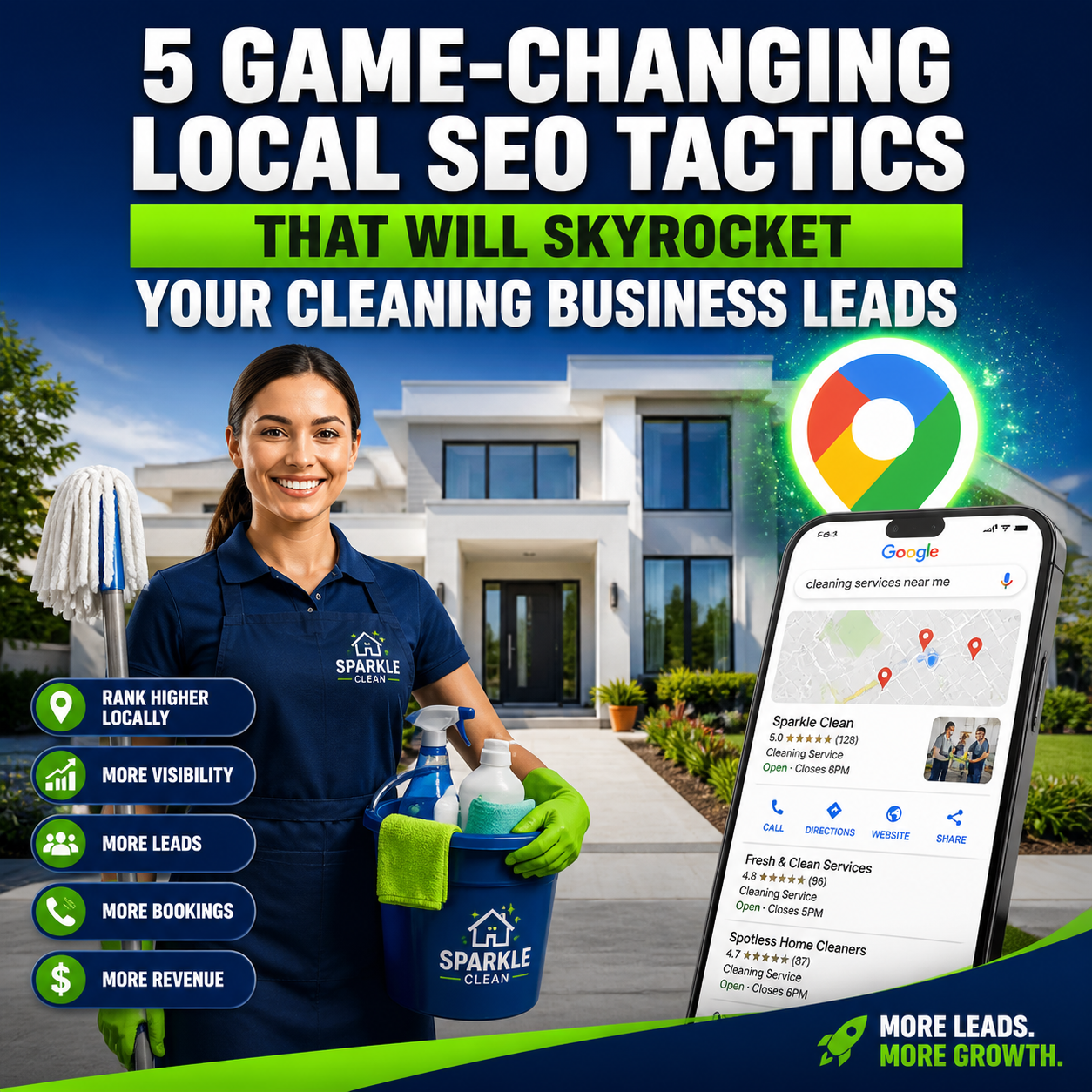
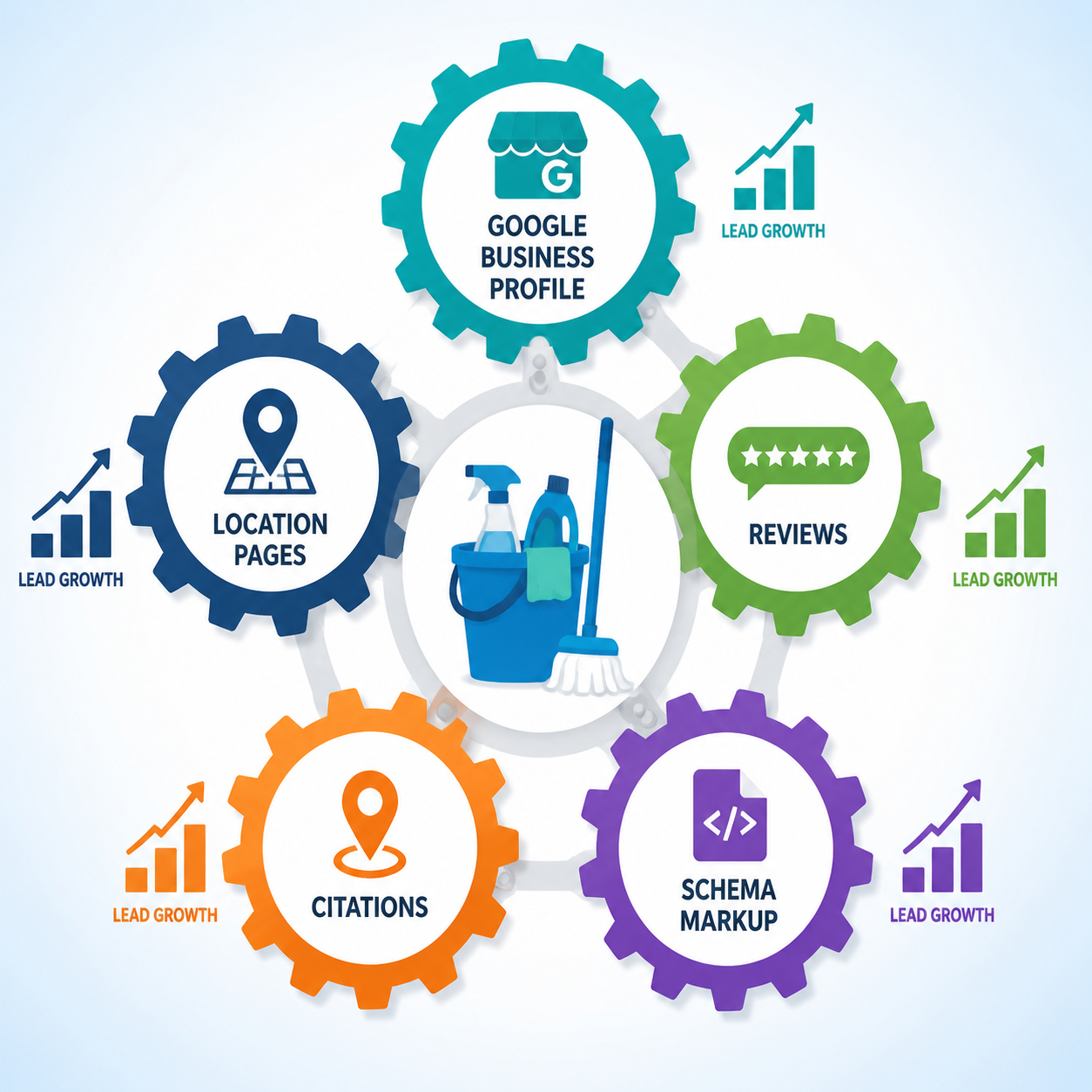
The 5 game-changing local SEO tactics that will skyrocket your cleaning business leads are: optimizing your Google Business Profile, building location-specific service pages, managing your online reviews actively, maintaining consistent citations across directories, and adding local schema markup to your website. Cleaning businesses that consistently execute all five of these strategies outperform competitors who apply only one or two [3].
Key Takeaways
- Google Business Profile (GBP) is your single most important local SEO asset — an incomplete or outdated profile directly costs you leads.
- Location-specific service pages outperform generic “we serve your area” claims because they give Google real content to rank.
- Reviews are a ranking signal, not just social proof — actively requesting them is a business practice, not optional marketing.
- NAP consistency (Name, Address, Phone) across directories builds trust with Google and prevents ranking confusion.
- Schema markup helps search engines understand exactly what your business does and where it is, improving your chances of appearing in rich local results.
- Question-based keywords (“how much does house cleaning cost?”) drive high-intent traffic that converts well [4].
- Mobile-first design is non-negotiable — most local searches happen on phones, and a slow or broken mobile site loses leads before they even read your content [5].
- Cleaning businesses that implement all five core local SEO systems generate significantly more leads than those treating SEO as a one-time task [3].
Why Most Cleaning Businesses Struggle With Local SEO
Most cleaning companies fail at local SEO not because the tactics are complicated, but because they implement only one or two pieces of the puzzle and then wonder why the phone isn’t ringing. Local SEO for a cleaning business is a system, and every part needs to work together [3].
Here’s what typically goes wrong:
Fix all five, and you have a real competitive edge over the cleaning company down the street.
Most cleaning companies fail at local SEO not because the tactics are complicated, but because they implement only one or two pieces of the puzzle and then wonder why the phone isn’t ringing. Local SEO for a cleaning business is a system, and every part needs to work together [3].
Here’s what typically goes wrong:
- GBP is set up but never updated — no posts, no photos, no responses to reviews.
- The website has one generic “services” page instead of separate pages for each service and city.
- Reviews are left to chance — happy customers don’t leave them unless asked.
- Business listings across the web have inconsistent phone numbers or addresses, which confuses Google’s trust signals.
- No schema markup, so search engines have to guess what the business does.
Fix all five, and you have a real competitive edge over the cleaning company down the street.
Tactic 1: Fully Optimize Your Google Business Profile
Your Google Business Profile is the foundation of local SEO for a cleaning business. A well-optimized GBP improves your visibility in Google Maps and local search results by giving Google accurate, complete information about your hours, location, services, and contact details [2].
What “fully optimized” actually means:
| GBP Element | What to Do |
|---|---|
| Business categories | Choose the most specific primary category (e.g., “House Cleaning Service”) |
| Services | List every service with descriptions and prices where possible |
| Photos | Add real photos of your team, equipment, and completed jobs — updated monthly |
| Posts | Publish weekly posts: promotions, cleaning tips, seasonal offers [2] |
| Q&A section | Pre-populate with common questions customers ask |
| Review responses | Reply to every review, positive or negative, within 48 hours |
Common mistake: Treating GBP as a one-time setup. Google rewards profiles that are actively maintained. A profile with recent posts and fresh photos signals to Google that the business is active and trustworthy.
For a detailed walkthrough of every GBP setting, see this Google Business Profile optimization guide.
Tactic 2: Build Location-Specific Service Pages
Generic websites don’t rank locally — location-specific pages do. Creating a dedicated page for each city you serve, combined with each core service, gives Google real content to index and rank for searches like “house cleaning in Corona” or “office cleaning Riverside” [4].
How to structure location pages:
- One page per city-service combination — “Move-Out Cleaning in Temecula” is more rankable than a single “Services” page listing everything.
- Use the “[city] + [service]” format naturally in headings and body copy — not stuffed, but woven in where it reads naturally [5].
- Write unique content for each page — don’t copy-paste the same text and swap the city name. Google penalizes thin duplicate content [4].
- Include local signals — mention nearby neighborhoods, landmarks, or local context that proves you actually serve that area.
- Add a clear call to action on every page — phone number, contact form, or booking link above the fold.
Choose this approach if: You serve more than one city. Even if you’re based in Corona, separate pages for Riverside, Perris, Menifee, and Moreno Valley can each rank independently and multiply your lead sources.
For a full checklist of what each page needs, the local SEO audit checklist walks through every element step by step.
Tactic 3: Build and Manage Your Online Reviews Actively
Reviews directly influence both your local rankings and your conversion rate. Google uses review quantity, recency, and your response behavior as ranking signals. A cleaning business with 80 recent reviews and active responses will consistently outrank a competitor with 12 old reviews and no engagement [2].
A simple review-building process:
- Ask immediately after service — send a text or email with a direct link to your Google review page within 24 hours of job completion.
- Make it easy — one tap, no login hurdles. Use a short link or QR code on a leave-behind card.
- Respond to every review — thank positive reviewers by name and address negative reviews professionally. This shows potential customers how you handle problems.
- List on the right directories — beyond Google, prioritize Yelp, Angie’s List, Thumbtack, and HomeAdvisor for cleaning businesses [2].
Pull quote: “Your review response behavior is visible to every potential customer reading your profile. How you handle a 2-star review often matters more than the review itself.”
Edge case: If a negative review contains false information, you can flag it for Google review. Don’t ignore it or respond defensively — either approach damages trust.
Tactic 4: Fix Your Citations and NAP Consistency
Inconsistent business information across the web confuses Google and suppresses your local rankings. NAP stands for Name, Address, and Phone number — and every listing across every directory needs to match exactly [5].
Why this matters:
Google cross-references your business information across dozens of sources (Yelp, Yellow Pages, Facebook, BBB, and more) to verify that your business is legitimate and located where you say it is. Mismatches — like an old phone number on one directory or a slightly different business name on another — create conflicting signals that reduce Google’s confidence in your listing.
How to fix it:
- Audit your existing citations — search your business name and phone number to find every listing.
- Claim and correct each one — update the name, address, and phone to match your GBP exactly.
- Submit to the top directories for cleaning businesses: Google, Yelp, Angie’s List, Thumbtack, HomeAdvisor, and the BBB [2].
- Use the same format consistently — if your GBP says “Suite 200,” every listing should say “Suite 200,” not “#200.”
This is unglamorous work, but it’s one of the highest-leverage fixes for cleaning businesses that have been operating for a few years and accumulated inconsistent listings.
Tactic 5: Add Local Schema Markup and Optimize for Mobile
Local schema markup tells search engines exactly what your business is, where it operates, and what it offers — in a structured format that machines can read reliably [5]. Combined with a mobile-optimized website, this tactic closes the gap between showing up in search and actually winning the click.
Schema markup basics for cleaning businesses:
- Use LocalBusiness schema (or the more specific “HouseCleaning” type where applicable).
- Include your business name, address, phone, hours, service area, and price range.
- Add a service schema for each individual service page.
- Test your markup with Google’s Rich Results Test tool before publishing.
Mobile optimization checklist:
- Pages load in under 3 seconds on mobile
- Phone number is a click-to-call on every page
- The contact form works on a small screen
- Text is readable without zooming
- Buttons are large enough to tap easily
Why it matters: Most people searching “house cleaning near me” are on their phone, often while standing in their home, deciding who to call. If your site loads slowly or the contact button is hard to find, they’ll call your competitor instead [5].
For more on building a complete local SEO foundation for your service business, see our proven local SEO strategies for 2026.
How the 5 Game-Changing Local SEO Tactics Work Together
These five tactics aren’t independent — they reinforce each other. Your GBP sends traffic to your location pages. Your location pages convert visitors who found you through citations. Your reviews build the trust that makes schema-rich search results worth clicking. And your mobile-optimized site closes the deal.
Cleaning businesses that treat these as a connected system — rather than a checklist of separate tasks — are the ones that see consistent lead growth month over month [3].
If you’re not sure where your current setup stands, start with a local SEO audit to identify your biggest gaps before investing time in any single tactic.
FAQ
Q: How long does it take to see results from local SEO for a cleaning business?
Most cleaning businesses start seeing measurable improvements in 3 to 6 months when GBP, website content, and citations are all addressed. Competitive markets may take longer.
Q: Do I need a physical address to rank locally?
You can rank as a service-area business without displaying a physical address on Google. Set your service area in GBP to cover the cities you actually serve.
Q: How many Google reviews do I need to rank in the Map Pack?
There’s no fixed number. What matters more is recency, response rate, and review quality relative to your local competitors. In many smaller markets, 20 to 30 recent reviews can be competitive.
Q: Should I create separate pages for every city I serve?
Yes, if you serve multiple cities. Each city-service page can rank independently and brings in leads from searches you’d otherwise miss entirely [4].
Q: What keywords should a cleaning business target?
Start with “[city] + [service type]” combinations. Also target question-based searches like “how much does house cleaning cost in [city]” or “best cleaning company near me” — these convert well because the searcher is close to a buying decision [4].
Q: Is Google Business Profile really free?
Yes. GBP is free to create and manage. The investment is time, not money — and it’s one of the highest-ROI local SEO activities available to small cleaning businesses [2].
Q: What’s the biggest local SEO mistake cleaning businesses make?
Setting up GBP once and never returning to it. Inactive profiles lose ground to competitors who post regularly, add photos, and respond to reviews consistently [2].
Q: Do I need to hire an agency to do local SEO?
Not necessarily. Many of these tactics are DIY-friendly. But if you’re serving multiple cities and want to scale faster, working with a local SEO specialist who understands service-area businesses can compress your timeline significantly.
Conclusion: Your Next Steps
The 5 game-changing local SEO tactics that will skyrocket your cleaning business leads aren’t secrets — they’re a system. And like any system, they work best when you implement them completely rather than partially.
Here’s where to start this week:
- Log into your GBP and check that every field is filled in, your photos are current, and your last post was within the past 7 days.
- Audit your website for location-specific pages — if you serve 5 cities and have one generic page, that’s your biggest opportunity.
- Set up a review request process — even a simple text message with a Google review link sent after every job.
- Search your business name to find inconsistent citations and start correcting them.
- Check your site on a phone — if it’s slow or hard to navigate, fix that before anything else.
If you want expert help applying these tactics to your cleaning business in Corona, Riverside, or anywhere in the Inland Empire, reach out to Local Website SEO Services for a local SEO review. We’ll tell you exactly what needs to be fixed and in what order.
References
[2] 5 Proven Local SEO Strategies To Attract More Cleaning Clients – https://www.marketingforcleaningcompanies.com/services/seo/5-proven-local-seo-strategies-to-attract-more-cleaning-clients/
[3] Local SEO Checklist For Cleaning Businesses – https://www.localmighty.com/blog/local-seo-checklist-for-cleaning-businesses/
[4] Local SEO For Your Cleaning Business – https://smith.ai/blog/local-seo-for-your-cleaning-business
[5] 5 Local SEO Best Practices For Small Businesses – https://boulderseomarketing.com/5-local-seo-best-practices-for-small-businesses/
Tags: local SEO for cleaning businesses, Google Business Profile optimization, cleaning company leads, location-specific service pages, NAP consistency, local schema markup, review management, small business SEO, cleaning business marketing, local search rankings, service area SEO, Inland Empire SEO