Last updated: May 2, 2026
Quick Answer: To dominate local search as a small business, you need a fully optimized Google Business Profile, consistent NAP (Name, Address, Phone) citations, location-based website content, and a steady flow of customer reviews. These four pillars, working together, are what separate businesses that show up in Google’s local map pack from those that don’t.
Key Takeaways
- 46% of all Google searches have local intent, meaning millions of customers are actively looking for businesses like yours right now [3]
- Google Business Profile optimization delivers 2.3x more local search visibility compared to incomplete profiles [3]
- 72% of consumers who perform a local search visit a store within 5 miles [3]
- Consistent NAP information across all directories builds trust with Google and improves rankings [2]
- Over 60% of local searches happen on mobile devices, making mobile-friendly websites non-negotiable [3]
- LocalBusiness schema markup helps Google accurately index your business details [2]
- Service-area pages targeting specific cities are essential for businesses that serve multiple locations [3]
- Competitor keyword analysis using Google Autocomplete is a free, actionable research tool [2]
- Reviews influence both rankings and customer trust — a review strategy is not optional
- Tracking location-segmented organic traffic in Google Analytics shows you what’s actually working [1]
Why Local Search Is the Most Valuable Traffic a Small Business Can Get
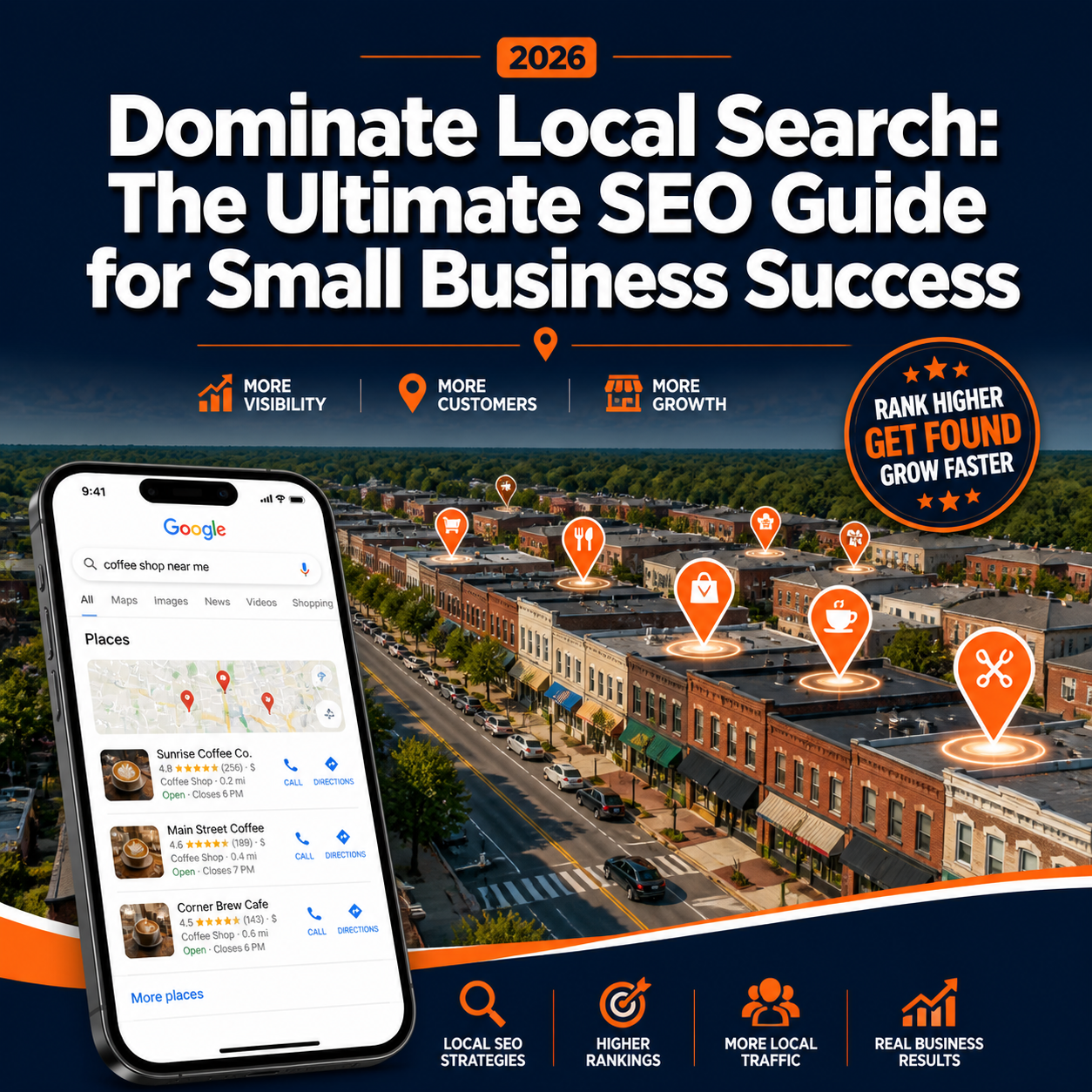
Local search traffic converts faster than almost any other channel. When someone searches “pool service in Corona” or “plumber near me,” they’re not browsing — they’re ready to call. This guide to Dominate Local Search: The Ultimate SEO Guide for Small Business Success exists because most small businesses leave this traffic on the table.
The math is straightforward: 46% of all Google searches target local information [3], and 72% of those searchers visit a business within 5 miles [3]. That’s not website traffic — that’s foot traffic and phone calls. The businesses capturing that attention share a few common practices, all of which you can apply starting today.
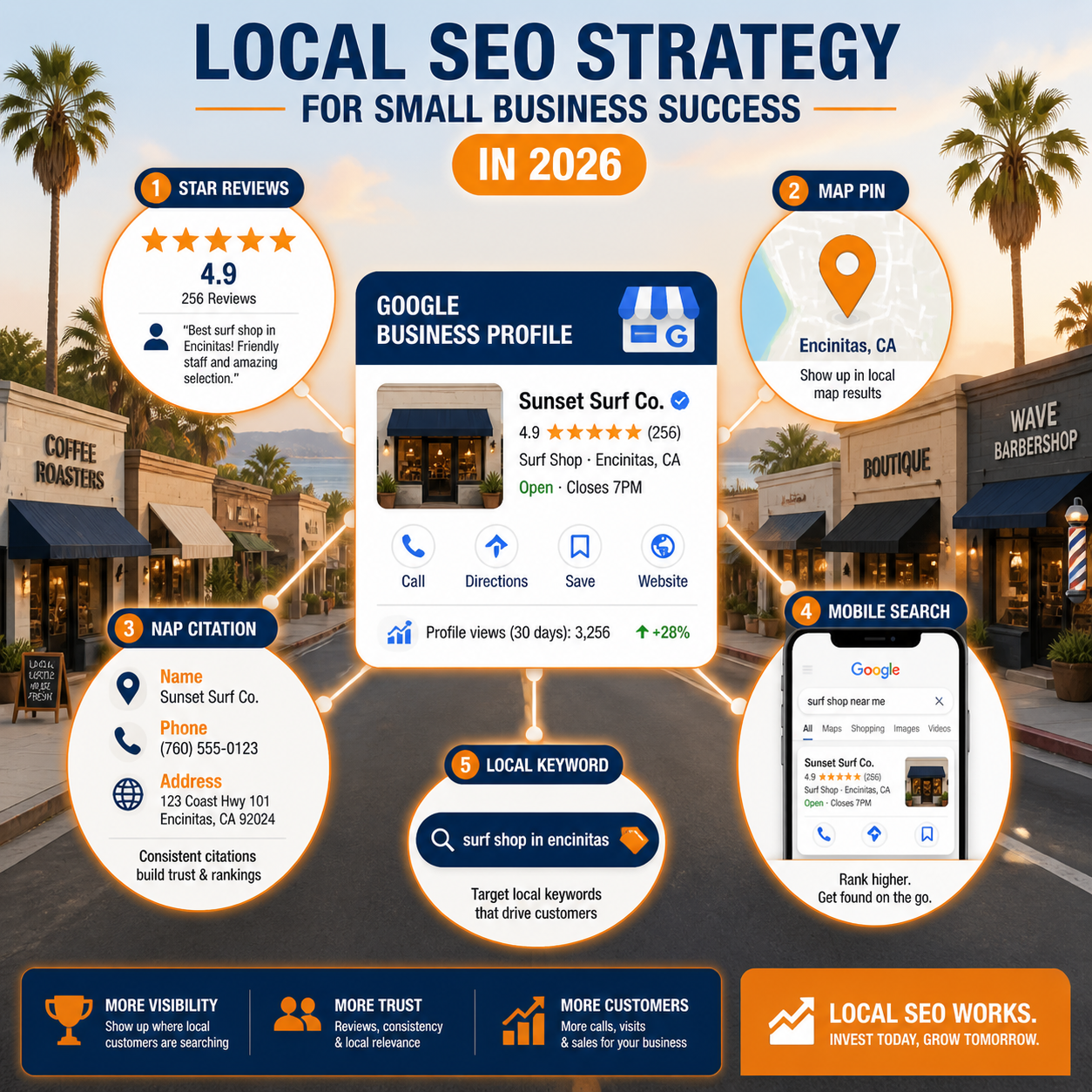
What Is Local SEO and How Does It Differ from Regular SEO?
Local SEO is the practice of optimizing your online presence so your business appears when customers search for services in a specific geographic area. Unlike traditional SEO, which targets broad audiences, local SEO focuses on proximity, relevance, and trust signals specific to your city or service area.
The three factors Google uses to rank local results:
| Factor | What It Means | Example |
|---|---|---|
| Relevance | Does your business match the search? | “pool repair” matches a pool service page |
| Distance | How close are you to the searcher? | Business in Corona ranks for Corona searches |
| Prominence | How well-known and trusted is your business? | Reviews, citations, and links signal this |
Common mistake: Many small business owners focus only on their website and ignore their Google Business Profile. In local search, GBP is often more important than the website itself for appearing in the map pack [2].
How Do You Optimize Your Google Business Profile for Maximum Visibility?
Your Google Business Profile (GBP) is the single most critical factor for appearing in Google’s local map pack [2]. An optimized GBP delivers 2.3x more local search visibility than an incomplete one [3].
Steps to optimize your GBP:
- Claim and verify your profile if you haven’t already
- Choose the right primary category — be specific (e.g., “Pool Cleaning Service,” not just “Service”)
- Add all secondary categories that apply to your business
- Write a keyword-rich business description that includes your city and core services
- Upload high-quality photos of your team, work, and location
- Add your services and products with descriptions and pricing where possible
- Post weekly updates to signal an active, engaged business
- Enable messaging and respond promptly
For a deeper walkthrough, see our Google Business Profile optimization guide for local visibility.
Choose this approach if: You’re starting from scratch or your profile has been sitting untouched for months. Even partial improvements — better photos, updated hours, added services — show results within weeks.
What Role Does NAP Consistency Play in Local Rankings?
NAP stands for Name, Address, and Phone number. Consistent NAP information across every online directory, social profile, and citation site tells Google your business is legitimate and trustworthy [2].
Why it matters: If your business name is listed as “ABC Pool Service” on Google, “ABC Pool Services Inc.” on Yelp, and “ABC Pools” on a local directory, Google sees three different entities. That inconsistency weakens your authority.
Where to audit and maintain your NAP:
- Google Business Profile
- Yelp
- Facebook Business Page
- Apple Maps
- Bing Places
- Industry-specific directories
- Chamber of Commerce listings
Quick example: A pool service company in Riverside had three different phone numbers listed across directories after changing numbers twice. After cleaning up citations and standardizing NAP, local rankings improved within 60 days.
Run a local SEO audit using this step-by-step checklist to find and fix NAP inconsistencies across your listings.
How Should You Structure Your Website for Local Search Success?
Your website needs to clearly communicate what you do and where you do it — both to visitors and to Google. Location-based keywords in your title tags, H1 headings, and opening paragraphs are direct signals to Google about your service area [2].
Core website elements for local SEO:
- Homepage title tag: Include your primary service + city (e.g., “Pool Service in Corona, CA | ABC Pool Company”)
- H1 heading: Match your title tag intent with natural phrasing
- Opening paragraph: Mention your city and service within the first 100 words
- Service pages: One dedicated page per core service — don’t lump everything together
- City/service-area pages: If you serve multiple cities, each city deserves its own page [3]
- LocalBusiness schema markup: Structured data that explicitly tells Google your name, address, phone, and hours [2]
- Mobile-friendly design: Over 60% of local searches happen on mobile [3]
Edge case: If you’re a service-area business with no storefront (like a mobile pool cleaner), you can hide your address on GBP and still rank locally. Set your service areas in GBP instead.
Explore our proven local SEO strategies for 2026 for a full breakdown of on-page tactics that move the needle.
How Do Customer Reviews Affect Your Local Search Rankings?
Reviews are a direct ranking signal and a conversion factor. A business with 80 four-star reviews will almost always outrank a competitor with 10 five-star reviews — volume and recency both matter.
A simple review strategy for small businesses:
- Ask every satisfied customer directly — in person, by text, or by email
- Send a direct link to your Google review page (shorten it for ease)
- Respond to every review, positive or negative, within 48 hours
- Never offer incentives for reviews — this violates Google’s guidelines
- Make it a habit, not a one-time campaign
“Your review strategy is your reputation strategy. Businesses that ask consistently outperform those that ask occasionally.”
Common mistake: Waiting for reviews to come in organically. Most happy customers won’t leave a review unless you ask them directly.
What Keywords Should Small Businesses Target for Local Search?
The best local keywords combine a service with a location. Think “HVAC repair Riverside” or “landscaper near Menifee” rather than just “HVAC repair.”
How to find the right keywords:
- Google Autocomplete: Start typing your service + city and note what Google suggests [2]
- Google’s “People Also Ask” and “Related Searches”: Free insight into what your customers actually search
- Competitor analysis: Search your top keywords and see which local competitors rank — then analyze their pages
- Google Search Console: If your site is live, this shows you what queries already bring traffic
Keyword targeting priority:
| Priority | Keyword Type | Example |
|---|---|---|
| High | Service + City | “pool cleaning Corona CA” |
| High | Service + “near me” | “plumber near me” |
| Medium | Service + Neighborhood | “pool service Eastvale” |
| Lower | Service only | “pool cleaning” |
For industry-specific examples, see how we approach pool service SEO in Corona and Riverside and plumbing SEO in Corona.
How Do You Measure Whether Your Local SEO Is Actually Working?
Tracking the right metrics tells you whether your efforts are paying off or where to adjust. Google Analytics and Google Search Console are free and give you the data you need [1].
Metrics to track monthly:
- Local keyword rankings: Are you moving up for your target city + service terms?
- Google Business Profile insights: Calls, direction requests, and website clicks from GBP
- Location-segmented organic traffic: Filter Analytics by city to see local visitor growth [1]
- Conversion actions: Phone calls, form submissions, direction requests
- Review count and average rating: Track week over week
Choose this metric if: You want a single number to watch — track GBP phone calls. It’s the most direct line between local SEO effort and real business results.
If you’re working with a local agency, our local SEO services for small businesses in Corona and Riverside include monthly reporting on exactly these metrics.
Conclusion: Your Next Steps to Dominate Local Search
This guide to Dominate Local Search: The Ultimate SEO Guide for Small Business Success covers the core pillars that actually move rankings for small businesses: GBP optimization, NAP consistency, website structure, reviews, local keywords, and performance tracking.
Your action plan for the next 30 days:
- ✅ Audit and fully complete your Google Business Profile
- ✅ Check NAP consistency across your top 10 directory listings
- ✅ Add location keywords to your homepage title tag and H1
- ✅ Create or improve one service page with city-specific content
- ✅ Ask your last five satisfied customers for a Google review
- ✅ Set up Google Search Console if you haven’t already
Local SEO is not instant, but it compounds. Businesses that build these fundamentals correctly in 2026 will be the ones dominating their local market in 2027 and beyond.
Ready to get started? Contact Local Website SEO Services or call/text 951-545-4118 for a local SEO review tailored to your business.
Frequently Asked Questions
Q: How long does local SEO take to show results?
Most small businesses see measurable improvements in GBP visibility and local rankings within 60 to 90 days of consistent optimization work. Competitive markets may take longer.
Q: Do I need a physical address to rank in local search?
No. Service-area businesses without a storefront can still rank locally by setting service areas in their Google Business Profile and hiding their address.
Q: How many citations do I need for local SEO?
Quality matters more than quantity. Start with the top 10 to 15 authoritative directories (Google, Yelp, Facebook, Apple Maps, Bing) and ensure NAP is consistent across all of them.
Q: Is Google Business Profile free?
Yes. GBP is completely free to set up and manage. It’s one of the highest-ROI tools available to small businesses.
Q: Can I do local SEO myself or do I need an agency?
You can handle the basics yourself — GBP setup, NAP cleanup, and asking for reviews. For competitive markets or faster results, working with a local SEO agency accelerates the process.
Q: What’s the difference between local SEO and national SEO?
Local SEO targets customers in a specific geographic area and relies heavily on GBP, citations, and local content. National SEO targets broad audiences without geographic focus and typically requires more domain authority and backlinks.
Q: How important are reviews for local rankings?
Very important. Review quantity, recency, and your response rate all influence where you appear in local search results. Businesses with more recent reviews consistently outperform those with stale profiles.
Q: Should every city I serve have its own webpage?
Yes, if you actively serve multiple cities. A dedicated page for each service area — with unique, relevant content — gives Google a clear signal and improves your chances of ranking in each location [3].
Q: What is LocalBusiness schema markup?
It’s structured data code added to your website that explicitly tells Google your business name, address, phone number, hours, and service type. It improves indexing accuracy and can enhance how your listing appears in search results [2].
Q: How do I find out what keywords my competitors rank for?
Start with Google Autocomplete by typing your service and city. Then search those terms and examine the top-ranking competitor pages. Free tools like Google Search Console show your own keyword data [2].
References
[1] Local Seo For Small Business The Ultimate Guide To Dominate Local Search – https://www.novaadvertising.com/local-seo-for-small-business-the-ultimate-guide-to-dominate-local-search/
[2] The Ultimate Guide To Local Seo A 10 Step Plan To Dominate Local Search – https://12amagency.com/blog/the-ultimate-guide-to-local-seo-a-10-step-plan-to-dominate-local-search/
[3] Local Business Seo Guide 2026 – https://chilledsites.com/blog/local-business-seo-guide-2026/
Tags: local SEO, small business SEO, Google Business Profile, local search optimization, NAP consistency, local keyword research, map pack rankings, service area pages, local citations, review strategy, on-page SEO, local SEO guide