Last updated: May 2, 2026
Quick Answer: Google marketing refers to the full suite of tools Google offers to help businesses attract customers — including Google Ads, Google Business Profile, YouTube advertising, and organic search (SEO). For small businesses, the highest-ROI starting point is usually a well-optimized Google Business Profile combined with targeted local search ads and a strong organic presence.
Key Takeaways
- Google marketing covers paid ads, local search, YouTube, and organic SEO — not just one channel.
- Google Business Profile is free and often the fastest way for local businesses to appear in search results.
- Google Ads uses AI-driven campaign types (Performance Max, AI Max) that automate targeting but still require human oversight.
- Small businesses should prioritize local intent keywords (city + service) over broad national terms.
- YouTube is now a direct shopping and conversion platform, not just a brand awareness tool [1].
- Google’s AI is now the core operating layer across ads, creative, and analytics — not just a feature [1].
- Consistent business information (name, address, phone) across the web strengthens Google’s trust in your business.
- Reviews on your Google Business Profile directly influence both rankings and customer decisions.
What Is Google Marketing and Why Does It Matter for Small Businesses?
Google marketing is the practice of using Google’s platforms — Search, Maps, YouTube, Display Network, and the Google Business Profile — to reach customers at the moment they’re looking for what you offer. For small businesses, this matters because Google processes billions of searches every day, and local searches (like “pool service near me” or “plumber in Corona CA”) carry extremely high purchase intent.
Unlike social media marketing, where you interrupt someone’s scroll, Google marketing connects you with people who are already searching for your service. That difference in intent is why local businesses often see strong returns from Google channels even with modest budgets.
How Does Google Marketing Work for Local Businesses?
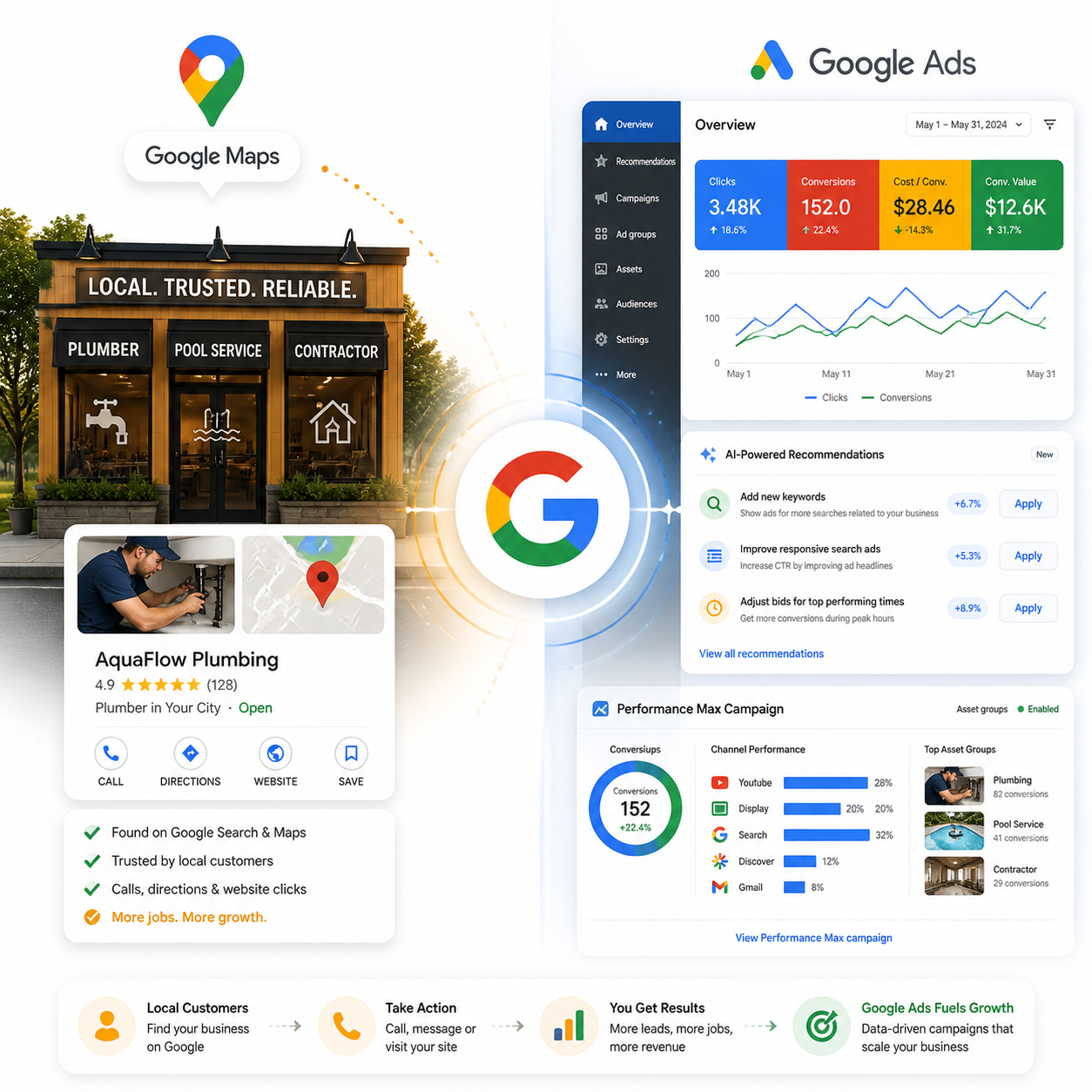
Google marketing for local businesses operates across two main tracks: paid (Google Ads) and organic (SEO + Google Business Profile). Both tracks feed into the same goal — showing up when a nearby customer searches for your service.
Paid track (Google Ads):
- Search ads appear above organic results for specific keywords.
- Local Service Ads (LSAs) show your business with a “Google Guaranteed” badge.
- Performance Max campaigns run across Search, YouTube, Gmail, and Display from one campaign.
Organic track (free):
- Google Business Profile controls your Maps listing, reviews, and local pack visibility.
- Your website’s SEO determines how well you rank in standard search results.
- Local citations (consistent NAP data across directories) reinforce your geographic relevance.
Choose paid if: You need leads quickly or you’re entering a competitive market.
Choose organic if: You’re playing a longer game and want sustainable, lower-cost visibility.
Most small businesses benefit from running both tracks together. For a deeper look at the organic side, our proven local SEO strategies for 2026 covers the full framework.
What Are the Main Google Marketing Tools Available in 2026?
Google’s marketing ecosystem has expanded significantly. Here’s a practical breakdown of the tools most relevant to small businesses:
| Tool | Cost | Best For |
|---|---|---|
| Google Business Profile | Free | Local visibility, Maps, reviews |
| Google Search Ads | Pay-per-click | High-intent local leads |
| Local Service Ads | Pay-per-lead | Service businesses (plumbers, cleaners, etc.) |
| Performance Max | Pay-per-click | Cross-channel reach with AI automation |
| YouTube Ads | Pay-per-view/click | Brand awareness + direct conversions |
| Google Display Network | Pay-per-click | Retargeting past website visitors |
AI Max for Search is a newer one-click feature suite that extends your search ad coverage beyond strict keyword matching. It uses your existing keywords, assets, and URLs as learning inputs to surface queries you might otherwise miss [1]. For small businesses with limited time to manage keyword lists, this can be a genuine time-saver — but monitor search term reports weekly to catch irrelevant traffic early.
How Do You Set Up Google Marketing on a Small Budget?
Small businesses don’t need a large ad budget to get started. Here’s a practical sequence:
Claim and optimize your Google Business Profile — This is free and should always come first. Complete every field: categories, services, hours, photos, and a keyword-rich description. See our Google Business Profile optimization guide for a step-by-step walkthrough.
Run a local SEO audit — Before spending on ads, know where your organic presence stands. Our local SEO audit checklist walks you through the key checkpoints.
Start with Local Service Ads (if eligible) — LSAs charge per lead, not per click, and display a trust badge. Service businesses like plumbers, electricians, and cleaners often outperform standard Search ads at a lower cost.
Add Search Ads for your top 3-5 service keywords — Focus on city-specific terms (“pool repair Riverside CA”) rather than broad terms (“pool repair”). Broad terms burn the budget fast.
Set a daily cap you can sustain for 60-90 days — Google’s algorithm needs time to learn. Pausing campaigns after two weeks gives you no useful data.
Common mistake: Running Google Ads to a homepage instead of a dedicated service page. A landing page focused on one service and one city converts far better than a generic homepage.
How Is AI Changing Google Marketing Right Now?
Google has moved AI from being a campaign feature to being the core operating layer across media buying, creative development, analytics, and account management [1]. For small business owners, this means:
- Less manual keyword management — AI Max and Performance Max handle much of the matching automatically.
- More creative assets needed — AI systems test headlines, descriptions, and images. The more quality assets you provide, the better the system performs.
- Search is becoming exploratory — Google now shows ads earlier in the customer decision journey, not just at the final high-intent query [1]. This means your ads may reach people who are researching, not just ready to buy.
- YouTube is now a conversion channel — New shoppable formats and connected TV shopping experiences mean YouTube isn’t just for awareness anymore [1].
Google’s “Power Pack” — Performance Max, AI Max, and Demand Gen — is designed as an integrated system connecting Search and YouTube for unified growth [1]. For most small businesses, starting with Performance Max alone is sufficient before adding Demand Gen.
What Google Marketing Strategies Work Best for Service-Area Businesses?
Service-area businesses (plumbers, landscapers, pool companies, contractors) have specific needs that differ from retail or e-commerce. The strategies that consistently work:
- City-specific landing pages: A page for “pool service in Corona” and a separate page for “pool service in Riverside” will outperform one generic service page. See how this applies in practice with our local SEO for plumbers in Riverside and in Corona guides.
- Review generation: Ask every satisfied customer to leave a Google review. Businesses with 50+ reviews and a 4.5+ rating consistently outperform competitors in local pack rankings.
- Photo updates on Google Business Profile: Fresh photos signal an active business and improve engagement rates in Maps.
- Respond to every review: Google factors owner responsiveness into local ranking signals.
For pool and home service businesses specifically, our pool service SEO guide for Corona and Riverside covers the local competitive landscape in detail.
Conclusion: Where to Start With Google Marketing in 2026
Google marketing gives small businesses direct access to customers who are actively searching for their services. The tools are more powerful than ever — and more automated — but they still reward businesses that put in the foundational work.
Your actionable next steps:
- ✅ Claim and fully complete your Google Business Profile today (it’s free).
- ✅ Run a basic local SEO audit to find gaps in your website and citations.
- ✅ Create at least one city-specific service page for your top service.
- ✅ Start a simple review request process for every completed job.
- ✅ If budget allows, test Local Service Ads for 60-90 days before scaling.
If you’re not sure where your local visibility stands right now, contact Local Website SEO Services for a straightforward review of your website, Google profile, and local keyword opportunities. We serve small businesses across Corona, Riverside, and the Inland Empire — and we focus on practical results, not confusing reports.
Frequently Asked Questions
Q: Is Google marketing the same as Google Ads?
A: No. Google marketing includes Google Ads (paid), but also covers Google Business Profile, organic search SEO, YouTube, and Google Display. Small businesses should use all relevant channels, not just paid ads.
Q: How much does Google Ads cost for a small business?
A: There’s no fixed minimum, but most local service businesses start with $500–$1,500/month in ad spend. Local Service Ads charge per lead rather than per click, which can be more cost-effective for service businesses.
Q: Do I need a website to use Google marketing?
A: You need a website for Google Ads and SEO. For Google Business Profile only, you can use a Google-hosted website, but a real website with service pages will always perform better.
Q: How long before Google marketing shows results?
A: Paid ads can generate leads within days. Organic SEO and Google Business Profile improvements typically take 2–4 months to show measurable ranking gains.
Q: What’s the difference between Performance Max and standard Search Ads?
A: Standard Search Ads target specific keywords on Google Search only. Performance Max uses AI to run ads across Search, YouTube, Gmail, Maps, and Display from one campaign, with broader automated targeting.
Q: Can a small business compete with large companies on Google?
A: Yes, especially in local search. Large national companies rarely dominate local pack results the way a well-optimized local business can. Local relevance, reviews, and proximity all favor small businesses in their service area.
Q: What is AI Max for Search?
A: AI Max is a Google Ads feature that extends your search coverage beyond exact keyword matching by using your existing assets and URLs as learning inputs to find additional relevant queries [1].
Q: Is Google Business Profile really free?
A: Yes, the core Google Business Profile is completely free. Some enhanced features (like Local Service Ads) involve costs, but the profile itself costs nothing.
References
[1] Google Marketing Live 2025 Updates Explained – https://almcorp.com/blog/google-marketing-live-2025-updates-explained/
[4] Highlights From Google Marketing Live 2025 For Search Advertisers – https://www.trimarkdigital.com/blog/highlights-from-google-marketing-live-2025-for-search-advertisers/
Tags: google marketing, google ads, local SEO, google business profile, small business marketing, performance max, AI max, local search ads, service area business, google marketing 2026, local visibility, search advertising