Last updated: May 2, 2026
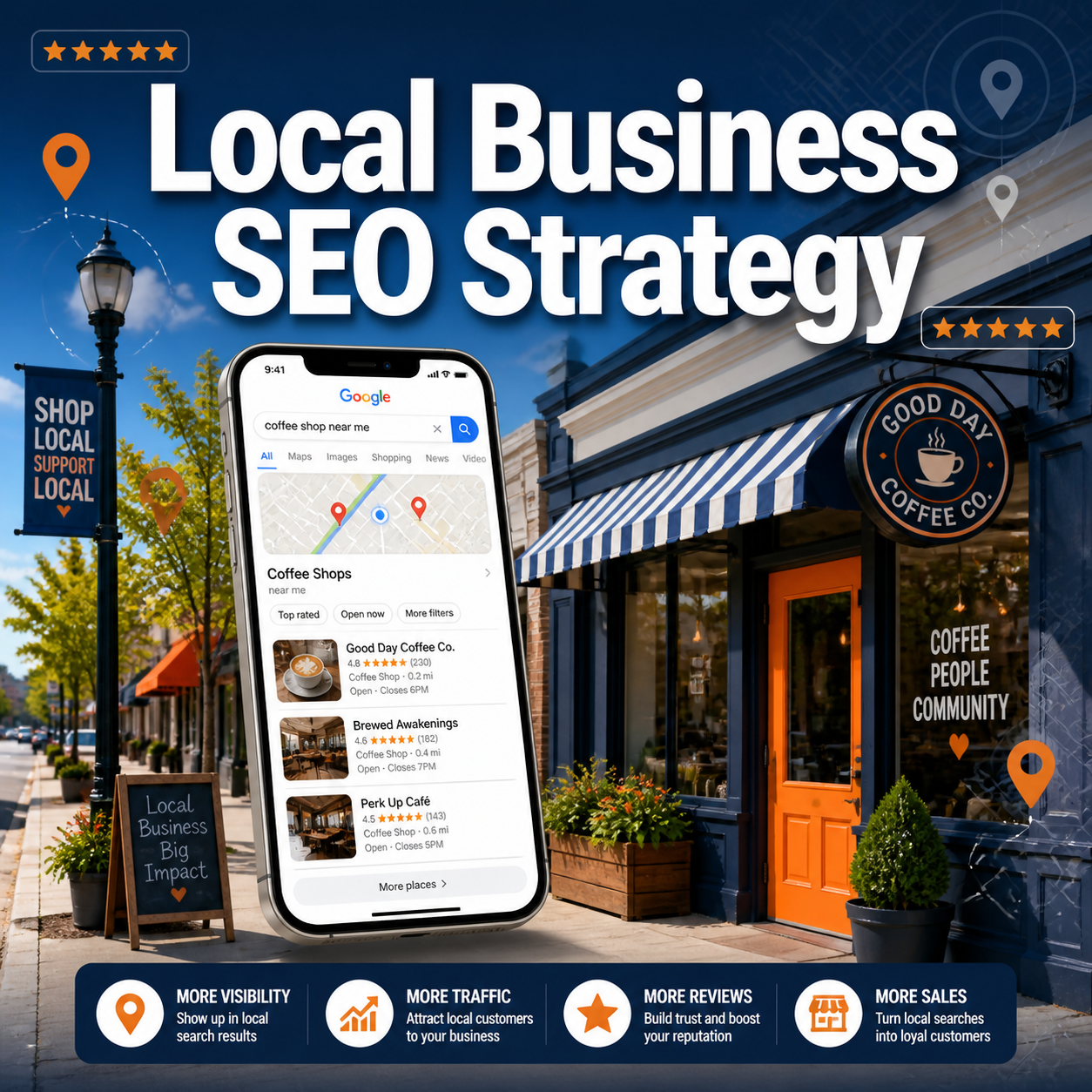
Quick Answer: A local business SEO strategy is a focused plan to help your business appear in Google searches when nearby customers look for your services. It combines Google Business Profile optimization, local keyword targeting, consistent citations, customer reviews, and locally relevant website content to drive real phone calls and foot traffic.
Key Takeaways
- Your Google Business Profile is the single most important local ranking asset you control
- Local Pack rankings depend on three factors: relevance, proximity, and prominence [6]
- Voice search users are three times more likely to search locally than text users, so conversational keywords matter [2]
- NAP consistency (Name, Address, Phone) across all directories directly affects how much Google trusts your business [5]
- Mobile-friendly design is non-negotiable because most local searches happen on phones [4]
- Schema markup helps search engines display your hours, location, and services more accurately [4]
- AI Overviews in Google are now pulling answers directly from well-structured local content [2]
- Reviews influence both rankings and customer decisions — building a review process is part of your SEO strategy [5]
- Locally focused content (city pages, neighborhood guides) signals geographic relevance to Google [5]
- Results from a consistent local business SEO strategy typically begin showing within a few months
What Is a Local Business SEO Strategy and Who Needs One?
A local business SEO strategy is a structured approach to improving your visibility in geographically relevant search results, specifically Google Maps, the Local Pack (the top three map results), and local organic listings. It applies to any business that serves customers in a specific area, whether you’re a plumber in Riverside, a pool service company in Corona, or a landscaper in Temecula.
If your customers search phrases like “HVAC repair near me” or “best cleaning service in Menifee,” you need this strategy. It’s not designed for national e-commerce brands. It’s built for service-area businesses that depend on local leads.
Who benefits most:
- Home service contractors (plumbers, electricians, HVAC)
- Pool and landscaping companies
- Local repair and cleaning services
- Fitness studios and wellness providers
- Any business serving a defined geographic area
Why Does a Local Business SEO Strategy Matter More in 2026?
Google’s search results have changed significantly. AI Overviews now appear at the top of many searches, pulling structured answers directly from business websites and profiles before users ever scroll to traditional results [2]. If your content isn’t structured clearly, you’re invisible to both AI-generated results and standard local searches.
At the same time, voice search has become a dominant behavior for local queries. According to Synup data cited by Ignite Visibility, users are three times more likely to use voice search for local queries than for general searches [2]. That means customers are asking Google Home or Siri things like “Who fixes pools near me?” rather than typing short keywords.
Pull quote: “If your business isn’t optimized for how people actually search locally — conversationally, on mobile, and with location intent — you’re handing leads to competitors who are.”
How Does Google Decide Which Local Businesses Rank?
Google uses three core signals to rank local businesses: relevance, proximity, and prominence [6].
- Relevance: Does your business match what the searcher wants? Accurate categories, detailed service descriptions, and keyword-rich content all improve relevance.
- Proximity: How close is your business to the searcher? You can’t change your location, but you can make sure your address and service area are accurate everywhere online.
- Prominence: How well-known and trusted is your business? Reviews, backlinks, citations, and a complete Google Business Profile all build prominence.
Common mistake: Many small business owners focus only on their website and ignore their Google Business Profile. Both need to work together. A strong website with a weak or incomplete profile will still underperform in local results.
What Are the Core Components of a Local Business SEO Strategy?
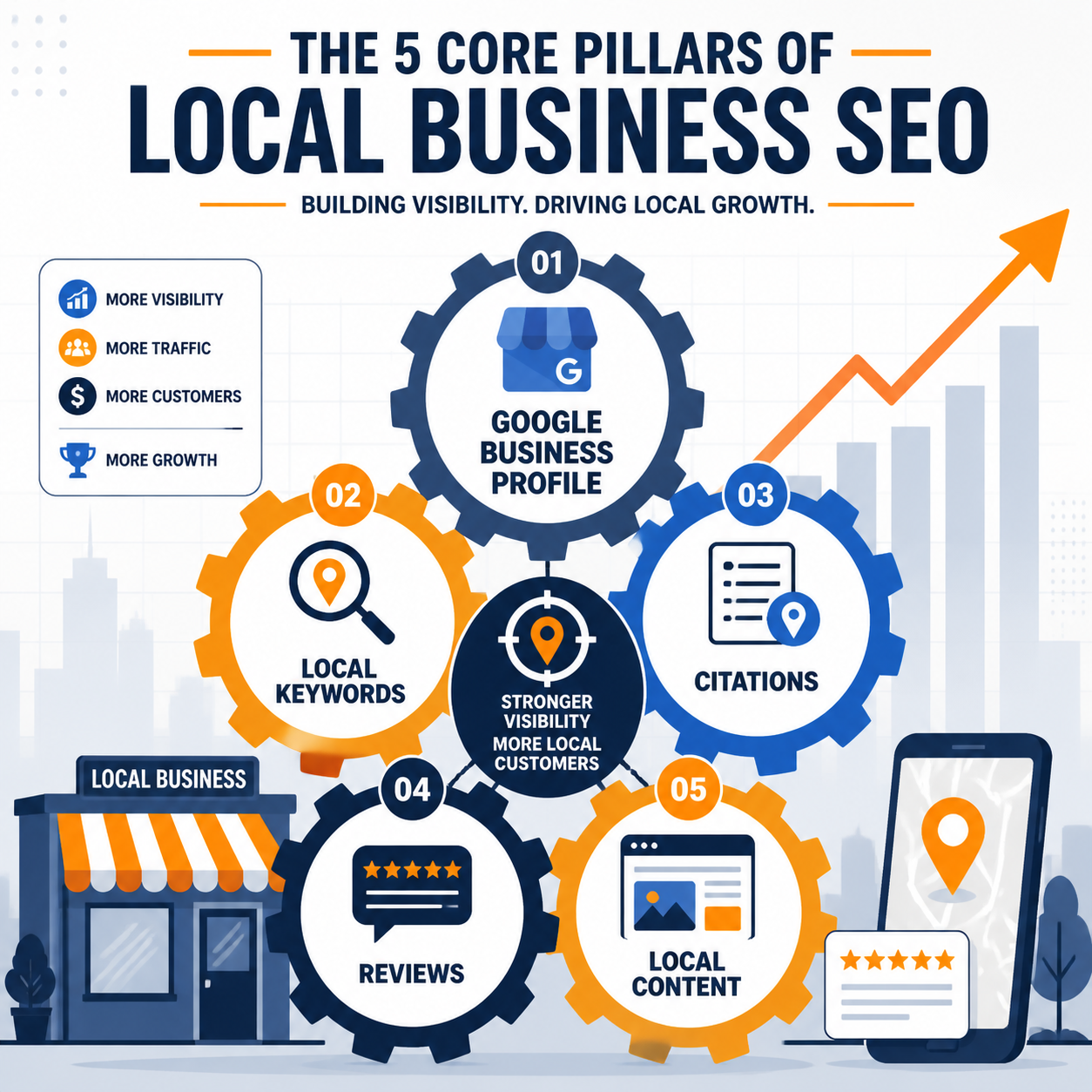
A complete local business SEO strategy covers six interconnected areas. Skipping any one of them creates a gap that limits your overall results.
1. Google Business Profile Optimization
Your GBP is often the first thing a customer sees. A fully optimized profile includes correct business name, address, phone number, hours, service categories, high-quality photos, and a detailed business description [5]. Update it regularly with posts, new photos, and Q&A responses.
For a deeper walkthrough, see this Google Business Profile optimization guide.
2. Local Keyword Research and Placement
Use location-specific phrases like “pool service in Corona” or “Riverside plumber” naturally in your page titles, headings, and body content [4]. Don’t stuff keywords — write for the customer first, then check that your location and service terms appear where they make sense.
3. NAP Consistency and Local Citations
Your business name, address, and phone number must match exactly across Google, Yelp, BBB, Apple Maps, Bing Places, and any other directory [5]. Even small inconsistencies (like “St.” vs. “Street”) can confuse Google and reduce trust.
4. On-Site Content and Service Pages
Thin websites that list services without detail don’t rank well. Each core service needs its own dedicated page with a clear description, local keywords, and a call to action. City or service-area pages help Google understand exactly where you work.
5. Reviews and Reputation
Reviews affect both your ranking and whether customers call you. Build a simple process to ask satisfied customers for Google reviews after every job. Responding to reviews (positive and negative) also signals engagement to Google [5].
6. Schema Markup and Technical SEO
Local business schema gives Google structured data about your hours, location, and services [4]. Combined with fast load times and a mobile-friendly layout, this technical foundation supports everything else you build.
For a complete audit of these areas, use this local SEO audit checklist as your starting point.
How Do You Build Locally Relevant Content?
Locally relevant content tells Google you’re an authority in both your service and your geographic area. This means going beyond generic service descriptions.
Effective local content types:
- City-specific service pages (“Pool Cleaning in Eastvale, CA”)
- Neighborhood guides or local resource posts
- Blog posts addressing local issues (“How Hard Water in the Inland Empire Affects Your Pool”)
- FAQ pages answering questions your local customers actually ask
Voice search queries are longer and more conversational than typed searches [5]. Write content that answers full questions, not just short keyword phrases. For example, a page that answers “How much does pool service cost in Corona?” will perform better for voice search than one that just targets “pool service Corona.”
For more ideas on what’s working right now, see these proven local SEO strategies for 2026.
Local Business SEO Strategy: Step-by-Step Checklist
Use this checklist to prioritize your work. Start at the top and work down.
| Priority | Task | Why It Matters |
|---|---|---|
| 🔴 High | Claim and fully complete your Google Business Profile | Directly affects Local Pack visibility |
| 🔴 High | Fix NAP inconsistencies across all directories | Builds Google’s trust in your location data |
| 🔴 High | Create dedicated pages for each core service | Helps each service rank independently |
| 🟡 Medium | Add local keywords to page titles and headings | Improves relevance signals |
| 🟡 Medium | Build a review request process | Reviews influence rankings and conversions |
| 🟡 Medium | Add local business schema markup | Improves how your listing appears in results |
| 🟢 Ongoing | Publish locally relevant content monthly | Builds geographic authority over time |
| 🟢 Ongoing | Add photos to your GBP weekly | Signals an active, trustworthy business |
What Mistakes Do Small Businesses Make With Local SEO?
Most small business local SEO problems fall into a handful of patterns.
- Ignoring the GBP after setup. A profile that hasn’t been updated in months sends a weak signal to Google.
- No service-area pages. If you serve five cities but only mention one on your website, you’re invisible in the others.
- Inconsistent phone numbers. Using a tracking number on your website but a different number on Google can create NAP conflicts.
- No review strategy. Waiting for reviews to appear organically means your competitors who ask will always outrank you.
- Skipping mobile optimization. Most local searches happen on phones. A slow or hard-to-navigate mobile site loses calls before they happen [4].
If you serve the Inland Empire, businesses like plumbers in Riverside and plumbers in Corona are already competing for these exact searches — which means the bar for a complete, optimized presence is rising.
How Long Does a Local Business SEO Strategy Take to Show Results?
Most businesses see measurable improvements within three to six months when they address the core areas consistently. GBP improvements (better photos, updated categories, new reviews) can show results faster — sometimes within weeks. Content and citation work compounds over time.
Choose this approach if: You want sustainable, long-term lead generation that doesn’t stop the moment you pause an ad budget.
It’s not the right fit if: You need leads within the next 48 hours. In that case, Google Local Services Ads or pay-per-click can bridge the gap while SEO builds.
Conclusion: Your Next Steps
A solid local business SEO strategy isn’t complicated, but it does require consistency across several areas at once. Start with what you can control today.
Actionable next steps:
- Audit your Google Business Profile — check that every field is complete, accurate, and updated
- Search your business name on Google, Yelp, and Bing to find NAP inconsistencies
- Review your website — does each service have its own page with local keywords?
- Ask your last five happy customers for a Google review this week
- Run a full local SEO audit using a structured checklist to find your biggest gaps
If you’re not sure where to start or want expert eyes on your current setup, contact Local Website SEO Services for a local SEO review. We work with small businesses across Corona, Riverside, and the Inland Empire to build visibility that turns into real phone calls.
You can also explore more practical guides and local SEO tips on our blog.
Frequently Asked Questions
What is a local business SEO strategy?
A local business SEO strategy is a plan to improve your business’s visibility in Google’s local search results, including the Map Pack and local organic listings. It includes optimizing your Google Business Profile, website, citations, reviews, and local content.
How is local SEO different from regular SEO?
Regular SEO targets broad or national search traffic. Local SEO focuses on searches with geographic intent — people looking for services in a specific city or neighborhood. It relies heavily on Google Business Profile and location-specific content.
Do I need a Google Business Profile for local SEO?
Yes. For most local businesses, a Google Business Profile is the most important single asset for local visibility. Without it, you won’t appear in Google Maps or the Local Pack.
How many reviews do I need to rank locally?
There’s no fixed number. What matters is having more recent, positive reviews than your local competitors, and responding to reviews consistently. Quality and recency matter as much as quantity.
Can I do local SEO myself?
Yes, especially for the basics: completing your GBP, fixing NAP issues, and creating service pages. More technical work like schema markup or competitive keyword research may benefit from professional help.
How much does local SEO cost for a small business?
Costs vary widely. DIY is free but time-intensive. Professional local SEO services for small businesses typically range from a few hundred to a few thousand dollars per month depending on competition and scope.
What is NAP consistency and why does it matter?
NAP stands for Name, Address, and Phone number. Consistent NAP across all online directories helps Google verify your business information and trust your location data, which supports local rankings [5].
Does social media affect local SEO?
Indirectly. Social media doesn’t directly boost local rankings, but active profiles can drive traffic to your website and GBP, and they help establish your business’s online presence and credibility.
What is the Local Pack?
The Local Pack is the group of three business listings (with a map) that appears at the top of Google search results for local queries. Appearing here drives significant call and click volume.
How does voice search affect my local SEO strategy?
Voice searches are longer and more conversational. Optimize by writing content that answers full questions naturally, and make sure your GBP has complete, accurate information since voice assistants often pull answers directly from it [2].
References
[1] Local SEO for Multi-Location Businesses: Strategies for Growth in 2025 – https://thesmarketers.com/blogs/local-seo-for-multi-location-businesses-strategies-for-growth-in-2025/
[2] Local SEO Trends – https://ignitevisibility.com/local-seo-trends/
[3] Local SEO Strategy – https://www.brightlocal.com/learn/local-seo-strategy/
[4] 5 Local SEO Best Practices for Small Businesses – https://boulderseomarketing.com/5-local-seo-best-practices-for-small-businesses/
[5] Best Local SEO Strategies – https://blacksmith.agency/resources/digital-marketing/best-local-seo-strategies/
[6] Optimizing Local SEO – https://wordlift.io/blog/en/optimizing-local-seo/
[7] Effective Local SEO Strategies for Small Businesses Today – https://precisionmarketingpartners.com/effective-local-seo-strategies-for-small-businesses-today/
Tags: local business seo strategy, local SEO, Google Business Profile, small business SEO, local citations, NAP consistency, local keyword research, voice search SEO, local pack ranking, service area pages, review strategy, Inland Empire SEO