On-Site SEO Service: Expert Optimization for Higher Rankings
On-Site SEO Service: Your Website’s Best Friend (And Why You’re Probably Neglecting It)
Last updated: July 6, 2026
Quick Answer: An on-site SEO service optimizes everything directly on your website, title tags, content, site speed, internal links, schema markup, and mobile performance, so search engines can find, understand, and rank your pages. For small businesses, it’s the single highest-leverage SEO investment because it fixes the foundation before any off-site work can deliver results. Most businesses see measurable improvements in organic traffic within 3 to 6 months of thorough on-site optimization.
Key Takeaways
- On-site SEO covers every element you control directly on your website: technical structure, content quality, metadata, and user experience.
- Without solid on-site SEO, off-site tactics like link building produce far weaker results; you’re building on a broken foundation.
- A professional on-site SEO service typically includes a technical audit, keyword mapping, content optimization, internal linking, schema markup, and Core Web Vitals improvements [1][2].
- For local small businesses, on-site SEO must also include NAP consistency, local schema, and location-specific landing pages.
- On-site SEO service costs range widely, from roughly $500 for a one-time audit to $1,500+ per month for ongoing optimization, depending on site size and provider.
- Results are not instant: expect 3 to 6 months for meaningful ranking shifts, with compounding gains over 12+ months.
- WordPress sites have specific on-site SEO needs and plugin considerations that differ from custom-built platforms.
- Red flags to avoid include providers who guarantee specific rankings, refuse to explain their methods, or rely on keyword stuffing.
- Only 8.9% of users are familiar with the term “search engine optimization,” which means most of your competitors are likely neglecting it too [7].
- The best on-site SEO services tie their work directly to business outcomes, not just rankings, but traffic quality and conversions.
What Is On-Site SEO and How Does It Work?
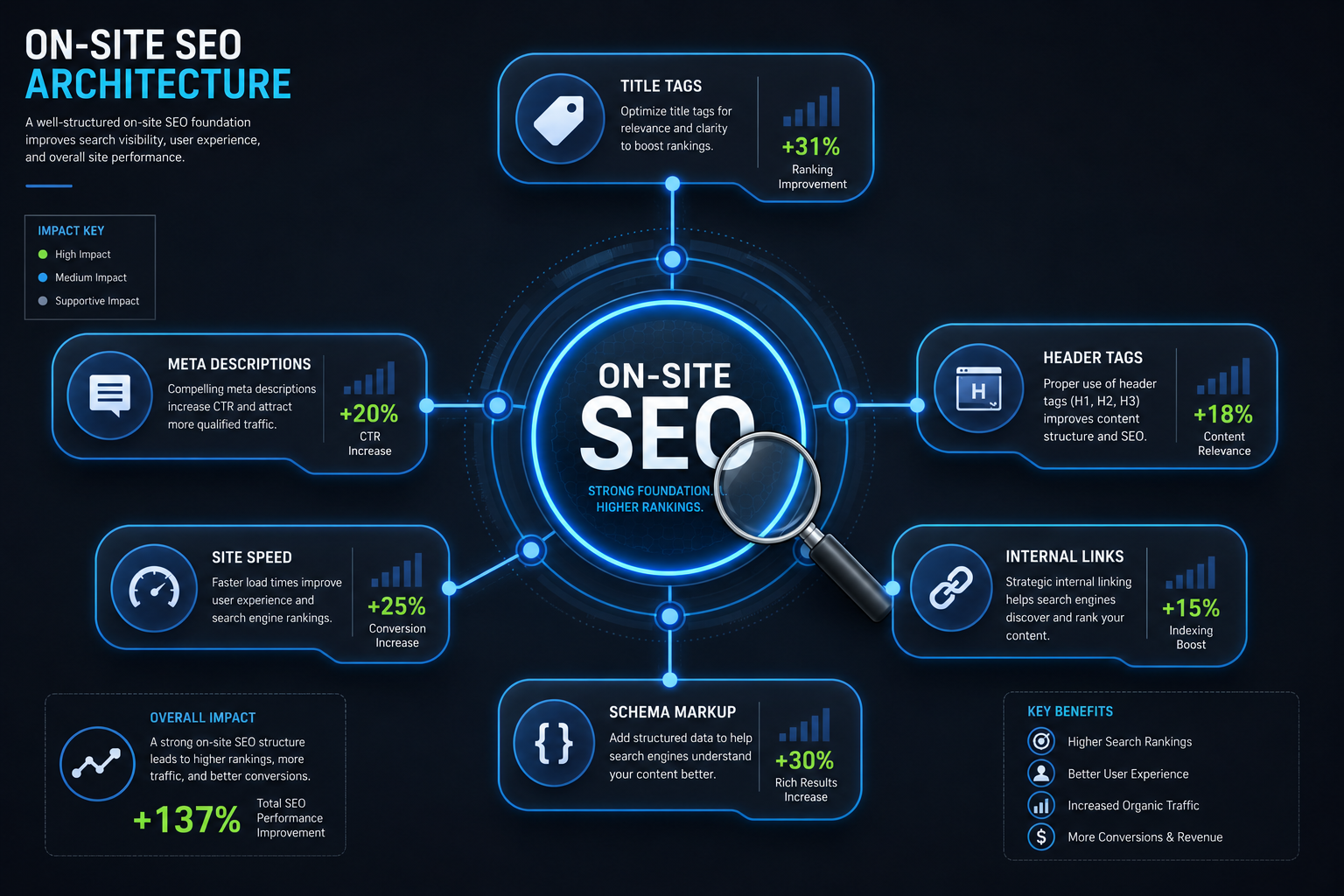
On-site SEO (also called on-page SEO) is the practice of optimizing elements within your own website to improve its visibility in search engine results. It works by making your site easier for search engine crawlers to read, understand, and rank, while simultaneously making it more useful for real visitors.
Search engines like Google send automated bots to crawl your website. Those bots read your page titles, headings, content, internal links, image alt text, and code structure. If those elements are clear, well-organized, and relevant to what people are searching for, Google is more likely to rank your pages for those queries. If they’re messy, slow, or confusing, your pages get buried.
Here’s what on-site SEO actually touches:
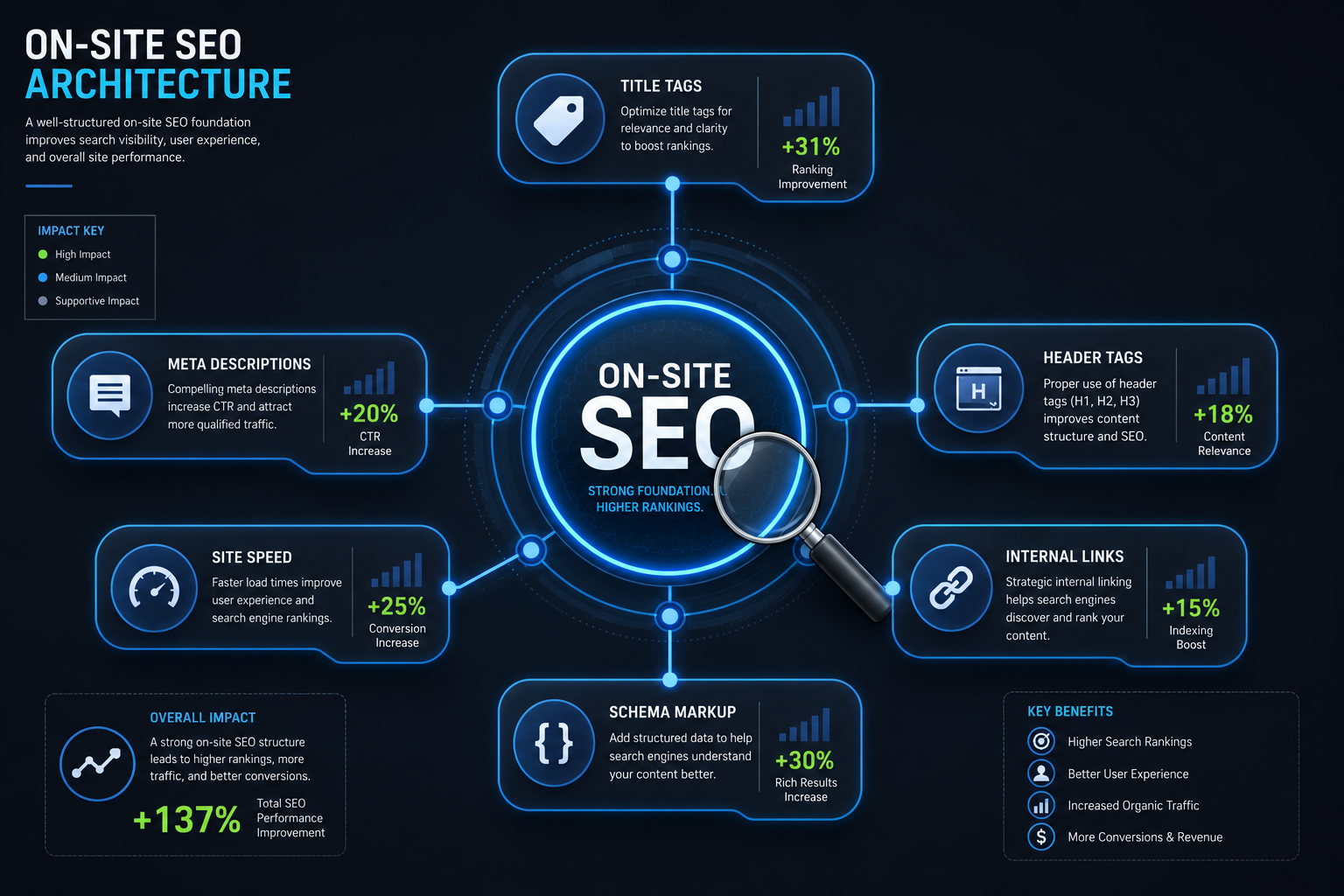
- Title tags, the clickable headline shown in search results [4]
- Meta descriptions, the short summary below the title in search results [4]
- Header tags (H1, H6), the structural outline of each page
- Body content, keyword relevance, depth, and readability
- Internal links, connections between your own pages [3]
- Image optimization, file size, alt text, and descriptive filenames
- URL structure, clean, descriptive page addresses
- Schema markup, structured data that helps Google display rich results [5]
- Site speed and Core Web Vitals, loading, interactivity, and visual stability [2]
- Mobile responsiveness, how your site performs on phones and tablets [6]
A professional on-site SEO service starts with a comprehensive audit to identify which of these elements are broken, missing, or underperforming. Then it systematically fixes and improves them. For a deeper look at what a site audit involves, see this complete SEO site audit guide for Inland Empire businesses.
On-Site SEO vs. Off-Site SEO: What’s the Difference?
On-site SEO covers everything you control on your own website. Off-site SEO covers everything that happens elsewhere, primarily backlinks from other sites, Google Business Profile signals, and social mentions. Both matter, but on-site SEO must come first.
Think of it this way: off-site SEO sends authority and trust signals to your site. But if your site can’t receive and use those signals properly because of technical errors, thin content, or poor structure, that authority leaks away. You’re essentially pouring water into a cracked container.
| Factor | On-Site SEO | Off-Site SEO |
|---|---|---|
| Control | Full, you own every element | Partial, depends on other sites |
| Examples | Title tags, content, site speed, schema | Backlinks, citations, Google Business Profile |
| Timeline | 3-6 months for visible gains | 6-12 months for authority to build |
| Priority order | First, fix before off-site work | Second, amplifies on-site foundation |
| Best for | All businesses, especially local | Competitive industries needing authority |
Decision rule: If your site has never had a professional audit, start with on-site SEO before spending a dollar on link building or paid citations.
What Does an On-Site SEO Service Include, Exactly?
A quality on-site SEO service is not just “fixing your keywords.” It covers a structured set of technical and content improvements across your entire website [1][2][3].
Here’s what a thorough service should deliver:
Technical audit and fixes
- Crawlability and indexation review, checking that Google can actually access your pages [2]
- Status code analysis (404 errors, redirect chains, broken links) [2]
- Core Web Vitals assessment, measuring loading speed, interactivity, and visual stability [2]
- SSL certificate verification
- XML sitemap and robots.txt review
Content optimization
- Title tag rewrites for each key page [4]
- Meta description improvements to increase click-through rates [4]
- Header tag restructuring (H1, H2, H3 hierarchy)
- Keyword mapping, aligning specific search terms to specific pages [5]
- Thin content identification and improvement [3]
- Duplicate content detection and resolution [2]
Structural improvements
- Internal linking strategy, distributing authority across your site, and guiding visitors logically [3]
- URL structure cleanup
- Image optimization, compression, alt text, descriptive filenames
- Schema markup implementation for rich results (FAQs, reviews, services, local business) [5]
Local-specific elements (for small businesses)
- NAP consistency across all pages
- Local business schema markup
- Location-specific landing pages
- Google Business Profile alignment
For small businesses in Southern California, see our on-page local SEO guide for a region-specific breakdown of these elements.
Do I Really Need On-Site SEO Services?
Yes, especially if your site has never been professionally audited, if your organic traffic has stalled, or if you’re spending on ads while your organic rankings sit on page 3. A 2022 study found that only 8.9% of users are familiar with the term “search engine optimization” [7], which means most small business owners are managing their sites without understanding what’s actually holding them back.
You probably need an on-site SEO service if:
- Your site loads slowly on mobile devices
- You’ve never reviewed your title tags or meta descriptions
- Your pages don’t rank even for your own business name plus city
- You have duplicate pages, thin content, or broken links you don’t know about
- You’ve been doing SEO for a year with no measurable traffic growth
You might be able to manage without it if your site is brand new (start with a solid setup instead), you’re in a very low-competition niche with almost no local competitors, or you have an in-house team with genuine technical SEO experience.
For most local small businesses, the honest answer is: the DIY approach leaves too many issues undetected. A professional service pays for itself by uncovering problems that have been quietly costing you traffic for months or years.
How Much Does an On-Site SEO Service Cost?
On-site SEO service costs vary based on site size, competitive market, and scope of work. For small businesses, expect to pay roughly $100 to $2,500 for a one-time audit and optimization project, or $750 to $2,000 per month for ongoing on-site SEO management.
Here’s a general breakdown:
- One-time technical audit only: $300 to $800 for small sites (under 20 pages)
- Audit plus initial optimization: $800 to $2,500, depending on site complexity
- Ongoing monthly on-site SEO: $750 to $2,000/month for small business sites
- Enterprise or e-commerce sites: $2,500 to $10,000+ per month
Factors that push costs higher include large product catalogs, multiple location pages, severe technical issues, and highly competitive local markets.
For a detailed breakdown of what you should expect to pay and what to watch out for, our local SEO pricing guide covers the full range of service tiers.
Common mistake: Choosing the cheapest option available. Low-cost providers often deliver automated reports with no actual implementation, leaving you with a list of problems and no solutions.
How Long Does It Take to See Results from an On-Site SEO Service?
Most businesses see initial ranking improvements within 3 to 6 months of completing on-site optimization. Full results, including compounding traffic growth, typically take 6 to 12 months. Sites with severe technical issues may see faster gains once those issues are resolved, because they were actively suppressing rankings.
Realistic timeline:
- Month 1-2: Audit complete, fixes implemented, Google begins re-crawling updated pages
- Month 3-4: Initial ranking shifts are visible for lower-competition keywords
- Month 5-6: Measurable organic traffic increase for target pages
- Month 9-12: Compounding gains as content authority builds and internal linking distributes equity
What speeds up results: fixing critical crawl errors quickly, significantly improving page speed, and adding or improving content on pages that already have some ranking history.
What slows results: a brand-new domain with no history, a highly competitive local market, or only partial implementation of recommended fixes.
On-Site SEO Services for Small Businesses: What Matters Most
For small local businesses, an on-site SEO service needs to prioritize local relevance above all else. A general on-page optimization approach designed for national brands won’t fully serve a plumber in Riverside or a salon in Temecula.
The highest-impact on-site elements for local small businesses are:
- Location-specific title tags include your city and service in every key page title
- Local business schema markup tells Google your name, address, phone, hours, and service area
- NAP consistency, your Name, Address, and Phone number must match exactly on every page
- Service area pages, dedicated pages for each city or neighborhood you serve
- Mobile performance, most local searches happen on phones; slow mobile sites lose customers immediately [6]
- Google Business Profile alignment: Your website content should mirror and reinforce your GBP listing
For small businesses just getting started, our small business SEO services guide walks through the full local optimization process step by step.
On-Site SEO Service for E-Commerce Sites
E-commerce sites face on-site SEO challenges that standard service packages often underestimate. The core issues are scale (hundreds or thousands of pages), duplicate content from product variations, and thin category pages that add little unique value.
Key on-site SEO priorities for e-commerce:
- Canonical tags prevent duplicate content penalties when the same product appears under multiple categories
- Product page optimization, each product needs a unique title tag, meta description, and descriptive content (not just the manufacturer’s copy)
- Category page content: add introductory text and FAQs to category pages so they rank independently
- Faceted navigation handling, filter pages (size, color, price) can generate thousands of near-duplicate URLs; use no-index or canonical tags to manage them
- Structured data for products, price, availability, and review schema enable rich results that increase click-through rates [5]
- Site architecture: Keep any product within three clicks of the homepage
Edge case: If you sell on both your own site and a marketplace like Amazon, ensure your product descriptions are unique. Copying manufacturer descriptions across both platforms creates duplicate content issues that hurt your own site’s rankings.
On-Site SEO Service for WordPress Sites
WordPress is the most common platform for small-business websites, and it has specific on-site SEO considerations that differ from those of custom-built sites. The good news: WordPress is highly SEO-friendly when configured correctly. The bad news: most WordPress sites are not configured correctly out of the box.
Critical WordPress-specific on-site SEO tasks:
- SEO plugin setup, Yoast SEO or Rank Math, must be properly configured, not just installed
- Permalink structure, set to “Post name” (not the default numeric format) for clean URLs
- XML sitemap, generate and submit to Google Search Console via your SEO plugin
- Image compression, WordPress doesn’t auto-compress images; use a plugin like ShortPixel or Smush
- Page speed, WordPress sites often accumulate slow plugins; a performance audit is essential
- Duplicate content from tags and categories, WordPress generates archive pages that can create duplicate content; configure no-index settings appropriately
For a complete walkthrough of WordPress-specific local SEO setup, see our local WordPress SEO guide.
On-Site SEO Services Near Me: How to Find and Evaluate Local Providers
“On-site SEO services near me” is a common search query, but proximity matters less than expertise and transparency. A local provider who understands your specific market, city-level competition, regional search behavior, and local directories can offer real advantages over a national agency that treats every client the same.
When evaluating local on-site SEO providers, ask these specific questions:
- Can you show me a sample audit report from a previous client (anonymized)?
- What specific on-site changes will you make in the first 30 days?
- How do you measure success beyond rankings?
- Do you implement the changes, or just provide recommendations?
- What does your reporting look like month to month?
A provider who answers these clearly and specifically, without vague promises, is worth a conversation. One who leads with ranking guarantees or refuses to explain their process is not.
For businesses in Southern California, our Inland Empire local SEO services team specializes in on-site optimization for small businesses across Riverside, Corona, Temecula, and surrounding cities.
On-Site SEO Service: Common Mistakes to Avoid
The most common on-site SEO mistakes are not technical errors; they’re strategic oversights that waste time and budget. Knowing what to avoid is as important as knowing what to do.
Keyword stuffing, forcing a keyword into every sentence, damages readability and can trigger Google penalties. Write for people first; include keywords where they fit naturally [4].
Ignoring title tag length, Title tags over 60 characters get cut off in search results. Every character counts when that title is your first impression [4].
Duplicate title tags and meta descriptions. Many small business sites use the same meta description on every page. Each page needs unique, specific metadata.
No internal linking strategy, Publishing content without linking it to related pages leaves authority stranded. A deliberate internal linking plan distributes that authority across your site [3].
Skipping schema markup, Most small business sites have zero structured data. Adding local business, FAQ, and service schema is one of the fastest ways to improve how your site appears in search results [5].
Treating on-site SEO as a one-time project, Search algorithms update, competitors improve their sites, and your content ages. On-site SEO requires periodic reviews, not a single fix.
Optimizing for the wrong keywords. High-volume keywords sound impressive, but often have low conversion intent. Aligning keywords with actual buying behavior produces better business results [5].
On-Site SEO Service vs. Hiring In-House: Which Is Right for You?
For most small businesses, hiring an on-site SEO service is more cost-effective than bringing someone in-house. A full-time SEO specialist costs $55,000 to $85,000 per year in salary alone, before benefits, tools, and training. A professional service typically costs $9,000 to $24,000 per year and brings a team with specialized tools already in place.
Choose an on-site SEO service if:
- You have fewer than 500 pages on your site
- You need results without a long hiring and onboarding process
- Your SEO needs are consistent, but not full-time in scope
- You want access to a team (technical, content, strategy) rather than one generalist
Choose in-house if:
- You have a large site with constant content publishing needs
- You’re in a highly competitive market requiring daily optimization
- You have the budget for a senior specialist plus tools ($10,000+ per year in software alone)
- SEO is a core part of your product or business model
For most local small businesses, the service model wins on both cost and results. Our guide on SEO services for small businesses covers this comparison in more detail.
Red Flags to Avoid When Choosing an On-Site SEO Service
Not every provider offering on-site SEO services delivers real value. Some rely on outdated tactics, automated reports with no implementation, or vague deliverables that make it impossible to measure results.
Watch for these specific warning signs:
- Guaranteed rankings: No legitimate provider can guarantee specific positions. Google’s algorithm is not for sale.
- No audit before recommendations. Any provider who proposes a strategy without first auditing your site is guessing.
- Keyword stuffing in their own content. If their website reads like it was written by a bot, that’s how they’ll treat yours.
- No clear deliverables, “We’ll optimize your site” is not a deliverable. Ask for a specific list of what changes will be made.
- Refusing to share reports or access, You should always have access to your own Google Search Console and Analytics data.
- Overnight results promise, but sustainable on-site SEO takes months. Anyone promising page-one rankings in two weeks is selling something that won’t last.
- No case studies or references. Legitimate providers have examples of their work and clients willing to speak to the results [1].
For a structured checklist to evaluate any SEO provider, our guide on 10 critical factors for selecting an SEO company is a useful starting point.
Conclusion: Your Next Steps With On-Site SEO
On-site SEO service is not a luxury for large companies with big budgets. For local small businesses competing in 2026, it’s the foundation that determines whether everything else you do in marketing actually works.
Here’s where to start:
- Get a professional site audit. You can’t fix what you don’t know is broken. Start with a structured audit of your technical setup, content, and metadata. Our free local SEO audit checklist is a good first step you can do yourself.
- Prioritize your top five pages, Homepage, main service page, and your top three traffic pages. Fix those first before touching anything else.
- Add local schema markup. If you serve a specific city or region, local business schema is one of the fastest wins available with no content writing required.
- Fix site speed on mobile. Run your site through Google’s PageSpeed Insights. If your mobile score is below 70, that’s your first technical priority.
- Build an internal linking plan, identify your most important pages, and ensure at least 3 other pages on your site link to them.
- Set a 90-day review. On-site SEO is not set-and-forget. Schedule a 90-day review to measure what moved and what still needs work.
The businesses that will dominate local search in 2026 and beyond are not the ones spending the most on ads. They’re the ones that built a website search engines can actually read, and visitors actually trust.
Frequently Asked Questions
What is the difference between on-site SEO and technical SEO?
Technical SEO is a subset of on-site SEO. On-site SEO covers both technical elements (site speed, crawlability, schema) and content elements (title tags, headings, internal links). Technical SEO refers specifically to the infrastructure and code-level factors that affect how search engines access and process your site.
How often should on-site SEO be reviewed?
For most small businesses, a full on-site SEO review every 6 months is sufficient, with monthly checks on Core Web Vitals and any new pages added. After a major Google algorithm update, an immediate review is advisable.
Can I do on-site SEO myself?
Yes, for basic elements like title tags, meta descriptions, and image alt text. Technical issues, crawl errors, schema markup, and Core Web Vitals fixes typically require professional tools and expertise to address correctly without creating new problems.
Does on-site SEO help with Google Maps rankings?
Indirectly, yes. Your website’s on-site signals (local schema, NAP consistency, location pages) reinforce your Google Business Profile and contribute to local pack rankings. On-site SEO and Google Business Profile optimization work together, not independently.
What’s the most important on-site SEO element for a small business?
For small local businesses, schema markup and location-specific title tags have the most direct impact on local search visibility. After those, mobile page speed is the next highest priority.
How do I know if my on-site SEO is working?
Track organic traffic in Google Analytics, keyword rankings in Google Search Console, and conversion rates for organic visitors. Rankings alone are not sufficient, you want to see traffic and business outcomes improving together.
Is on-site SEO a one-time fix or ongoing work?
Both. An initial optimization project addresses existing issues. Ongoing work maintains performance as Google’s algorithm updates, competitors improve their sites, and you add new content. Most businesses benefit from quarterly on-site reviews at a minimum.
Does on-site SEO affect paid search performance?
Yes. Google Ads uses a Quality Score that includes landing page experience, which is essentially on-site SEO. Better on-site optimization can lower your cost per click and improve ad performance alongside organic results.
What tools do on-site SEO services use?
Common tools include Screaming Frog (technical audits), Ahrefs or SEMrush (keyword and competitor analysis), Google Search Console (indexation and performance), PageSpeed Insights (Core Web Vitals), and Schema Markup Validator (structured data testing).
How is on-site SEO different for a service business vs. a product business?
Service businesses focus on location pages, service-specific content, and trust signals like reviews and credentials. Product businesses focus on product page uniqueness, category structure, and schema for pricing and availability. Both need the same technical foundation, but the content strategy differs significantly.
References
[1] On Page – https://www.outerboxdesign.com/digital-marketing-services/seo/on-page/?utm_source=openai
[2] On Page Seo Services – https://enleaf.com/services/on-page-seo-services/?utm_source=openai
[3] On Page Seo Services – https://www.20northmarketing.com/digital-marketing-services/on-page-seo-services?utm_source=openai
[4] On Site Optimization – https://www.firestarterseo.com/seo/on-site-optimization/?utm_source=openai
[5] On Page Seo – https://www.webfx.com/seo/services/on-page-seo/?utm_source=openai
[6] On Page Seo – https://www.1stoplink.com/services/on-page-seo?utm_source=openai
[7] arxiv – https://arxiv.org/abs/2204.10078?utm_source=openai
Meta Title: On-Site SEO Service: Complete Guide for Small Businesses
Meta Description: Learn what an on-site SEO service includes, how much it costs, how long results take to appear, and how to avoid common mistakes. Built for local small businesses in 2026.
Tags: on site seo service, on-page SEO, local SEO, small business SEO, technical SEO, website optimization, SEO audit, content optimization, mobile SEO, schema markup, WordPress SEO, local search rankings