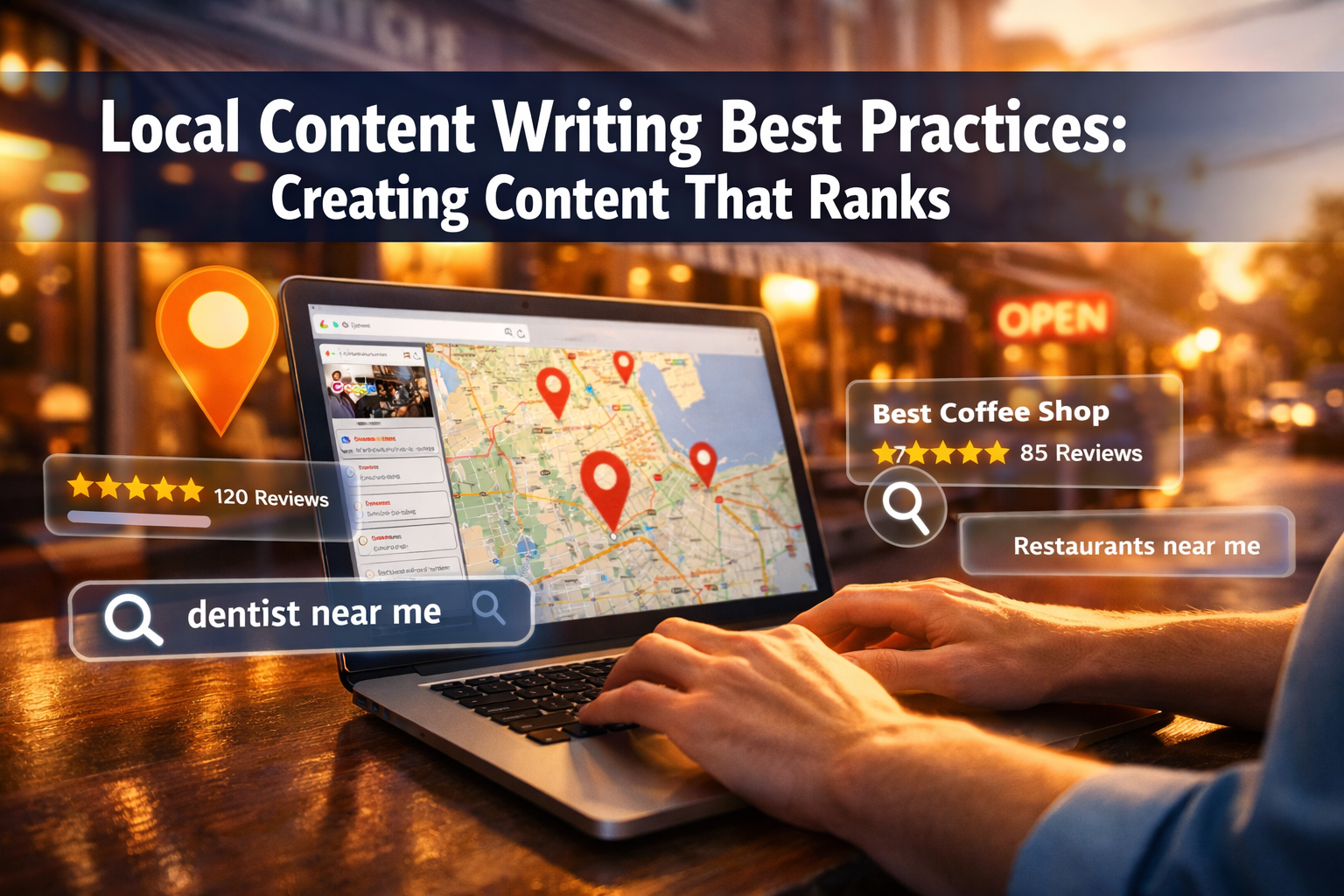
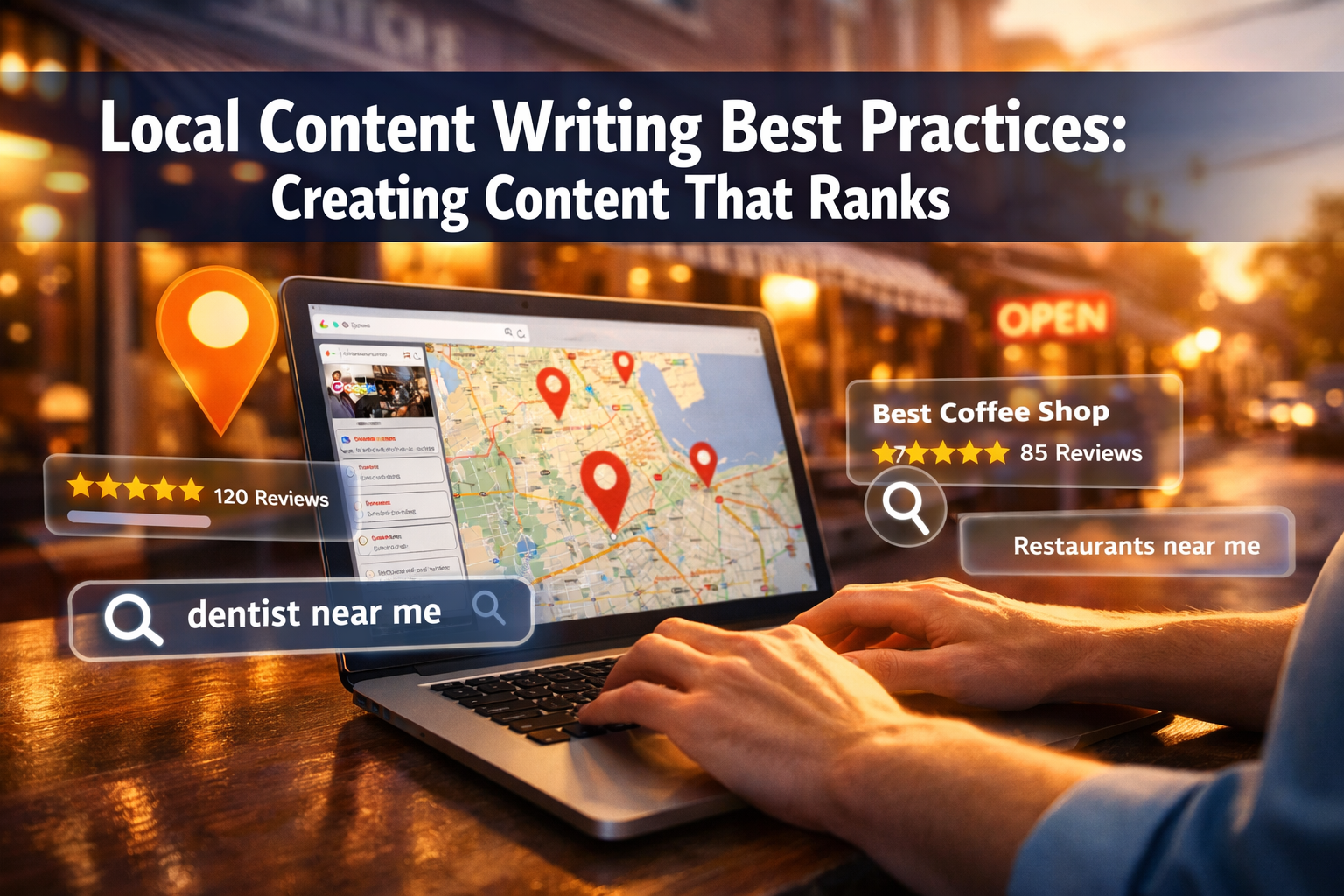
Here’s the truth: you can have the best plumbing skills in Corona or run the most reliable HVAC company in Riverside, but if people can’t find you online, you’re invisible. And in 2026, being invisible means losing customers to competitors who’ve figured out local content writing best practices — creating local-centric SEO content that ranks.
I’ve seen it happen too many times. A solid local business with great reviews and loyal customers struggles to attract new ones because their website reads like it could be anywhere in the country. Generic content doesn’t cut it anymore. Google’s gotten smarter, and so have your potential customers. They’re searching for “emergency plumber in Corona” or “best auto repair near me” — and if your content doesn’t speak their language and reflect their neighborhood, you’re not showing up.
Let’s fix that. We’re diving into the real, practical strategies that help local businesses like yours create content that doesn’t just exist — it ranks, converts, and makes your phone ring.
Key Takeaways
- Location-specific content signals local expertise — mentioning actual neighborhoods, landmarks, and community connections tells Google (and customers) you’re the real deal in your area
- Each service area needs its own unique content — cookie-cutter pages with swapped city names don’t work; Google sees through it and your rankings suffer
- Local keywords should feel natural, not forced — integrate terms like “Corona HVAC repair” or “Riverside chiropractor” into genuinely helpful content that answers real customer questions
- Consistency across all platforms matters — your NAP (Name, Address, Phone) must match exactly everywhere, from your website footer to your Google Business Profile
- Community-focused content builds authority — blog posts about local events, neighborhood guides, and local case studies prove you’re embedded in the community, not just serving it
Why Local Content Writing Best Practices Matter for Your Business

Let’s start with what we mean by local content writing. It’s not just slapping your city name into a generic service page and calling it a day. Real local content writing best practices involve creating content that’s genuinely rooted in your community — content that reflects your local expertise, speaks to local concerns, and proves you understand the area you serve.
Think about it from your customer’s perspective. When someone in Corona searches for “reliable electrician,” they’re not just looking for someone with electrical skills. They want someone who knows the older homes in the historic district, understands the permit requirements with the local building department, and can get there quickly when an emergency strikes.
Your content needs to prove you’re that person.
Google’s algorithm has gotten incredibly sophisticated at understanding local intent. It doesn’t just look at whether you’ve mentioned a city name — it analyzes the depth and authenticity of your local connections. Are you writing about actual neighborhoods? Mentioning real landmarks? Discussing local regulations or seasonal issues specific to your area?
This is where most businesses drop the ball. They create one generic service page and maybe add a location tag. That’s not local content — that’s lazy content. And it doesn’t rank.
Understanding Local Search Intent and Behavior
Before you write a single word, you need to understand how your local customers actually search. In 2026, local search behavior breaks down into a few key categories:
Emergency/Immediate Need Searches
- “24 hour plumber Corona”
- “emergency HVAC repair near me”
- “open now auto repair Riverside”
Research/Comparison Searches
- “best chiropractor in Corona CA”
- “top-rated landscaper Riverside reviews”
- “affordable dental implants near me”
Specific Service + Location Searches
- “water heater installation Corona”
- “AC tune-up Riverside CA”
- “brake repair Eastvale”
Each type of search requires different content. Emergency searches need quick, clear information about your availability and response time. Research searches need detailed service explanations, credentials, and social proof. Specific service searches need dedicated pages that thoroughly cover that exact service in that exact location.
Your local SEO strategy should address all three types with targeted content.
Creating Location-Specific Landing Pages That Actually Rank
Here’s where we get into the nuts and bolts of local content writing best practices. If you serve multiple cities or neighborhoods, you need individual landing pages for each location. But — and this is crucial — each page must have genuinely unique content.
What doesn’t work:
Creating one template and swapping out city names. Google’s algorithm is way too smart for that in 2026. It recognizes duplicate content patterns and will tank your rankings across all those pages.
What does work:
Creating unique pages that include:
- Specific neighborhood references — mention actual street names, local landmarks, nearby businesses
- Location-specific service details — “We serve the historic district homes in downtown Corona, where older electrical systems often need specialized attention”
- Local team members — “Meet Sarah, our lead technician serving the Riverside area for 12 years”
- Unique NAP for each location — if you have multiple physical locations, each needs its own address and phone number displayed consistently
- Embedded Google Map — showing your business location or service area for that specific region
- Location-specific testimonials — reviews from customers in that area, mentioning their neighborhood or city
- Local case studies — real projects you’ve completed in that area with before/after details
I’ve seen this approach transform rankings. One HVAC client went from page 3 to the top 3 map pack results in Corona within four months just by replacing generic location pages with genuinely unique, locally-focused content.
Optimizing Your Content Structure for Local SEO
The way you structure your content matters just as much as what you write. Here’s the hierarchy that works:
H1 Tag — Your Primary Local Keyword
Your H1 should include your main service and location: “Emergency Plumbing Services in Corona, CA” or “Riverside’s Trusted HVAC Repair Experts”
H2 Tags — Service Variations and Local Keywords
Break down your content with H2s that include related local terms:
- “Why Corona Homeowners Choose Our Plumbing Services”
- “Common HVAC Issues in Riverside’s Climate”
- “Serving Corona, Norco, and Eastvale Communities”
H3 Tags — Specific Details and Long-Tail Keywords
Use H3s for more specific topics:
- “Water Heater Repair in Corona’s Older Neighborhoods”
- “AC Installation for Riverside’s Hot Summers”
This structure helps Google understand your content hierarchy while naturally incorporating local keywords throughout. It also makes your content scannable for readers — and in 2026, people skim more than ever.
Writing Local Keywords That Don’t Sound Robotic
Here’s where a lot of businesses mess up. They know they need local keywords, so they stuff them awkwardly into every sentence until the content reads like it was written by a malfunctioning robot.
Bad example:
“Our Corona plumbing company provides Corona plumbing services to Corona residents who need Corona plumbers for their Corona plumbing needs.”
Yeah, that’s awful. Don’t do that.
Good example:
“We’ve been serving Corona homeowners since 2010, handling everything from emergency repairs in the historic district to new installations in the growing neighborhoods near Dos Lagos. Our team knows the local plumbing challenges — from older pipe systems in established areas to the specific needs of newer construction.”
See the difference? The second version mentions Corona naturally, references actual local areas (historic district, Dos Lagos), and provides context that proves local expertise. It’s written for humans first, search engines second — which is exactly what Google wants in 2026.
When you’re working on your content marketing strategy, always read your content out loud. If it sounds weird or forced, rewrite it. Local keywords should flow naturally within genuinely helpful information.
Creating Local Blog Content That Builds Authority
Your service pages handle the direct “I need this service now” searches. Your blog handles everything else — and it’s where you really prove your local expertise.
Local blog content that works:
Community Event Coverage
Write about local events, especially if you’re participating or sponsoring. “Supporting the Corona High School Football Team” or “What We Learned at the Riverside Small Business Expo” shows community involvement.
Neighborhood Guides
Create detailed guides about the areas you serve. “The Complete Guide to Corona’s Neighborhoods: Where to Live and What to Know” or “Riverside’s Best Family-Friendly Spots” position you as a local expert, not just a service provider.
Local Case Studies
Detail actual projects you’ve completed for local customers. “How We Solved a Tricky HVAC Issue in a Historic Corona Home” tells a story while showcasing expertise and local knowledge.
Seasonal Local Content
Address seasonal issues specific to your area. “Preparing Your Riverside Home’s AC for Summer Heat” or “Fall Plumbing Maintenance for Corona Homeowners” targets timely, location-specific concerns.
Local Industry News
Comment on local regulations, building codes, or industry changes affecting your area. “New Corona Building Codes: What Homeowners Need to Know” establishes thought leadership.
The key is making sure every piece of content includes genuine local references — not just a city name dropped in for SEO purposes, but real, specific details that only someone with local knowledge would know.
Displaying Your NAP Consistently Everywhere
This seems basic, but you’d be shocked how many businesses mess it up. Your NAP — Name, Address, Phone number — must be identical everywhere it appears online. And I mean identical. Down to the punctuation.
On your website:
Display your NAP in the footer of every page, and on a dedicated contact page. Use the exact same format every time:
Local Website SEO Services
123 Main Street, Suite 100
Corona, CA 92882
(951) 555-0123
Why it matters:
Google uses NAP consistency as a trust signal. If your address is “123 Main St” on your website but “123 Main Street” on your Google Business Profile and “123 Main St., Suite 100” on Yelp, Google gets confused about which is correct. That confusion hurts your rankings.
Pro tip: Create a master document with your exact NAP format and use it every single time you list your business anywhere online. No variations. No abbreviations on one platform and spelled-out words on another.
For businesses serving multiple locations, each location needs its own NAP displayed on its dedicated location page. And if you’re a service-area business without a physical location customers visit, you can still display your service areas clearly without confusing Google about your actual business address.
Embedding Google Maps and Using Schema Markup
Two technical elements that significantly boost your local content’s effectiveness:
Embedded Google Maps
On every location page, embed a Google Map showing your business location or service area. This is a strong local signal to Google and helps customers visualize where you’re located or what areas you serve.
For service-area businesses, you can create custom maps showing your coverage areas. This visual element helps customers immediately understand if you serve their neighborhood.
Schema Markup
Schema markup is code that helps search engines understand your content better. For local businesses, LocalBusiness schema is essential. It defines:
- Your business name, address, and phone number
- Your service areas
- Your hours of operation
- Your business type
- Pricing information (if applicable)
- Review ratings
You don’t need to be a coding expert. Many WordPress plugins handle schema markup automatically, or you can use Google’s Structured Data Markup Helper to generate the code.
Why does this matter? Schema markup can help you appear in rich results — those enhanced search listings that show star ratings, hours, and other details right in the search results. They stand out visually and get more clicks.
Leveraging Local Customer Reviews in Your Content
Reviews aren’t just for your Google Business Profile. They’re powerful content elements that boost your local SEO when used strategically on your website.
How to use reviews in your local content:
Dedicated testimonials page
Create a page featuring customer reviews, organized by location or service type. Include the customer’s city or neighborhood (with permission): “Sarah from Corona says…” or “Mike in Riverside writes…”
Service page testimonials
Add relevant reviews to each service page. If someone raved about your AC installation, feature that review on your AC installation page.
Location page social proof
On each location-specific page, include reviews from customers in that area. This reinforces your local presence and builds trust with potential customers in that neighborhood.
Blog post integration
When writing case studies or project highlights, include customer testimonials about that specific project.
Always ask customers for permission before using their reviews on your website, and consider including their first name and city (but not full address for privacy).
Avoiding Common Local Content Mistakes
Let me save you from the mistakes I see businesses make constantly:
Mistake #1: Keyword Stuffing
Cramming your location and service into every sentence makes your content unreadable and can actually hurt your rankings. Write for humans first.
Mistake #2: Duplicate Content Across Location Pages
Using the same content with swapped city names is a fast track to poor rankings. Google recognizes this pattern and won’t reward it.
Mistake #3: Ignoring Mobile Users
In 2026, most local searches happen on mobile devices. If your content isn’t mobile-friendly — short paragraphs, clear headings, fast loading — you’re losing customers.
Mistake #4: Generic Stock Photos
Using generic stock images instead of real photos from your local area misses an opportunity to reinforce your local presence. Show your actual team, real local projects, recognizable local landmarks.
Mistake #5: Inconsistent NAP Information
We covered this, but it’s worth repeating. Inconsistent business information confuses Google and hurts your rankings.
Mistake #6: No Clear Calls-to-Action
Every piece of local content should guide readers toward the next step — calling you, booking an appointment, requesting a quote. Don’t make them hunt for your contact information.
Measuring Your Local Content Success
You can’t improve what you don’t measure. Here’s what to track:
Local Keyword Rankings
Monitor where you rank for your target local keywords. Tools like Google Search Console show which queries bring people to your site and where you appear in results.
Google Business Profile Insights
Check how many people find your business through search vs. maps, what actions they take (calls, website visits, direction requests), and which search queries trigger your listing.
Website Traffic by Location
Use Google Analytics to see where your website visitors are located geographically. Are you attracting traffic from your target service areas?
Conversion Tracking
Set up conversion tracking for phone calls, form submissions, and other lead-generating actions. Which local content pages drive the most conversions?
Page Performance
Which location pages or blog posts get the most engagement? Which have high bounce rates? This data tells you what’s working and what needs improvement.
Track these metrics monthly and adjust your content strategy based on what the data tells you. If a particular neighborhood page is performing well, create more content targeting that area. If blog posts about local events drive traffic but don’t convert, adjust your calls-to-action.
Creating a Local Content Calendar
Consistency matters in content marketing. Create a calendar that includes:
Monthly local blog posts
Aim for at least 2-4 posts per month covering local topics, seasonal issues, or community involvement.
Quarterly service page updates
Review and refresh your main service and location pages every quarter. Add new customer reviews, update any changed information, and look for opportunities to add more local details.
Seasonal content
Plan content around seasons and local events. If you’re an HVAC company, create summer cooling content in spring and winter heating content in fall.
Local event tie-ins
Schedule content around major local events, holidays, or community happenings relevant to your business.
A content calendar keeps you consistent and ensures you’re always feeding Google fresh, relevant local content — which helps maintain and improve your rankings over time.
Working with Local Content Writing Professionals
Look, I get it. You’re running a business. You’re fixing pipes, installing AC units, repairing cars, or seeing patients. You don’t have time to become a content writing expert on top of everything else.
That’s where working with professionals who understand local website SEO services makes sense. The right partner will:
- Research local keywords specific to your service areas
- Create genuinely unique content for each location you serve
- Optimize your content structure for both users and search engines
- Ensure NAP consistency across all platforms
- Implement proper schema markup
- Track performance and adjust strategy based on results
The key is finding someone who doesn’t just churn out generic content with city names plugged in. You need a partner who takes time to understand your local market, your competition, and what makes your business unique in your community.
When evaluating potential content partners, ask to see examples of location-specific pages they’ve created. Do they look genuinely unique? Do they include real local details and references? Or do they look like templates with swapped city names?
Taking Action: Your Local Content Writing Roadmap
Ready to put these local content writing best practices into action? Here’s your roadmap:
Week 1: Audit Your Current Content
- Review all existing location and service pages
- Check NAP consistency across your website
- Identify duplicate or thin content that needs improvement
- List all service areas that need dedicated pages
Week 2: Research Local Keywords
- Use Google Search Console to see what local terms already bring you traffic
- Research competitor content and keywords
- Create a keyword map matching services to locations
- Identify long-tail local keyword opportunities
Week 3-4: Create Your First Location Page
- Choose your primary service area
- Write genuinely unique content with specific local references
- Include proper heading structure, NAP, embedded map
- Add local customer testimonials
- Implement schema markup
Month 2: Expand to Additional Locations
- Create unique pages for your other service areas
- Ensure each has distinct content, not duplicated templates
- Add location-specific blog content
Month 3 and Beyond: Maintain and Expand
- Publish regular local blog content
- Update existing pages with fresh information
- Track performance and adjust strategy
- Build on what’s working
The businesses that win at local SEO in 2026 aren’t the ones with the biggest budgets. They’re the ones that consistently create genuinely helpful, authentically local content that proves they’re embedded in their community.
You don’t need to be perfect from day one. Start with your primary service area, get that content right, then expand. Consistency beats perfection every time.
Conclusion: Your Local Content Makes the Difference
Here’s what I want you to remember: local content writing best practices aren’t about gaming Google’s algorithm. They’re about genuinely connecting with your community through content that reflects your local expertise, addresses local concerns, and proves you’re the right choice for customers in your area.
When you mention specific neighborhoods, reference local landmarks, discuss local regulations, and share stories about real local customers, you’re not just optimizing for search engines — you’re building trust with potential customers who want to work with someone who truly understands their area.
The businesses dominating local search results in 2026 are the ones creating content that couldn’t exist anywhere else. Content so specifically tied to their community that a competitor in another city couldn’t just copy and paste it with a different city name.
That’s the standard you’re aiming for. And when you hit it, you’ll see the results — better rankings, more qualified traffic, and most importantly, more phone calls from customers ready to hire you.
Ready to create local content that actually ranks? Start with one solid location page this week. Make it genuinely unique, pack it with local details, and optimize it properly. Then measure the results and build from there.
You’ve got this. And if you need help along the way, we’re here to make sure your local content works as hard as you do.
References
[1] BrightLocal, “Local Consumer Review Survey 2026,” BrightLocal.com, 2026.
[2] Google, “How Google’s Local Search Algorithm Works,” Google Search Central Documentation, 2026.
[3] Moz, “Local Search Ranking Factors Study,” Moz.com, 2026.
[4] Search Engine Journal, “The State of Local SEO in 2026,” SearchEngineJournal.com, 2026.
“, path: