Last updated: May 10, 2026
Quick Answer: Local SEO mastery means getting your business to appear at the top of Google when nearby customers search for your services. It requires a fully optimized Google Business Profile, consistent NAP (Name, Address, Phone) data, location-specific content, and a steady flow of reviews — all working together. Small businesses that get these fundamentals right consistently outrank larger competitors in their immediate service area.
Key Takeaways
- Your Google Business Profile is the single most important tool for local search visibility — optimize it completely before anything else.
- NAP consistency across all directories accounts for roughly 20% of on-page local ranking signals and requires monthly checks [4].
- Local citation building from quality directories carries approximately 15% weight in local link signals [4].
- Location pages need at least 300 words of unique, location-specific content — duplicate templates hurt rankings [4].
- Hyperlocal keyword targeting (neighborhood names, landmarks, “near me” phrases) drives more qualified traffic than broad city-level terms [4].
- Voice search is reshaping local queries — conversational, question-based content captures more of this traffic [4].
- Service-area businesses should hide their physical address on Google Business Profile and use service area settings instead [4].
- Quarterly audits of citations, content, and keyword performance keep your local rankings from slipping [4].
- Reviews influence both rankings and customer trust — build a simple, repeatable process to collect them.
- Schema markup helps search engines understand your location, services, and reviews, improving how your listing appears [1].
Why Most Small Businesses Lose Local Search to Competitors
Small businesses lose local search rankings not because of budget, but because of inconsistent basics. A competitor with a complete Google Business Profile, clean citations, and 40 recent reviews will outrank a business with a better service every time.
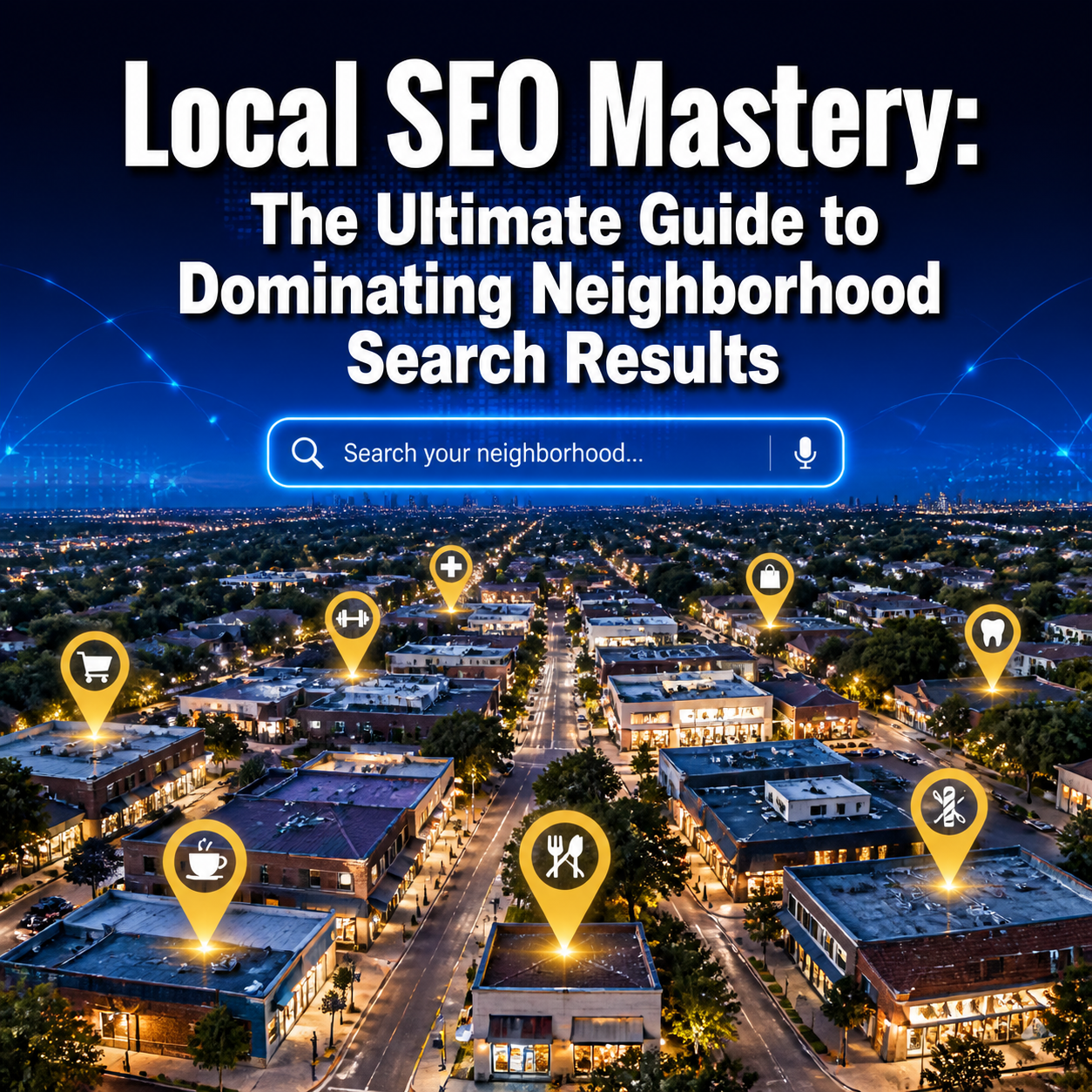
This is the core insight behind Local SEO Mastery: The Ultimate Guide to Dominating Neighborhood Search Results — local search is winnable for small businesses, but only when the fundamentals are done correctly and maintained consistently. For more details on the technical side, check out our guide on On-Page Local SEO.
The most common gaps I see:
- Incomplete or unclaimed Google Business Profile
- NAP data that differs across Yelp, Facebook, and local directories
- Service pages with thin content that Google can’t rank
- Zero review strategy — waiting and hoping customers leave feedback
Fix these four areas and you’ll outperform most local competitors within a few months.
What Is Local SEO and Who Actually Needs It?
Local SEO is the practice of improving your online presence so your business appears in search results when customers look for services in your geographic area [2]. It’s distinct from general SEO because it targets location-based intent — searches like “plumber near me,” “pool service Corona CA,” or “best HVAC company in Riverside.”
Who needs it: Any business that serves customers in a specific geographic area. This includes service-area businesses (plumbers, landscapers, pool companies), brick-and-mortar stores, and professional service providers. To get started with a plan, see our Proven Local SEO Strategies.
Who it’s less useful for: Purely e-commerce businesses with no local service component, or national brands without location-specific offerings.
Choose local SEO if your revenue depends on customers from a specific city, neighborhood, or region. If you serve multiple cities, you need a local SEO strategy for each one — not a single generic page.
How to Optimize Your Google Business Profile the Right Way
Your Google Business Profile (GBP) is the foundation of local search visibility [2]. A complete, accurate profile dramatically improves your chances of appearing in the Google Map Pack — the three business listings that appear above organic results.
Step-by-step GBP optimization:
- Claim and verify your listing — Go to Google Business and verify ownership via phone, postcard, or video.
- Choose the right primary category — Be specific. “Pool Service” ranks better than “Home Services.”
- Fill every section completely — Business description, hours, services, service areas, and attributes.
- Add real photos — Interior, exterior, team, and work examples. Profiles with photos receive significantly more direction requests.
- Use the Posts feature — Weekly updates signal an active business to Google.
- Set service areas correctly — If you don’t serve walk-in customers, hide your address and list your service cities instead [4].
For a deeper walkthrough, see our Google Business Profile optimization guide.
Common mistake: Selecting too many categories. Stick to your primary service as the main category and add secondary categories only when they’re genuinely relevant.
Why NAP Consistency Is Non-Negotiable
NAP stands for Name, Address, and Phone number. Search engines cross-reference your business information across dozens of directories to confirm your legitimacy. When that data conflicts — even minor differences like “St.” vs. “Street” — it creates ranking uncertainty [4].
NAP consistency accounts for roughly 20% of on-page local SEO signals, making it one of the highest-leverage fixes available to small businesses [4].
Where to audit your NAP:
- Google Business Profile
- Yelp, Facebook, Apple Maps
- Bing Places
- Industry-specific directories
- Chamber of commerce listings
Run a monthly check. Business information changes — you move, change phone numbers, rebrand — and directories don’t update automatically. Our local SEO audit checklist covers exactly how to find and fix these inconsistencies.
How to Build Location Pages That Actually Rank
For businesses serving multiple cities, dedicated location pages are essential. A single “Service Areas” page listing ten cities doesn’t rank for any of them.
Each location page needs [4]:
- 300+ words of unique, location-specific content — Not a template with the city name swapped in.
- Local landmarks and neighborhood references — Mention specific areas, cross streets, or community names.
- A unique title tag and meta description — “Pool Service in Corona, CA | Local Website SEO Services”
- Local schema markup — Structured data that tells Google your address, phone, and service area [1].
- A clear call to action — Phone number, contact form, or booking link above the fold.
Edge case: If you serve 15 cities, don’t build 15 identical pages. Prioritize your top 5 revenue markets first, build quality pages, then expand. Thin pages across too many cities can hurt more than help.
For an example of how this works in a specific trade, see our local SEO guide for plumbers in Riverside.
Conclusion: Putting Local SEO Mastery Into Practice
Local SEO Mastery: The Ultimate Guide to Dominating Neighborhood Search Results comes down to one principle: consistency beats complexity. You don’t need advanced tactics to outrank most local competitors — you need a complete Google Business Profile, accurate citations, genuine reviews, and location pages with real content.
Your next steps, in order:
- Claim and fully complete your Google Business Profile today.
- Run a NAP audit across your top 10 directory listings this week.
- Build or improve one location page for your highest-revenue city.
- Set up a simple review request process and use it after every job.
- Schedule a quarterly SEO audit to maintain what you build.
If you serve the Inland Empire and want help with any of these steps, our team at Local Website SEO Services works specifically with small businesses in Corona, Riverside, and surrounding communities. You can also contact us directly to request a local SEO review.
Frequently Asked Questions
Q: How long does local SEO take to show results?
Most small businesses see measurable improvements in Google Maps rankings within 60 to 90 days when GBP, NAP, and on-page basics are properly addressed. Competitive markets may take 4 to 6 months.
Q: Do I need a physical address to rank locally?
No. Service-area businesses can rank in local results without displaying a physical address. Set your service areas in Google Business Profile and hide your address if you don’t serve customers at your location [4].
Q: How many citations do I need?
Focus on quality over quantity. Being listed accurately on 30 to 50 relevant, authoritative directories is more effective than 200 low-quality listings. Start with Google, Yelp, Facebook, Apple Maps, and Bing Places.
Q: What is schema markup and do I really need it?
Schema markup is structured code added to your website that helps search engines understand your business details — address, phone, hours, and reviews. It directly improves how your listing appears in search results and is worth implementing [1].
Q: Can I do local SEO myself?
Yes, for the basics. GBP optimization, NAP audits, and review requests are manageable without an agency. Technical work like schema markup, site structure, and competitive analysis benefits from professional help.